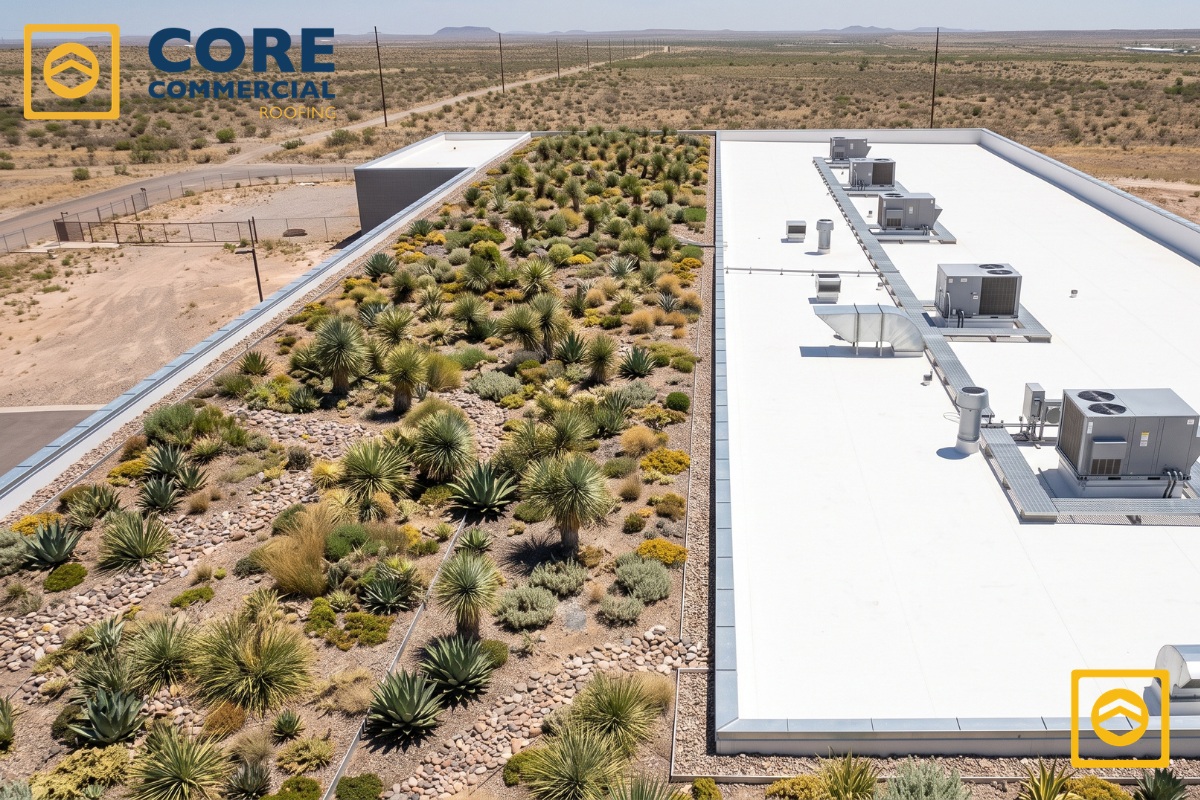
A green roof is a working landscape sitting on top of your building. In Texas that means it has to survive triple-digit heat, long dry spells, wind, and hail, all while staying watertight. The honest answer to whether it is practical is not yes or no. It depends on where in Texas the building sits, what the structure can carry, and whether anyone is going to water it.
Here is what the field research and the building code actually say, and where a conventional reflective roof is the smarter call.
Table of Contents
Are green roofs practical on Texas commercial buildings?
Green roofs are practical on Texas commercial buildings only when three things are true: the structure can carry a fully saturated system, the plants come from species proven to survive Texas summers, and someone owns the irrigation and maintenance. Miss any one of those and you have a dead landscape sitting on a roof you can no longer inspect.
Most articles on this subject treat Texas as one place. It is not. A vegetative roof in Houston is fed by roughly 50 inches of rain a year. The same assembly on the South Plains gets less than half of that, on a windier, sunnier, more exposed roof. Two buildings, same product, completely different outcome.
The buildings where green roofs make the most sense in this state are new construction with the load designed in from day one, buildings where the roof doubles as usable outdoor space, and projects chasing a specific sustainability target. For an existing warehouse, retail box, church, or school with a low-slope roof, the answer is usually no, and the reason is structural rather than botanical.
How does the Texas climate change the equation?
A green roof only performs while its plants are alive, and Texas is hard on plants that live in four inches of soil. Rainfall, not heat alone, is what decides whether the system stays green through August.
The gap inside the state is wide. Lubbock averages 18.33 inches of precipitation a year against a normal daily high of 75 degrees and 1,950 cooling degree days, according to National Weather Service climate normals. East and southeast Texas get two to three times that rainfall. A green roof design pulled from a Houston project, or from a European or Midwestern manufacturer’s standard detail, is being asked to run on half its water budget out here.
Three other conditions matter more in Texas than the brochures suggest. Solar exposure on an open low-slope roof is brutal and constant. Wind on the Caprock strips moisture out of shallow growing media and can scour lightweight substrate off the roof entirely if it is not detailed for uplift. And the state swings between drought and heavy single-event rainfall, so the same roof has to survive months of nothing and then shed several inches in an afternoon.
The practical consequence is that unirrigated green roofs are realistic in parts of Texas and unrealistic in others. West of I-35, plan on permanent irrigation, a cistern, or a plant palette narrow enough to count on one hand.
Which plants actually survive on a Texas green roof?
In a three-year Texas A&M trial of 15 species on unirrigated shallow modules, only four survived with no losses at all, and five species had no survivors. Several sedums that get recommended for Texas green roofs were among the failures.
The study, published in AoB PLANTS by Dvorak and Volder, tested plants in 4.5-inch modular trays on a four-story building in College Station. Irrigation was applied only during the first few weeks of establishment and then stopped. That is the real test, because a roof that needs permanent watering to stay alive is a landscape with an ongoing water bill attached, not a low-maintenance roof.
| Species | Survival without irrigation | What it means for a Texas roof |
| Phemeranthus calycinus (Texas rock pink) | 100% in all three plantings | The standout. It also reseeded itself onto nearby trays. |
| Graptopetalum paraguayense (ghost plant) | 100% | Held through a record drought year. |
| Manfreda maculosa (Texas tuberose) | 100% | Native, rated healthy at the end of the trial. |
| Malephora lutea (yellow ice plant) | 100% in one planting, 0% in an earlier one | Heat is not the risk. An unusually long freeze wiped out the earlier planting. |
| Lampranthus spectabilis | 56% at best | Partial cover only. Expect gaps. |
| Bulbine frutescens | 44% at best | Median survival was under 200 days in the tracked group. |
| Sedum kamtschaticum | 26%, then 0% in the drought year | A widely recommended green roof sedum that did not hold up. |
| Nassella tenuissima (Mexican feathergrass) | 22% | The only grass tested, and it struggled in shallow media. |
| Sedum mexicanum | 8% to 11% | Near total loss. |
| Delosperma cooperi (ice plant) | 0% top growth | Died back completely, then re-emerged only after rain returned. |
| Sedum moranense, Sedum tetractinum, Dichondra argentea, Stemodia lanata, Myoporum parvifolium | 0% | No survivors at all. |
Survival figures from the College Station trial. Results in a wetter or drier year, or with deeper growing media, will differ.
Two takeaways matter for a building owner. First, every species that came through with zero losses was a succulent, and most were upright rather than mat-forming. Second, nativity was not the deciding factor. Some Texas natives failed and some imports thrived, because deep-rooted native prairie plants are adapted to deep soil, not to four inches of engineered media on a hot roof.
If a supplier hands you a plant list with bluebonnets and buffalo grass on it for an extensive roof, ask what depth of media it assumes and what irrigation it expects. Those plants can work in deeper intensive systems with water. They are not a low-input solution in four inches of substrate.
Can your building carry a vegetative roof?
Under the building code, the weight of the growing media and plants is dead load, and it has to be calculated with the soil fully saturated rather than dry. That one rule is what disqualifies most existing Texas commercial roofs from a green roof retrofit.
The numbers are worth understanding before you call anyone. A conventional single-ply roof assembly adds only a couple of pounds per square foot. A thin extensive green roof commonly lands somewhere around 15 to 30 pounds per square foot once saturated, and deeper intensive systems with shrubs and walkways run several times higher. On top of that dead load, the 2021 International Building Code, which the City of Lubbock and many other Texas jurisdictions have adopted, sets a design live load of 20 pounds per square foot for unoccupied landscaped roof areas and 100 pounds per square foot where the roof garden is used for assembly, with no live load reduction permitted in that case.
In practical terms, a low-slope metal deck on open web joists designed decades ago for a 20 pound roof live load and a light membrane has no margin for a saturated soil layer. Reinforcing it is possible, but it is a structural project with a structural budget, and it belongs to an engineer rather than a roofing crew.
The sequence matters. Get a licensed structural engineer to evaluate the existing framing and issue a load report first. Only then does it make sense to price a system. The same discipline applies to any added rooftop weight, which is why rooftop solar on a commercial flat roof starts with the same conversation. Owners who skip the engineering step and go straight to bids usually lose the money they spent on design.
Drainage is the other structural question. Ponding water on a green roof is heavier than ponding water on a bare membrane, because saturated media holds it. Roofs that already drain poorly are the worst candidates, not the best ones.
What does a green roof cost against a conventional roof?
A vegetative roof costs several times what a conventional single-ply system costs on the same building, and the gap widens sharply if the structure needs reinforcement. It is best understood as a landscape and amenity investment that happens to sit on a roof, not as a cheaper way to buy a roof.
The cost stack has more line items than owners expect:
- The waterproofing membrane itself, which still has to be installed to full standard underneath everything
- A root barrier, drainage layer, filter fabric, and growing media
- Plants and establishment period labor
- Irrigation, and in much of Texas that means a permanent system or a cistern
- Structural engineering, and any reinforcement it calls for
- Edge restraint, walkways, fall protection, and roof access suitable for maintenance crews
- An ongoing horticultural maintenance contract, separate from roof maintenance
On the return side, the honest case is mixed. Shading and evaporative cooling genuinely lower rooftop temperature and reduce cooling load, and covering the membrane protects it from the UV that ages most Texas roofs. But a reflective white membrane delivers a large share of that same cooling benefit for a fraction of the cost, which is covered in our breakdown of how a new commercial roof lowers energy bills. If the whole justification is energy savings, the math rarely favors the green roof in Texas.
Where the numbers do work is when the roof earns revenue or value in another way. Usable outdoor space for tenants, stormwater credit in cities that offer one, or a certification requirement on a new build can carry the cost in a way that energy savings alone cannot.
What about hail, wind, and finding leaks?
A layer of soil and plants protects the membrane from hail impact and UV, which is a real durability benefit. The tradeoff is that the same layer hides leaks, and Texas is the worst state in the country to own a roof you cannot see.
On a bare membrane, a leak investigation starts with a visual walk and moves to moisture scanning. Under a green roof, the water that shows up inside the building may have traveled a long way through the drainage layer before it found a breach, so the wet ceiling tile tells you very little about where the failure is. Tools like infrared thermal roof inspection and drone roof inspections lose much of their value once soil covers the surface. Locating the breach can mean pulling back media by hand across a wide area.
This is why electronic leak detection, either a permanent grid installed under the media or a periodic scan, is close to mandatory on any serious vegetative roof. It is a line item that owners often cut and then regret.
Two more Texas-specific points. Wind uplift on a lightweight extensive system has to be engineered, not assumed, because loose media on an exposed roof will move. And whatever sits under the plants still has to be detailed correctly at every penetration and edge, since roof flashing failures at parapets and curbs cause most commercial leaks in this state regardless of what is on top of the field.
Check the warranty language before you commit. Many membrane manufacturers treat a green roof as overburden and will either restrict coverage or require a specific waterproofing system and inspection protocol. Ask for that in writing at the bid stage rather than after installation.
When is a cool roof the better answer?
For most Texas commercial buildings, a reflective roof with adequate insulation delivers most of the cooling benefit of a green roof at a small fraction of the cost, with no structural upgrade, no irrigation, and no loss of inspectability. That is the default recommendation for an existing building, and it is not a compromise.
The realistic alternatives look like this:
- A reflective single-ply system. TPO roofing is the common choice in Texas, and our guide to how long a TPO roof lasts in Texas covers what to expect from it.
- Spray foam, which insulates and waterproofs in the same layer and adds very little weight. See SPF roofing compared with TPO.
- A reflective coating over a sound existing membrane, which is often the cheapest path. Our comparison of roof coating versus replacement walks through when that applies.
- Added insulation at the next replacement, which does more for energy bills over time than surface reflectivity alone.
- Chasing a formal rating if you need documentation, through ENERGY STAR roof certification in Texas.
There is also a middle option that gets overlooked. Plenty of buildings can support a small planted area over a structurally capable bay, a courtyard roof, or a low-level canopy while the main roof stays conventional. You get the visible amenity and the marketing value without asking the whole building to carry saturated soil. This works particularly well on multi-story office buildings in Texas, where tenant-facing outdoor space has real value.
A decision checklist before you spend anything
- Get a structural load report. A licensed engineer, on your existing framing, before any design work. This decides the project.
- Answer the water question honestly. Who irrigates it, from what source, and what happens during a drought restriction.
- Name the reason. Amenity space, stormwater credit, certification, or brand. If the only answer is energy savings, price a reflective roof instead.
- Fix drainage first. A roof that ponds today will pond worse under saturated media.
- Specify the waterproofing to full standard. Plus a root barrier and electronic leak detection. The membrane is the roof. The plants are the finish.
- Choose plants from proven survivors. Match the species to your rainfall, not to a national catalog.
- Confirm the warranty in writing. Ask the manufacturer specifically how overburden affects coverage.
- Budget the maintenance contract. Horticultural upkeep and roof inspection are two separate line items, every year, for the life of the roof.
If you get through all eight and the project still stands up, a green roof can work in Texas. If it falls over at step one or step two, which is common, the reflective options above are where the money should go. Either way, the decision is worth taking to a contractor who will tell you when the answer is no, and our guide to choosing a commercial roofing contractor in Texas covers what to ask.
Frequently asked questions
Do green roofs need irrigation in Texas?
In east and southeast Texas, a carefully chosen extensive system can survive on rainfall after an establishment period. West of roughly I-35, where annual rainfall drops under 25 inches, plan on permanent irrigation or accept that the roof will look bare in dry years.
Do green roofs make leaks harder to find?
Yes, and that is the biggest practical objection to them. Water can travel through the drainage layer before it enters the building, so the interior symptom rarely points to the breach, which is why electronic leak detection is standard practice on these roofs.
What is the difference between an extensive and an intensive green roof?
Extensive roofs use shallow media, generally six inches or less, and support low succulents and groundcover with minimal upkeep. Intensive roofs use deeper media to support shrubs, larger plants, and foot traffic, and they carry far more weight and far more maintenance.
Can you add a green roof to an existing commercial building?
Sometimes, but the existing structure usually decides against it. Most low-slope commercial roofs were framed for a light membrane and a 20 pound live load, so a saturated soil layer requires a structural evaluation and often reinforcement.
Does a green roof protect the membrane from hail?
It does shield the membrane from direct impact and from UV, which can extend service life. The catch is that hail damage to the plants and media still has to be repaired, and any membrane damage underneath is harder to locate afterward.
What roofing system works best under a green roof?
The waterproofing layer needs to be a system rated for permanent burial with a proven root barrier, and single-ply and modified bitumen assemblies are both used this way. Our overview of modified bitumen roofing in West Texas covers one of those options in detail.
The bottom line for Texas building owners
Green roofs are not a gimmick, and they are not a general-purpose answer for Texas either. They work on buildings that were designed to carry them, in parts of the state with the rainfall to support the plants, for owners who have a reason beyond energy savings. That describes new construction and amenity space far more often than it describes an existing warehouse, retail building, church, or school.
The two questions that settle it are structural and agricultural, and neither one is a roofing question. Can the framing carry saturated media, and who is going to keep the plants alive in August. Owners who answer those honestly before they price anything either end up with a green roof that lasts or with a reflective roof that costs a fraction as much and does most of the same work.
If you are weighing this for a building in Texas, start with a load report and a straight assessment of the roof you already have. The right answer is often the simpler one, and it is worth hearing that from someone before the design money is spent rather than after.