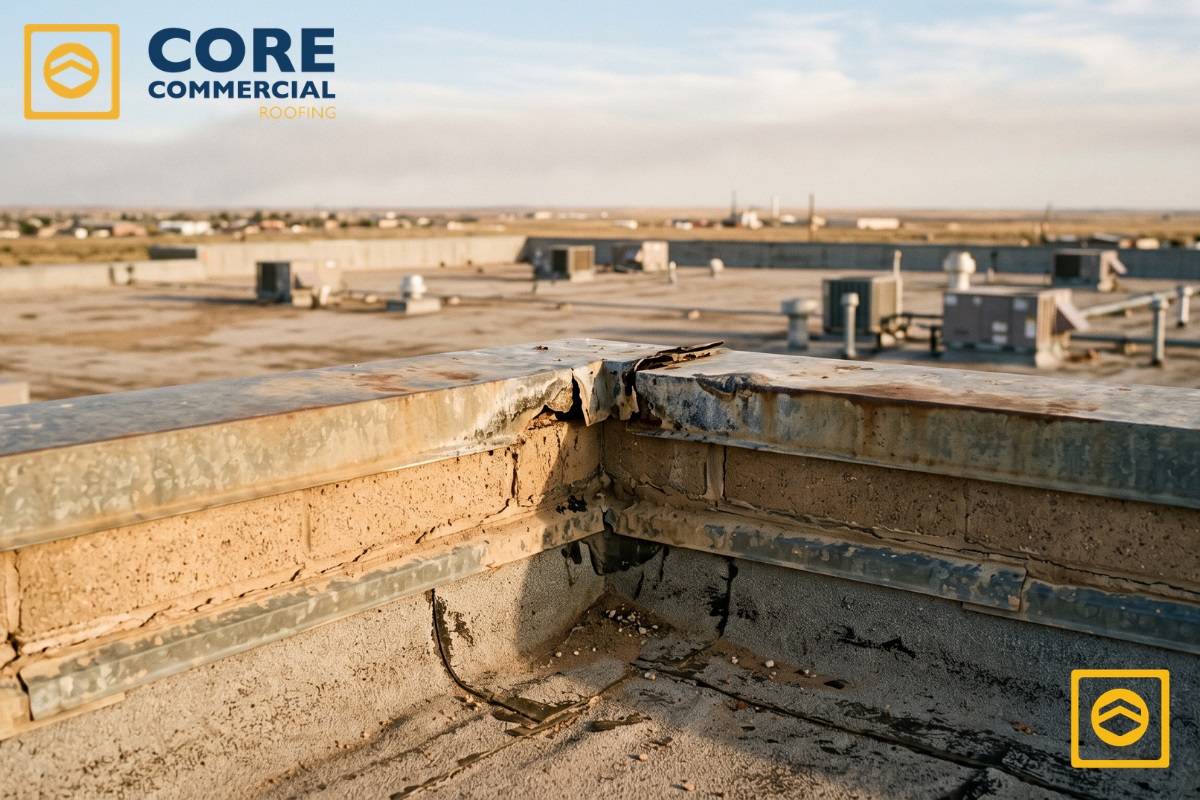
Most commercial roof leaks in Texas do not start in the middle of the roof. They start where the roof stops: at a parapet, a wall, an equipment curb, or the edge metal. Those transitions are all flashing, and flashing is the part of the system that gets patched the most and understood the least.
What is commercial roof flashing?
Commercial roof flashing is the set of components that seals every point where the roof membrane ends, turns up a vertical surface, or gets penetrated. On a low-slope roof, the membrane itself is rarely the weak link. The joints around it are.
This is where a lot of published advice goes wrong. Search for roof flashing and you will get step flashing, chimney flashing, and valley flashing, which are steep-slope residential details. A warehouse in Lubbock or a retail center in Midland does not have any of those. It has base flashing, counterflashing, coping, edge metal, curb flashing, penetration flashing, and expansion joint covers. Different parts, different failure modes, different repairs.
What are the types of commercial roof flashing?
Low-slope commercial roofs use seven main flashing families: base flashing, counterflashing, coping, fascia and gravel stop, curb flashing, penetration flashing, and expansion joint covers. Each one seals a different kind of transition and fails in its own predictable way.
Knowing which one you are looking at changes the conversation with your contractor. A failed reglet joint and a failed curb corner both show up as a ceiling stain, but they are not the same repair and they do not carry the same cost.
| Flashing type | Where it is on the building | What it seals | How it usually fails |
| Base flashing | At the bottom of any wall, parapet, or curb the roof runs into | Carries the membrane up the vertical surface so water cannot get behind it | Sags or pulls away at the termination bar, splits at inside and outside corners |
| Counterflashing | On the wall above the base flashing, set into a reglet or surface mounted | Shields the top edge of the base flashing from weather and UV | Anchors work loose from masonry, reglet sealant hardens and cracks open |
| Coping | Capping the top of a parapet wall | Keeps water out of the top of the wall assembly | Joints open with movement, cleats release, sections lift in high wind |
| Fascia and gravel stop | Along the roof edge on buildings with no parapet | Terminates and holds down the membrane at the perimeter | Peels back in wind, strip-in plies split where metal sections meet |
| Curb flashing | Around HVAC units, skylights, hatches, and equipment stands | The raised base under anything sitting on the roof | Corner splits, curbs built too low, damage from service technician traffic |
| Penetration flashing | Around pipes, conduit, vents, and drains | Round and irregular openings through the deck | Draw bands loosen, boots crack from UV, sealant pots dry out and shrink |
| Expansion joint cover | Where the building structure is designed to move | The gap between two structurally independent sections | Fabric tears, or the cover gets fastened tight and fights the movement |
Curb flashing deserves its own note because it fails more often than the rest on Texas buildings. Rooftop units get serviced, technicians step where they should not, and condensate lines drip in the same spot for years. We covered that detail on its own in our guide to HVAC curb flashing leaks.
Why does commercial roof flashing fail?
Flashing fails for four reasons: wind uplift at the roof edge, thermal movement working joints open, corrosion, and sealant being used in place of a proper detail. Age matters, but these four causes explain most of what we open up.
Does wind really pull the edge off first?
Yes. In FM’s own review of windstorm losses, most roof covering failures involve perimeter flashing that was improperly designed or built. The edge lets go, wind gets underneath the membrane, and the field of the roof peels from there.
This matters more in West Texas than almost anywhere. Uplift pressure is not uniform across a roof. It is highest at the corners, lower along the perimeter, and lowest in the middle. That is why fastener spacing at corners is roughly half what it is along the rest of the edge, and why a coping fastened at one consistent spacing all the way around is under-secured exactly where the wind is worst.
It is also why the wood nailer underneath matters as much as the metal on top. FM’s guidance calls for the nailer to be bolted or screwed to the structure at a spacing tied to the wind rating, and its loss examples show failures where nailers were fastened with short nails driven into masonry joints. The metal did not fail. The wood it was screwed to came off the building.
Why do the metal joints keep opening back up?
Because the metal is supposed to move. Perimeter metal is run in sections of roughly eight to ten feet with a deliberate gap between them so the metal can expand and contract, and that movement is what works the joint loose over time.
FM’s data sheet is blunt about the consequence: the strip-in plies over metal gravel guard joints are likely to break open at every second or third joint, because those joints rely on roofing cement to stay tight while the metal moves under it. That is not a defect. It is a maintenance item that gets ignored until it leaks.
A Texas roof runs through a wide daily temperature swing for a large part of the year. Metal on that roof expands every afternoon and contracts every night, several thousand cycles over the life of the roof. Anything rigid that spans a moving joint will eventually crack.
Why is my flashing rusting or streaking the wall?
Corrosion on flashing usually comes from two things: dissimilar metals in contact with each other, and metal set directly against pressure-treated wood. Both are installation decisions, not weather.
Aluminum flashing against copper fasteners, or plain steel fasteners through aluminum, sets up a reaction that eats one of the two metals. Pressure-treated lumber is the other one people miss. FM’s guidance is to separate uncoated or painted metal flashing from pressure-treated wood with a barrier such as a membrane strip, and to use stainless or hot-dipped galvanized fasteners when treated wood is involved. Skip that and the fasteners corrode from the inside of the assembly, where nobody sees it until the metal is loose.
Rust streaks running down a parapet are worth taking seriously. They tell you the fasteners holding that metal are already compromised.
Is caulk a repair or a symptom?
Sealant is a maintenance item, not a waterproofing layer. When caulk is the only thing standing between the weather and the inside of your building, the detail underneath has already failed.
Flashing is designed to shed water by geometry: laps that overlap in the direction water travels, drip edges that break surface tension, counterflashing that covers the top of the base flashing. Sealant fills the small gap that geometry cannot close. It was never meant to carry the joint.
This is the most common thing we find on roofs that have been patched by whoever was cheapest. A bead of caulk over a reversed lap will stop the drip for a season. The water keeps entering the same way it always did, only now it runs somewhere else and shows up thirty feet away, and the insulation and deck keep getting wet the whole time. By the time the stain returns, the repair is no longer a flashing repair.
The test is simple. If someone proposes to fix your leak with sealant and nothing else, ask what is under the sealant and why it stopped working. If there is no answer, it is not a repair.
How do you know if flashing is causing the leak?
Flashing leaks show up along wall lines and around rooftop equipment rather than in the open field of the roof. They also tend to track with wind direction and rain intensity instead of appearing during every rainfall.
The signs worth walking your roof for:
- Interior stains that follow the perimeter wall or sit directly under a rooftop unit
- Membrane pulling away from the termination bar, or a visible gap at the top of the base flashing
- Counterflashing that has come out of the reglet, or hardened sealant you can flake off with a fingernail
- Coping or edge metal that rattles, lifts at a corner, or has open joints you can see daylight through
- Rust streaking below metal flashing, or fastener heads that have backed out
- Ponding water held against a curb or a wall base after a rain
- Leaks that only appear when it rains hard, or only when the wind comes from one direction
Visual inspection tells you where to look, not always where the water entered. Water travels along the deck, along conduit, and along insulation joints before it drops through a ceiling tile. Confirming the actual entry point is where non-destructive testing earns its cost. An infrared thermal roof inspection maps wet insulation so you can see how far the moisture has already spread, and drone roof inspections let you document long runs of parapet and edge metal without putting anyone on a ladder.
Does roof edge metal have to meet code in Texas?
Yes. Metal edge systems on low-slope commercial roofs are a code-tested item, not a fabrication detail left to the installer. The International Building Code requires them to be designed for wind loads and tested to a specific standard.
The National Roofing Contractors Association explains that ES-1 applies to perimeter edge-metal flashing systems including embedded edge metal, metal fascia, and metal copings, and that ES-1 is referenced in the 2024 International Building Code as a test requirement for those systems. External gutters fall under a separate standard, GT-1, with its own test methods. Adoption varies by jurisdiction in Texas, so the version enforced on your building depends on which code cycle your city has adopted.
This is the question almost nobody asks at bid time, and it is the one that separates two proposals that look identical on price. If a bid says “furnish and install edge metal” with no reference to a tested system or the design pressures it has to resist, you have no way to compare it to anything. Ask for the standard and ask for the wind pressures the edge was designed to. A contractor who works to these standards will have the answer ready.
Insurance carriers care about this too, particularly for larger facilities. If your property is written on a policy that references approved assemblies, the flashing is part of what gets evaluated. We wrote about that in more detail in our guide to FM Global approved roofing.
How is commercial roof flashing repaired?
A real flashing repair removes the failed detail, verifies the substrate underneath, and rebuilds the termination. Sealant goes on at the end as protection for a joint that already works, never at the beginning as the fix itself.
The sequence on a typical wall or curb detail:
- Find the actual entry point. Trace the water back rather than repairing under the stain. Wet insulation mapping tells you how far it has already traveled.
- Open the detail. Pull the counterflashing or coping and expose the base flashing termination. You cannot judge a flashing repair from the outside of it.
- Check the substrate. Look at the nailer, the masonry, and the deck. Rotted wood nailers and corroded fasteners get replaced now, not worked around. Nothing fastened to a bad nailer will hold.
- Cut back the wet material. Saturated insulation stays wet under a new membrane and keeps the deck corroding. It comes out.
- Re-terminate the membrane. Bring the base flashing back to full height up the wall, fasten it at the correct spacing, and rebuild the corners, which is where base flashing splits first.
- Reinstall metal correctly. Counterflashing anchors go into sound masonry, not mortar joints, and the counterflashing has to lap well down over the base flashing so water cannot get behind the top edge.
- Seal last. Sealant protects the reglet and the metal laps. It is not holding the assembly together.
There is a separate case for existing perimeter metal that is loose but not otherwise failed. FM’s maintenance guidance is to refasten it through the lower third of the flashing using corrosion-resistant fasteners with bonded sealing washers at a spacing set by the wind rating, tighter at the corners. That is a legitimate retrofit and it is far cheaper than a full perimeter rebuild, but it only applies where the metal, nailer, and membrane are otherwise sound.
Repair details also depend on the roof system. Terminations on a single-ply roof are not built the same way as terminations on a torch-applied system, which is worth knowing if you own a modified bitumen roof in West Texas or a TPO membrane roof.
When should flashing be replaced instead of repaired?
Repair when the failure is local and the substrate underneath is sound. Replace the run when the nailer is rotted, fasteners are corroded through, or the same detail has already been patched more than once.
The repeat-patch rule is the practical one. A detail that has failed twice is telling you the detail itself is wrong, not that the last repair was unlucky. Spending a third time on the same twenty feet of parapet costs more over five years than rebuilding it correctly once.
The other threshold is scope. If flashing has failed at scattered points around most of the perimeter, and the roof is well into its service life, you are no longer making a flashing decision. That is a whole-roof decision, and the same trade-off applies as in any roof repair versus replacement analysis. Worth knowing before you get there: coating over failed flashing does not fix it, which is one of the limits we cover in roof coating versus replacement.
How often should flashing be inspected?
At minimum twice a year, plus before and after any storm with high wind, heavy rain, or hail. FM’s maintenance guidance sets that same schedule and includes base tie-ins, strip-in plies, drains, and rooftop equipment in the walk, not just the metal.
For a Texas building, that storm clause does most of the work. Spring hail season and the wind events that come with it are the two things most likely to move your edge metal, and a semiannual schedule alone will miss them by months. The practical cadence here is a spring pass, a fall pass, and a targeted walk after anything significant blows through.
A post-storm walk is also documentation. If you ever file a claim, photographs taken within days of the event are worth considerably more than a description written months later.
What drives the cost of a flashing repair?
Flashing repair is priced by the linear footage of failed detail and the condition of what is underneath it, not by the square footage of the roof. A small building with rotted nailers along one wall can cost more than a large building with one bad curb.
The variables that actually move the number:
- Linear feet involved. Twelve feet of parapet is a service call. Two hundred feet is a project.
- Substrate condition. If the nailer and deck are sound, you are paying for flashing. If they are not, you are paying for carpentry and possibly deck work too.
- How much wet insulation has to come out. This is the cost that grows the longer a leak runs, and it is the reason delay is expensive.
- Access and disruption. Roof height, crane or lift requirements, and whether work has to happen outside business hours.
- Metal fabrication. Standard profiles versus custom-bent coping for an unusual parapet width.
- Wind design requirements. Corner zones need tighter fastening and sometimes heavier gauge, which affects both material and labor.
Be careful comparing two bids that name the same scope at different prices. One may include opening the detail and replacing the nailer, and the other may not. Ask both what happens if the wood underneath turns out to be rotted, and you will usually find the difference. Our guide on choosing a commercial roofing contractor in Texas covers what else to ask before you sign.
Frequently asked questions
Can flashing be repaired without replacing the whole roof?
In most cases yes, as long as the membrane is still in reasonable condition and the deck and nailers are sound. Flashing is a discrete part of the assembly and can be rebuilt independently of the roof field.
Is flashing covered under a commercial roof warranty?
It depends on the warranty. Manufacturer system warranties typically cover flashing installed as part of the approved assembly but exclude damage from unauthorized rooftop work, so read what your document says about penetrations added after installation.
Can a flashing repair wait until the next budget year?
Rarely without cost. Water entering at a flashing detail saturates insulation and corrodes the deck the entire time it is left open, so a deferred repair usually returns as a larger scope with insulation and deck work attached.
Who is responsible for flashing on a leased building, the landlord or the tenant?
That is set by the lease, and it is frequently ambiguous on roofs. In many commercial leases the landlord holds structure and roof while the tenant holds rooftop HVAC, which is exactly where curb flashing disputes start.
The short version
Flashing is where low-slope roofs leak, where wind damage starts, and where cheap repairs hide expensive problems. Learn the seven types on your building, walk the perimeter twice a year and after every storm, and treat any repair that consists only of sealant as a warning rather than a solution.
If you are seeing stains along a wall line or loose metal at the roof edge, get it opened up and looked at before the next storm rather than after it.