Most commercial roof failures do not start with a visible leak. They start with a pinhole in a seam or a cracked flashing that lets water into the insulation, where it sits and spreads for months or years before anyone inside the building sees a stain. By the time the ceiling tile turns brown, the wet area is rarely small.
An infrared thermal roof inspection is how you find that water while it is still cheap to fix. This guide covers what the scan actually does, what it cannot do, and the specific decisions that should never be made without one.
Table of Contents
What is an infrared thermal roof inspection?
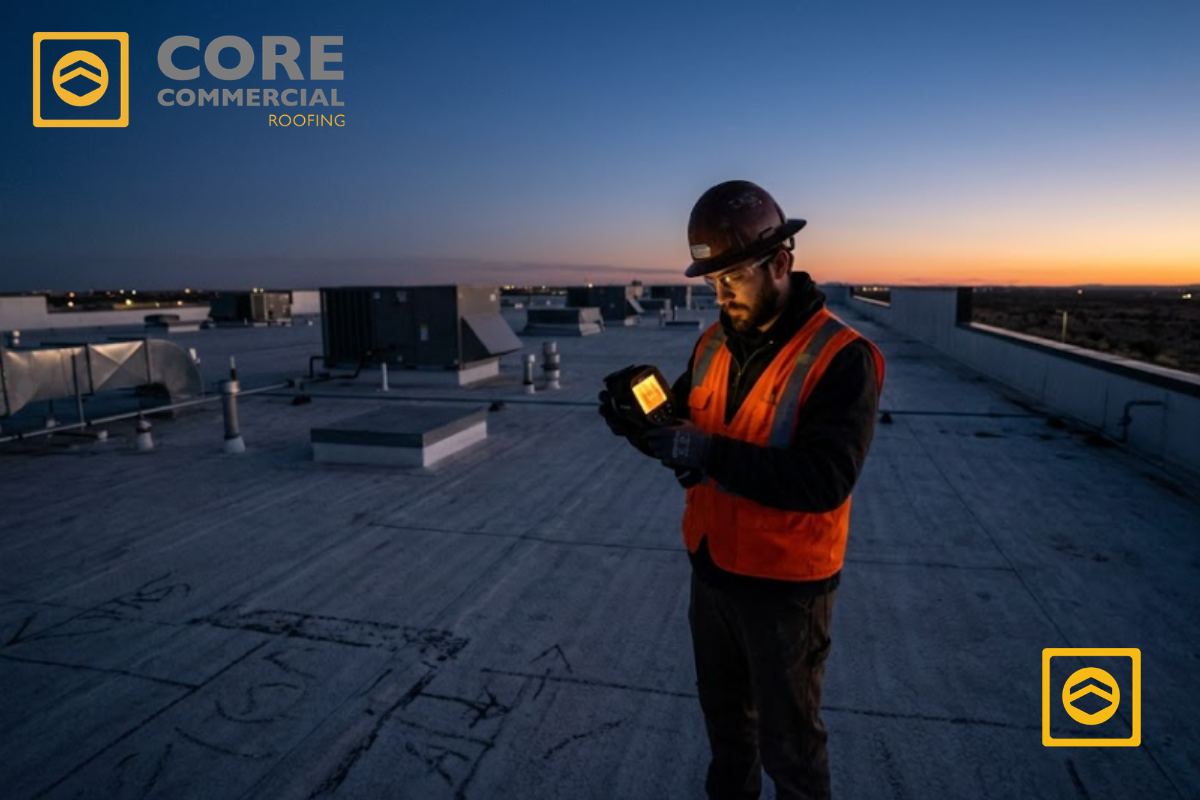
An infrared thermal roof inspection is a non-destructive survey that uses a thermal imaging camera to locate wet insulation beneath a low-slope roof membrane. It reads temperature differences across the roof surface to map where water is trapped, without cutting the roof open.
The method is not improvised. It is governed by ASTM C1153, the standard practice for locating wet insulation in roofing systems using infrared imaging, which applies to roofs with insulation above the deck in direct contact with the waterproofing, and which sets the ground rules for the whole process: what the camera has to be capable of, what the weather has to be doing, what the operator has to know, and how the findings get verified afterward. That scope covers most built-up, modified bitumen, and single-ply commercial roofs in Texas. A scan that ignores those conditions produces pictures, not data.
It is worth being precise about what the survey delivers. It gives you a map of saturated insulation. It does not give you a repair invoice, and it does not give you the leak.
How does an infrared roof scan find wet insulation?
Wet insulation holds heat longer than dry insulation. After the sun goes down, dry areas of the roof cool quickly while saturated areas release their stored heat slowly, and that lag shows up on the camera as a distinct thermal signature.
Water has far more thermal mass than the air trapped in dry polyiso, perlite, or fiberboard. During the day the whole roof absorbs solar energy fairly evenly. As the surface begins radiating that energy back to the night sky, the dry sections drop in temperature first. The wet sections lag behind, and the outline of the saturated area appears against the cooler roof around it.
That outline usually does not match what you would guess from inside the building. Water travels laterally between insulation boards and along seams, so the saturated footprint often sits well away from the penetration that let it in. This is also why ponding water on a flat commercial roof is treated as urgent rather than cosmetic. Standing water finds every weakness in a membrane eventually.
Why are infrared roof scans done at night?
Scans are performed at night because daytime solar loading heats the entire roof more or less uniformly, which erases the contrast the camera needs. ASTM C1153 is explicit that the practice applies to infrared imaging performed at night.
The usable period after sunset is often called the scanning window. It opens once the roof has cooled enough for the difference between wet and dry areas to register, and it closes when that difference flattens out. On a clear night after a sunny day, the window can run for hours. On a cloudy, humid, or windy night, it may never open at all.
What weather conditions ruin an infrared roof scan?
Wind is the main enemy. Air movement near 15 miles per hour can shorten or close the scanning window completely, the roof surface has to be free of water, snow, or ice for the imaging to mean anything, and where thermal contrast comes from heat escaping the building rather than from solar loading, roughly 27 degrees Fahrenheit of difference between indoor and outdoor air is needed on a typical built-up roof. High relative humidity filters radiated heat and softens the contrast further, and some insulation types absorb less moisture and emit less energy, which shortens the window again.
None of this makes infrared unreliable. It means the scan has to be scheduled around conditions rather than around the calendar.
In practice, wind is the single biggest reason a scan gets rescheduled out here. Between the Caprock and the Permian Basin, a calm night after a clear day is not something anyone can promise a client three weeks in advance. We treat the scan date as a target and the weather as the decision maker, and we say that up front rather than forcing a survey through conditions that will produce a report nobody should act on.
What actually counts as “wet” insulation?
The working threshold is insulation that has lost at least 20 percent of its original insulating ability because of moisture in the core. Federal roofing guidance has used that 20 percent definition as the line between damp and functionally wet for decades.
This matters because “wet” is not a yes or no condition, and contractors use the word loosely. Insulation can carry moisture and still perform. Once it crosses that threshold, you are paying to condition a building through material that is no longer doing its job, and the assembly above and below it starts to degrade in ways that have nothing to do with energy bills.
The documented consequences of wet insulation go well past the energy bill. Saturated board adds dead load to the deck. It expands and contracts at a different rate than the dry board beside it, which stresses seams and encourages splits. It corrodes fasteners and metal decking, weakens wind uplift resistance by attacking adhesion and attachment, and sets up freeze and thaw damage during West Texas cold snaps. The R-value loss is often the least expensive part of the problem.
Can wet roof insulation dry out on its own?
No. Corps of Engineers exposure testing found that venting and so-called breathable membranes were essentially ineffective at drying sealed roof insulation, with drying times measured in decades rather than seasons. In the same research, saturated insulation retained only 21 percent of its dry insulating ability until the water was physically removed.
Read that number again, because it reframes the entire repair conversation. Insulation holding water is not operating at 80 or 90 percent. In that documented case it was operating at roughly one fifth of what it was specified to do, and after the water was extracted it recovered to 83 percent. It never came back to new.
The practical consequence is simple. Waiting does not help. There is no scenario where a wet area on a commercial roof quietly resolves itself while you finish the fiscal year. It either gets removed and replaced, or it grows.
When do you need an infrared roof inspection?
You need one before any decision that assumes the insulation underneath is dry. Coating, restoration, a repair versus replace call, a hail claim scope, a purchase or lease, and a capital budget request all rest on that assumption, and a scan is the only affordable way to test it across an entire roof.
The coating decision is the one that punishes owners hardest. Sealing a reflective coating over saturated insulation traps the water permanently against the deck, and because the moisture will not dry out through the assembly, the coating fails from below while the warranty paperwork says everything is fine. If you are weighing commercial roof coating against full replacement, the moisture survey comes first, not second.
| Trigger | What the scan tells you | Cost of skipping it |
| Before a coating or restoration | Whether the substrate is dry enough to seal over | Coating fails early over trapped water, and you pay twice |
| Repair versus full replacement | How much of the roof is actually compromised | Tearing off dry insulation, or repairing a roof that is already gone |
| After a hail or wind event | Saturation that visual inspection and initial claim scopes miss | Underpaid claim, damage discovered after the deadline |
| Before warranty expiration | Defects still covered by the manufacturer or installer | Warranty lapses on problems that were never documented |
| Pre-purchase or pre-lease diligence | The real condition of an asset you are about to inherit | Buying a roof replacement you did not budget for |
| Ongoing asset management | Small wet areas while they are still small | Isolated repairs turn into a full tear-off |
For buyers and landlords, that fourth and fifth row deserve extra attention. Coverage terms vary, and it is worth confirming early whether roofing warranties transfer to new owners on the building you are evaluating.
Do you still need core samples after an infrared scan?
Yes. ASTM C1153 addresses verification of infrared data using invasive test methods, because a warm area on a thermogram is a suspicion, not a finding.
Several things besides water produce a thermal anomaly. Extra bitumen thickness holds heat. So does a heat source directly below a thin section of insulation, an exhaust fan, a change in insulation type, or reflected heat from a taller adjacent wall. An experienced thermographer can usually tell these apart on the image, but the way you prove it is to open the roof at marked locations and pull cores.
Cores also convert the survey into something you can act on and defend. A marked, cored, and documented wet area supports a repair scope, a claim, or a capital request in a way that a thermal image alone does not. If you are being asked to approve six figures of roofing work, insist on a comprehensive roof report that includes verification, not just pictures.
What an infrared roof scan cannot tell you
It cannot tell you where the water got in. ASTM C1153 states that the practice does not provide methods to determine the cause of moisture or its point of entry, and it does not evaluate whether a given system is suitable as waterproofing.
The gap between where water shows up and where it entered is larger than most owners expect. In one documented survey of an 85,000 square foot roof, handheld infrared identified 16 separate wet areas totaling roughly 4,950 square feet. The building had 22 reported interior leaks, but only 8 of the 16 infrared-identified wet areas could be connected to those interior leak locations, and none of the wet areas were visible during the walk-on visual survey.
That is the whole argument for scanning, stated in one case. The interior tells you where water finally arrived. The visual survey tells you what failed on the surface. Neither one tells you how much of the assembly is already compromised. Pairing the scan with a proper hidden leak investigation is how you get from symptom to source.
What does an infrared roof survey cost compared to a replacement?
An infrared survey is a rounding error against the cost of a roof. Historical Air Force case work put non-destructive survey pricing at a small fraction of the per square foot cost of tearing off and replacing a built-up roof, and the surveys repeatedly paid for themselves by narrowing the scope of work.
Two examples are worth citing because the ratio holds even though the dollar figures are decades old. At one installation, a $72,000 survey supported redesigning a project and cut roughly $308,000 from the estimate once most of the insulation turned out to be dry. At another, a survey costing under $10,000 reclassified a single 22,000 square foot roof from full replacement to targeted repair, saving an estimated $150,000 on that building alone.
Treat those as ratios rather than as current pricing. The point is structural, not historical. When the survey costs cents per square foot and the replacement costs dollars per square foot, the survey does not have to find much to justify itself.
Why West Texas commercial roofs are a special case
West Texas roofs take more storm punishment than almost anywhere in the country. NOAA records show that severe storm events are the dominant category of billion-dollar disasters affecting Texas, accounting for 126 of the 190 such events between 1980 and 2024, with the five-year average frequency climbing sharply.
Hail is the mechanism that matters most for insulation. Impact does not have to open a hole you can see to bruise a membrane, fracture a seam, or crack flashing at a curb. Water enters slowly, spreads laterally, and stays. That is why an owner can pass a post-storm visual inspection and still be carrying thousands of square feet of saturated board. If your building took a hit, a Lubbock hailstorm inspection should include a moisture survey and not stop at the surface.
There is a second local wrinkle. Highly reflective white membranes and cool-roof coatings are everywhere in West Texas for good reason, since they cut cooling load in a brutal climate. Those same surfaces store and re-radiate heat differently than a dark built-up roof, which changes how a thermographer reads the image. It does not make scanning impossible on a TPO roofing system, but it does mean the operator needs to know the assembly before the camera comes out.
The buildings that worry us most after a storm are the ones where nothing looks wrong. An owner walks the roof with an adjuster, sees a few bruises, agrees to a small repair scope, and closes the file. Two seasons later the deck is corroding under insulation that has been wet since the storm. We push for a scan during the claim window rather than after it, because documentation gathered while a claim is open is worth far more than documentation gathered once it is closed.
Frequently asked questions
How long does an infrared roof scan take?
A ground-based walk-on survey of a typical commercial roof usually takes a few hours inside the scanning window after sunset. Larger portfolios and multi-building campuses take longer, and verification coring is normally scheduled as a separate daytime visit.
Can you scan a white TPO or coated roof?
Yes, though reflective surfaces behave differently than dark membranes and require an operator who knows the assembly beforehand. The scan is still valid, but the interpretation depends on knowing what materials are in the system and how thick they are.
Does insurance pay for an infrared roof survey?
It depends on the carrier and the claim. A survey is often most useful as claim documentation rather than as a reimbursed expense, because it quantifies damage that a visual scope missed. Ask your adjuster before the claim closes rather than after.
How often should a commercial roof be scanned?
A survey every three to five years is a reasonable baseline for an asset management program, with an additional scan after any significant hail or wind event and one timed to catch defects before warranty expiration.
Will the scan find my leak?
No. It finds saturated insulation, which is where water ended up, not where it entered. Locating the entry point requires visual inspection of penetrations, seams, and flashings, and sometimes water testing.
Is infrared better than a nuclear or capacitance moisture meter?
Infrared covers the entire roof surface rather than sampling a grid, which is why it catches small wet areas that point-testing methods miss. The methods are complementary, and meters are often used alongside cores to confirm infrared findings.
Can a drone do the scan instead of walking the roof?
Aerial thermography is well established and can cover large portfolios quickly, and ASTM C1153 covers both ground-based and aerial inspections. Verification coring still has to happen on the roof either way.
The bottom line
An infrared thermal roof inspection answers one question that no visual inspection can answer: how much of your roof assembly is already wet. Because that water will not dry out on its own, and because the wet area only grows, the value of the survey is almost entirely in timing. Scan before you coat, before you decide to repair or replace, while a hail claim is still open, and before a warranty runs out.
The scan is not the whole answer. It maps saturation, not entry points, and its findings need cores to become defensible. But it is the cheapest way to stop guessing about the most expensive part of your building, and in a region that absorbs more severe storms than almost anywhere else, guessing is not a strategy.
If you own or manage a commercial building in West Texas and cannot say with confidence how much of your roof insulation is dry, that is the gap worth closing first.