
School & Education Roofing in West Texas
School roofs are low-slope over classrooms and gyms, with traffic, rooftop units, and tight schedules tied to the academic year. The right assembly is TPO or PVC over R-25 continuous insulation, or modified bitumen for impact, installed inside the summer window, detailed to ASCE 7 zones after a survey.
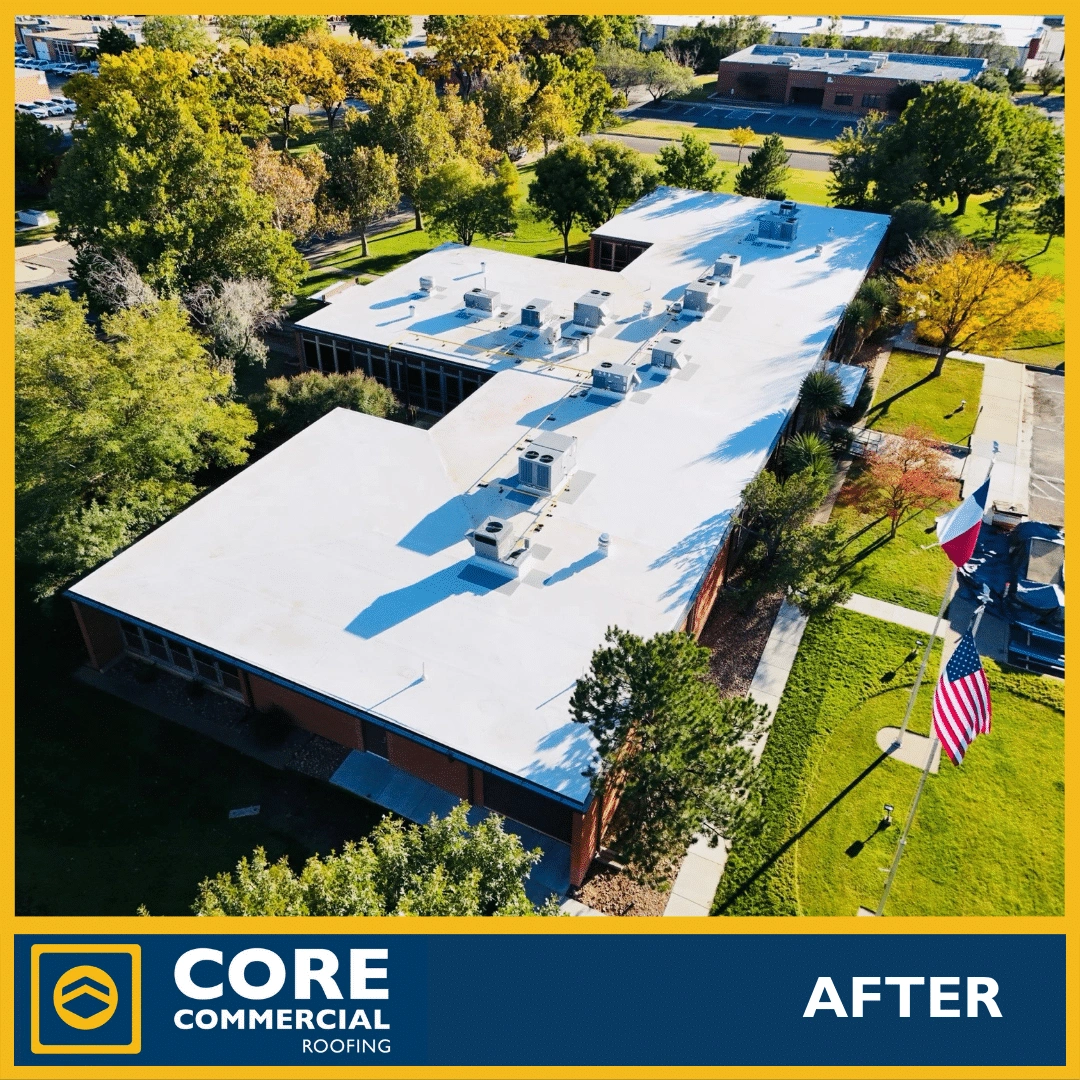
- Low-slope, classroom and gym wings
- TPO, PVC, modified bitumen, coatings
- R-25 ci above deck
- Summer and break windows
- Rooftop units and service
- 20 to 30 years
What a school roof has to handle
- +Classroom and admin wings over occupied space
- +Re-cover within the IBC two-layer limit
- +Owner wants a reflective, cool roof for energy and comfort
- -Gymnasium with forklift or equipment traffic
- -Refrigerated food-service, see cold storage
- -Roof already at two membrane layers
Roof systems for school
TPO
DetailReflective and heat-welded. Common on classroom and admin wings, with a 20 to 25 year NDL path.
PVC
DetailResists cafeteria grease and kitchen exhaust that break down TPO and EPDM. Specified where food-service vents grease.
Modified bitumen
DetailMulti-ply and impact-tolerant. Suits high-traffic roofs and gym access where a redundant, repairable membrane is preferred.
Silicone coatings
DetailRestore a sound substrate for 10 to 20 years during a break, applied with the building occupied.
The code floor for a school roof in Lubbock
Texas sits in IECC Climate Zone 3. The 2021 IECC sets a minimum R-25 of continuous insulation installed entirely above the deck for low-slope commercial roofs, in at least two staggered layers.
ASCE 7 splits a low-slope roof into field, perimeter, and corner zones. Corners and perimeters carry the highest uplift and get increased fastening. Edge and corner flashing is detailed to the manufacturer uplift rating.
IBC requires positive drainage of low-slope roofs. NRCA and most membrane manufacturers specify at least 1/4 inch per foot slope to the drain. The assembly is chosen for the traffic, the equipment, and the substrate. The spec comes from the survey, before any specification.
Code figures cited: 2021 IECC Table C402.1.3 (R-25 ci, Climate Zone 3, insulation entirely above deck); ASCE 7 field, perimeter, and corner roof zones; IBC positive drainage requirement and NRCA and manufacturer 1/4-inch-per-foot guidance. Reviewed August 16, 2026.
What fails on school roofs in West Texas
The summer window sets the schedule. Work is scheduled inside the academic break to keep buildings occupied during the school year, and the survey and the schedule are set with the district before any material is ordered.
Cafeteria grease exhaust degrades single-ply near kitchens. PVC is specified where kitchen exhaust vents grease, and the survey identifies the kitchen and the exhaust before any specification.
Rooftop unit and service traffic punctures membranes. Walk pads and protected paths limit the damage, and the survey maps the traffic pattern.
Open West Texas wind drives perimeter and corner uplift. Edge and corner flashing is detailed to the manufacturer uplift rating.
School roofing questions
Can you re-roof a school during the summer break?
Yes. We schedule the survey and the work to the academic break so the building stays occupied during the school year. The scope, the schedule, and the material order are set with the district before work begins.
What roof system suits a school cafeteria?
PVC, where kitchen and cafeteria exhaust vent grease. TPO and EPDM break down faster under grease exposure. The survey identifies kitchen exhaust before any specification.
What insulation does a school roof need in Lubbock?
The 2021 IECC sets a minimum R-25 of continuous insulation above the deck for low-slope commercial roofs in Climate Zone 3, in at least two staggered layers. Tapered insulation adds slope to drain at the same time.
Can a school roof be coated instead of replaced?
Yes, when the substrate is dry and sound. A silicone or acrylic coating adds 10 to 20 years of service life at a fraction of replacement, applied during a break with the building occupied. Saturated insulation or a fractured membrane points to overlay or replacement.
Related steps for this building type
Get a condition report before you commit to a system.
Photographs, documented findings, and a written recommendation. Certificate of insurance available before contract.