If you own a commercial building in Lubbock, Midland, Odessa, or Amarillo, modified bitumen has probably shown up on a roofing bid with a label like 2-ply APP torch-down and very little explanation. This guide explains what the system actually is, how it handles the specific punishment a West Texas roof takes, what it costs, and when it is the right call versus when something else fits better.
Table of Contents
What is modified bitumen roofing?
Modified bitumen roofing is a multi-ply, asphalt-based membrane blended with a rubber or plastic polymer and reinforced with a fiberglass or polyester mat, designed for flat and low-slope commercial roofs. It is installed in factory-made rolls across the roof deck, layer over layer, to create a tough waterproof barrier.
The modified part is the polymer. Plain asphalt cracks and goes brittle over time, so manufacturers blend in either a rubber compound (SBS) or a plastic compound (APP) to make the membrane more flexible, more durable, and more resistant to temperature extremes. The reinforcing mat inside each sheet adds tensile strength so the membrane resists tearing and splitting.
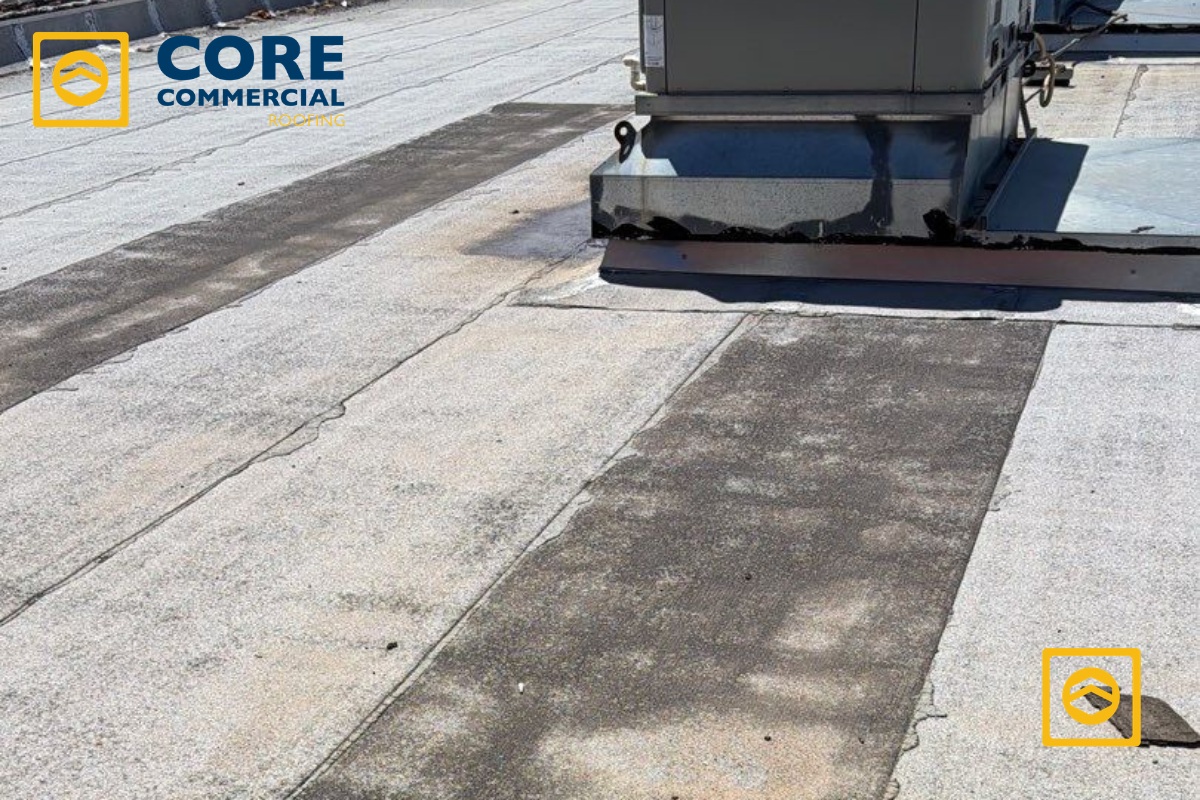
A finished system is usually two or three plies: a base sheet anchored to the deck, an optional middle reinforcing ply, and a weather-facing cap sheet that is often surfaced with mineral granules for UV protection. That layered build is the whole point. No single layer has to do everything, so a problem in one ply does not automatically mean a leak in the building.
How is modified bitumen different from built-up roofing (BUR)?
Modified bitumen is the factory-made, polymer-upgraded successor to built-up roofing, delivering the same multi-layer redundancy without the slow, on-site hot-asphalt process. BUR is built up by hand on the roof, one alternating layer of hot asphalt and felt at a time, which is effective but labor-intensive and dependent on crew skill.
Modified bitumen moved most of that work into the factory. The polymer, the asphalt, and the reinforcing mat are combined into consistent rolls that arrive ready to apply, which makes installation faster and the finished membrane more uniform than a field-built BUR system.
For a commercial building owner, the practical takeaway is that you get BUR-style layered protection in a system that goes down quicker, weighs less, and flexes better through heat and cold.
SBS vs APP: which modifier is right for West Texas?
For most West Texas commercial roofs, APP is the common starting point because it has a higher softening point and strong resistance to intense sun, while SBS is the more elastic, rubberized option built to absorb constant thermal movement. They are not interchangeable, and the right choice depends on the building and the priorities for that roof.
APP, or atactic polypropylene, is a plastic-based modifier. It is stiffer at normal temperatures, it is almost always torch-applied, and its granule-surfaced cap sheet holds up well under heavy UV. That makes it a natural fit for the long, bright, hot summers across the South Plains and Permian Basin.
SBS, or styrene-butadiene-styrene, is rubber-based. Its defining trait is elasticity: it stretches and returns to shape as the roof expands in the day’s heat and contracts at night. SBS is typically self-adhered or set in cold adhesive rather than torched, which also makes it a strong choice for occupied buildings where open flame is a concern.
West Texas pushes a roof in both directions at once, with brutal summer sun and wide day-to night temperature swings, so the SBS-versus-APP decision is rarely a slogan and usually a judgment call for the specific building.
From the field
When we do install modified bitumen, we typically go with APP, which is the torch-applied type. It’s a proven, durable system in this climate. That said, it’s worth knowing that some crews still use the older hot-asphalt mop method, which also makes for a durable roof – the method matters as much as the membrane.
Is modified bitumen good for West Texas heat and sun?
Yes, modified bitumen performs well in West Texas heat when it is specified with a reflective cap sheet rather than a dark one. The surface color does real work: according to the U.S. Department of Energy, a conventional dark roof can reach 150°F or more on a sunny afternoon, while a reflective roof can stay more than 50°F cooler under the same conditions.
That temperature gap matters for two reasons. A cooler membrane ages more slowly, since the heat that bakes and embrittles asphalt is the same heat a reflective surface sends back. And a cooler roof pulls less heat into the building, which eases the load on cooling equipment that runs hard for much of the year in this part of Texas.
Modified bitumen supports this directly. A cap sheet can be ordered with a factory-applied reflective mineral surface, or an aging membrane can be recoated with a reflective coating to restore that performance. The dark, heat-absorbing mod-bit roof that gives the system a bad reputation in hot climates is a specification choice, not a requirement.
How does modified bitumen hold up to West Texas hail and wind?
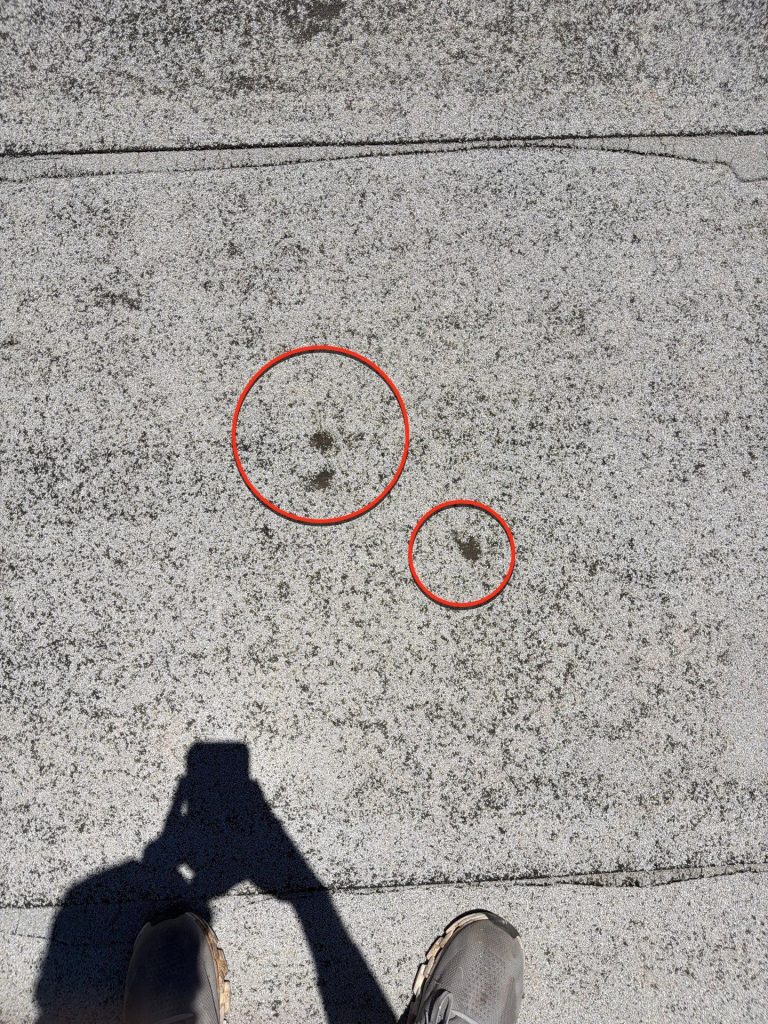
Modified bitumen is one of the more storm-resilient flat-roof systems for West Texas because its multiple plies resist puncture and it performs well under wind when the edges are detailed correctly. FEMA’s guidance on low-slope roofs notes that built-up and modified bitumen assemblies have demonstrated good wind performance as long as the edge flashing and coping hold, and that a modified bitumen membrane is more resistant to puncture than other common membrane types.
That puncture resistance is a direct answer to the local hazard. The South Plains and Panhandle see violent hail and wind: National Weather Service records for the region document hail as large as baseballs along with damaging winds and blowing dust. A single-ply membrane gives a hailstone one layer to defeat. A multi-ply mod-bit roof makes that hailstone work through several, so surface bruising does not automatically become an interior leak.
Wind is the other half of the equation. West Texas storms regularly drive straight-line gusts of 60 to 80 mph, and the FEMA guidance is blunt that the failure point on these systems is usually the perimeter, not the field of the roof. A fully adhered installation with properly fastened edge metal is what turns “good wind performance” on paper into a roof that stays put after a storm rolls through.
Blowing grit deserves its own mention here. The haboobs and dust that come with these storms sandblast a roof surface over time, which is one more reason a tough, granule-surfaced cap sheet earns its keep in this climate.
How long does a modified bitumen roof last in Texas?
A modified bitumen roof in Texas typically lasts 15 to 25 years, with the range driven by ply count, installation quality, and maintenance. A 2-ply system that is well installed and maintained generally lands in the 15-to-20-year band, while a 3-ply system with a quality cap sheet and good drainage can reach 20 to 25.
The fastest way to lose years off that number is neglect. Ponding water that sits after every rain, flashing that lifts and never gets resealed, and seams that separate without anyone noticing will all shorten a roof’s life well below its rated potential.
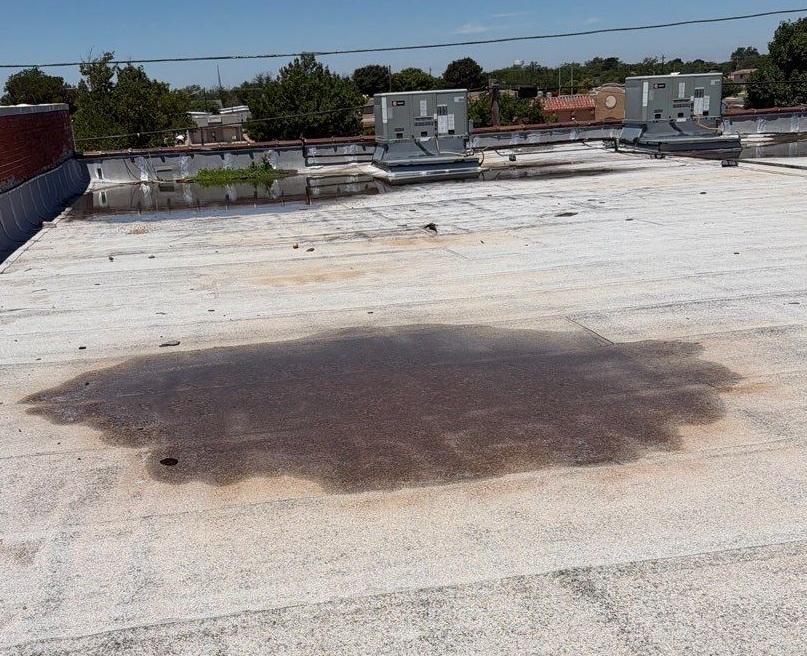
The good news is that maintenance is cheap relative to replacement. Twice-yearly inspections that catch a lifted seam or a failing flashing detail early are the difference between a roof that serves its full life and one that fails halfway through it.
From the field
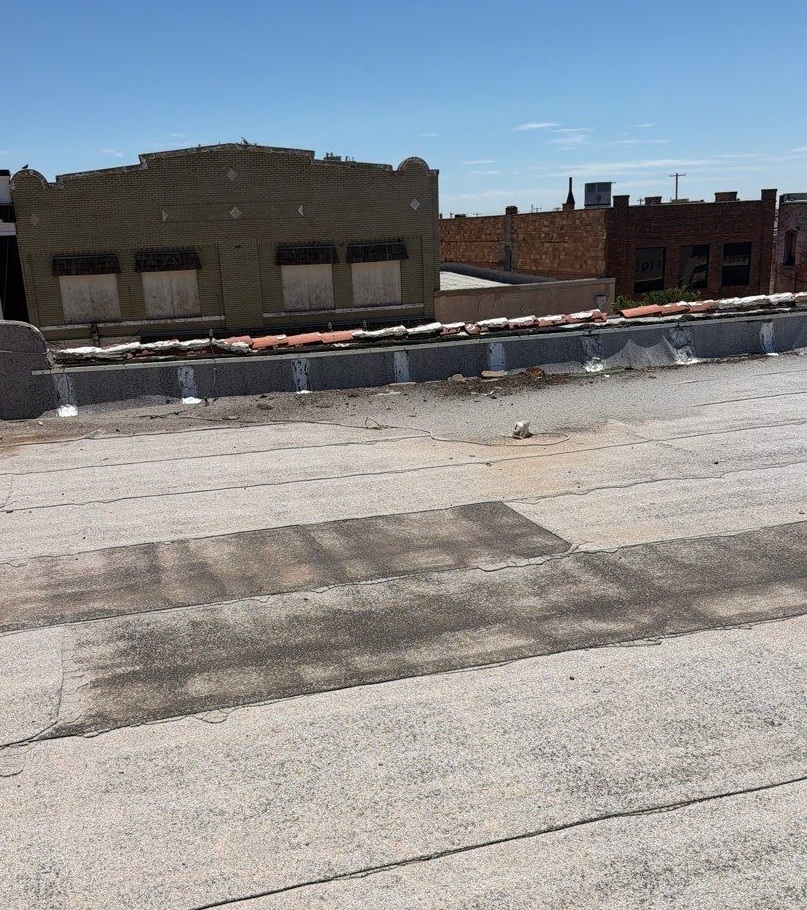
The oldest modified bitumen roof we’ve inspected in the area was somewhere in the range of 35 to 40 years old – well past its expected service life. It was still holding, and we were able to keep it going with patch repairs for a while, but at that age the membrane had given what it had to give and we ultimately replaced it. It’s a good reminder that even a tough, long-lived system reaches a point where repairs are just buying time.
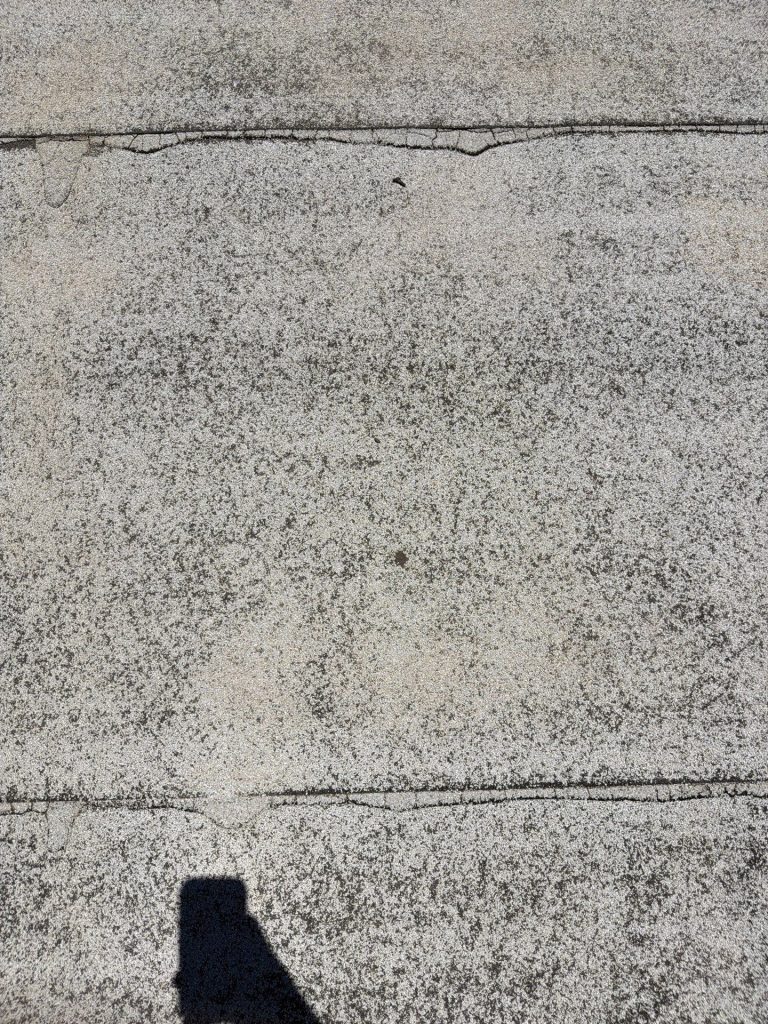
An aging modified bitumen roof in Lubbock. Even on a system that has held up well, you can see the surface cracking that develops in the field of the membrane over years of sun and thermal cycling – the kind of early sign that twice-yearly inspections are meant to catch.
What does it cost, and how does it compare to TPO and EPDM?
Modified bitumen typically runs $4 to $10 per square foot installed in Texas, with the final number set by ply count, installation method, deck condition, and cap sheet type. The table below puts that next to the two single-ply systems most building owners weigh against it, so the choice comes down to priorities rather than price alone.
| System | Installed cost (per sq ft) | Typical lifespan | Best fit for a West Texas building |
| 2-ply APP modified bitumen | $4 to $7 | 15 to 20 years | Budget-conscious projects wanting layered hail protection |
| 3-ply modified bitumen | $7 to $10 | 20 to 25 years | High-traffic or larger roofs needing maximum redundancy |
| TPO (single-ply) | $5 to $12 | 20 to 30 years | Owners prioritizing top reflectivity and longest life |
| EPDM (single-ply) | $4 to $8 | 25 to 35 years | Budget single-ply where a dark, heat-absorbing surface is acceptable |
The pattern is straightforward. Modified bitumen wins when hail redundancy and easy field repair matter most, since a damaged spot patches quickly with compatible membrane. TPO often wins on pure energy efficiency and lifespan thanks to its reflective white surface. EPDM competes on price but its standard black surface absorbs heat, which is a real drawback under West Texas sun.
Is torch-down installation safe?
Torch-down installation is safe when it is done by a trained crew that follows fire-watch procedure, and the fire risk it carries can be removed entirely by choosing a different method. Torch application uses an open propane flame to melt and bond APP membrane to the deck, which produces an excellent fully adhered bond but demands real discipline on site.
Responsible contractors manage that risk with practiced technique, designated fire-watch personnel during and after the work, and clear awareness of anything combustible nearby. The risk is genuine, which is exactly why it is treated as a procedure rather than an afterthought.
For occupied buildings, or any structure where open flame is a concern, self-adhered SBS or cold-process installation eliminates the flame from the job entirely while delivering comparable performance. The method should match the building, not the other way around.
So, is modified bitumen right for your West Texas building?
Modified bitumen is the right choice for a West Texas commercial building when hail redundancy, easy field repair, and a controlled budget are the top priorities. Its multi-ply build is
a genuine advantage in hail country, it patches without a full tear-off, and a reflective cap sheet keeps it viable under the region’s intense sun.
It is worth looking harder at a single-ply system like TPO when the goal is the longest possible lifespan or the highest possible reflectivity, and at the alternatives generally when the roof is simple, low-traffic, and unlikely to face the impact stress that rewards multiple layers.
The honest answer for most owners is that the spec details decide the outcome more than the system name. The modifier, the ply count, the cap sheet, and the edge detailing are what separate a roof that lasts its full life from one that fails early, and getting those in writing before signing is not optional.
Frequently asked questions
How long does a modified bitumen roof last in West Texas?
Most modified bitumen roofs last 15 to 25 years in this climate. A 2-ply system tends toward 15 to 20 years, while a well-drained 3-ply system with a quality cap sheet can reach 20 to 25 with regular maintenance.
How much does a modified bitumen roof cost?
Installed cost typically runs $4 to $10 per square foot in Texas. Ply count, installation method, deck condition, and cap sheet type are the variables that move the number within that range.
Is SBS or APP better for Texas?
APP is a common pick for hot, high-UV West Texas roofs because of its higher softening point and sun resistance, and it is usually torch-applied. SBS is the more flexible, rubberized option that handles thermal movement well and is often chosen for occupied buildings because it can be self-adhered without a flame.
What is the most common modified bitumen problem?
Seam and flashing failures at the roof’s details and edges are the most frequent source of leaks, not the field of the membrane. Ponding water that is never corrected is the other common culprit, which is why drainage and twice-yearly inspections matter.