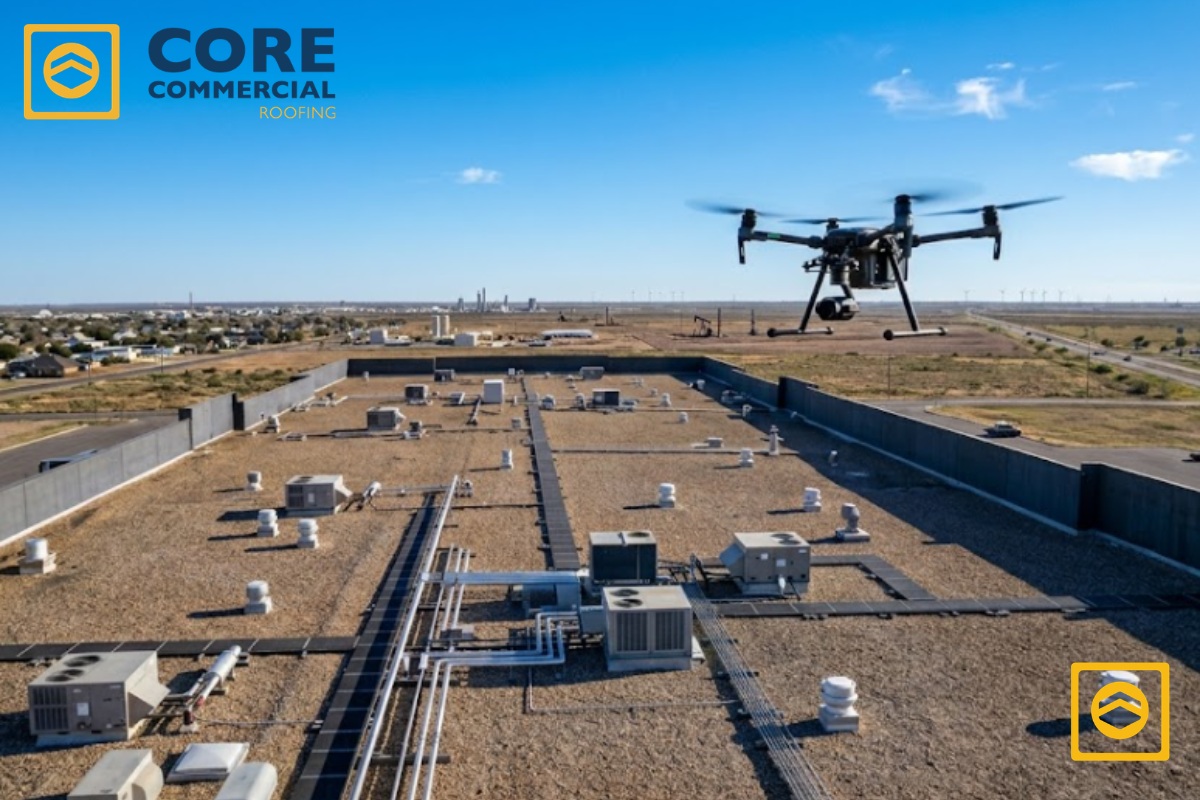
Drone roof inspections combine high-resolution visual imaging and infrared thermal scanning to assess a commercial roof’s condition without anyone stepping onto it. For property managers across West Texas, where hail damage isn’t a matter of if but when, that means faster, safer, better-documented inspections than a technician walking the roof ever could produce.
Table of Contents
How does a drone roof inspection actually work, step by step?
A drone roof inspection follows four stages: airspace and site check, a visual flight pass, an infrared thermal pass, and a documented report. The whole process typically takes under an hour for most commercial buildings and produces a report the same day or within 24 to 48 hours.
Step 1: Pre-flight and airspace check. Before the drone leaves the ground, the pilot confirms the building isn’t in restricted airspace (relevant near airports across the DFW, Midland-Odessa, and Lubbock corridors) and checks weather conditions, since wind and precipitation both affect image quality and flight safety.
Step 2: Visual imaging pass. The drone flies a grid pattern over the roof at a set altitude, capturing overlapping high-resolution photos that get stitched into a complete orthomosaic map of the surface. This pass documents visible damage: cracked membranes, granule loss, ponding water, damaged flashing, and debris.
Step 3: Thermal imaging pass. A second flight, usually conducted after sunset, uses an infrared camera to detect subsurface moisture that isn’t visible to the naked eye. This step is optional depending on the inspection’s purpose but is standard for insurance documentation and pre-purchase due diligence.
Step 4: Report and recommendations. The pilot compiles the visual and thermal data into an annotated report showing exact locations of damage or moisture, often layered onto a roof diagram, along with repair or maintenance recommendations.
Is it legal to fly a drone over a commercial building in Texas?
Yes, as long as the operator holds an FAA Remote Pilot Certificate under Part 107, which governs commercial drone use for aircraft under 55 pounds and requires pilots to keep the aircraft within visual line of sight and avoid manned aircraft during the flight.
Texas adds a layer specific to real estate transactions: a TREC-licensed inspector may perform drone inspections on commercial property, provided no other law prohibits it, and a Professional Engineer license may be required in some cases. If a real estate license holder has a personal or business relationship with the drone operator, that relationship must be disclosed to the client under state rule. For a facility manager hiring an outside roofing contractor rather than a real estate transaction inspector, this mostly matters as a reminder to ask who’s actually flying the drone and what license they’re operating under.
Can a drone detect roof leaks or moisture that isn’t visible?
Yes. Infrared thermography reads temperature differences across the roof surface caused by trapped moisture, since wet insulation holds heat differently than dry insulation after sunset.
The governing standard for this method is ASTM C1153, which uses infrared imaging to locate areas of wet or moisture-saturated insulation in low-slope roofing systems by taking advantage of the thermal mass difference between dry and wet material. In practice, the roof absorbs heat during the day and radiates it back after dark; wet insulation releases that stored heat more slowly than dry insulation, which creates a visible temperature contrast in thermal footage. This is why thermal passes are flown at night rather than during the day.
One caveat worth knowing: thermal imaging finds the location of trapped moisture, not the source of the leak. A drone survey tells you where a problem is; a roofing contractor still has to determine why it’s happening and how to fix it. For hidden leaks that don’t show obvious surface signs, that combination of thermal data plus a physical follow-up is usually what actually resolves the issue rather than just documenting it. Related: what an infrared thermal roof inspection actually measures.
How much does a commercial drone roof inspection cost in Texas?
Pricing depends mainly on building size and whether a thermal moisture survey is included alongside the standard visual pass, since thermal work requires specialized equipment and a nighttime flight window. A basic visual-only inspection on a smaller commercial roof tends to run toward the lower end of the market, while a full radiometric thermal survey on a larger property with georeferenced reporting costs more. For budgeting purposes, most commercial drone thermal surveys land somewhere in the low thousands of dollars total, which is still meaningfully less than the cost of scaffolding, safety equipment, and multi-day manual labor that traditional inspection methods require.
Some commercial property insurance policies cover thermal inspections as part of preventive maintenance programs, and the resulting report can support a claim if storm damage shows up later.
How often should a West Texas commercial roof get a drone inspection?
Twice a year at minimum, once ahead of hail season and once heading into winter, is the standard recommendation for West Texas commercial roofs. This region sits in one of the more hail-active parts of the state; Lubbock County alone has logged over 120 severe hail days since 2000, and that frequency is exactly why a biannual seasonal inspection cadence makes more financial sense than waiting for a visible leak.
A drone inspection right after a hail event is also worth scheduling on its own, separate from the routine schedule. Hail bruising on a membrane roof often doesn’t show up as an active leak for months, so a post-storm drone pass, especially the thermal component, can catch damage while it’s still cheap to fix instead of after it’s spread. For properties heading into a season known for severe weather, a broader pre-storm prep checklist alongside the inspection schedule covers the full picture.
How is a drone inspection different from a technician walking the roof?
| Drone Inspection | Traditional Walk-Through | |
| Time on site | Typically 30–60 minutes | Half a day or more for larger roofs |
| Safety | No one accesses a steep, wet, or storm-damaged surface | Technician physically walks the roof, including damaged areas |
| Documentation | Georeferenced photos and thermal maps tied to exact roof locations | Written notes and handheld photos, harder to map precisely |
| Moisture detection | Thermal imaging finds subsurface moisture invisible from the surface | Visual only, unless core samples are taken |
| Cost basis | Flat per-inspection cost regardless of roof complexity | Often scales with time, access difficulty, and crew size |
The walk-through still has a place. A physical inspection is required to verify what a thermal anomaly actually is (core sampling, per ASTM C1153, is the standard way to confirm a thermal reading before repairs are approved) and to check things a drone can’t, like flashing seams or rooftop equipment up close. The two methods work best together: drone data narrows down where to look, then a technician confirms it on the ground.
FAQ
Do I need to be on-site during a drone roof inspection?
No. Most commercial drone inspections don’t require the property owner or manager to be present, though it’s common practice for the pilot to confirm access and any site-specific restrictions beforehand.
Will insurance accept a drone inspection report for a storm damage claim?
Many insurers accept drone-captured documentation, especially when it includes timestamped, georeferenced imagery. It’s worth confirming with the specific carrier, since requirements vary by policy.
Can a drone inspect a roof right after a storm, before it’s safe to walk?
Yes, this is one of the main advantages. A drone can document damage from the air while a roof is still wet, storm-damaged, or structurally uncertain, conditions where sending a technician up would be unsafe.
Does a drone inspection replace the need for a roofing contractor to look at the roof?
No. A drone inspection identifies where problems are; a qualified roofing contractor still needs to assess the cause and recommend or perform repairs, particularly when core sampling or hands-on verification is needed.
The Bottom Line
Drone roof inspections give Texas commercial property owners something a ladder and a clipboard never could: a complete, georeferenced picture of the roof’s surface and subsurface condition in under an hour, without putting anyone on a hot, steep, or storm-damaged roof. For West Texas properties in particular, where hail season isn’t a matter of if but when, pairing a biannual drone inspection schedule with a post-storm flight after any major weather event is the most cost-effective way to catch damage while it’s still small. The drone finds where to look; a qualified roofing contractor still has to confirm what’s actually there and fix it. Core Commercial Roofing handles both ends of that process for commercial properties across West Texas.