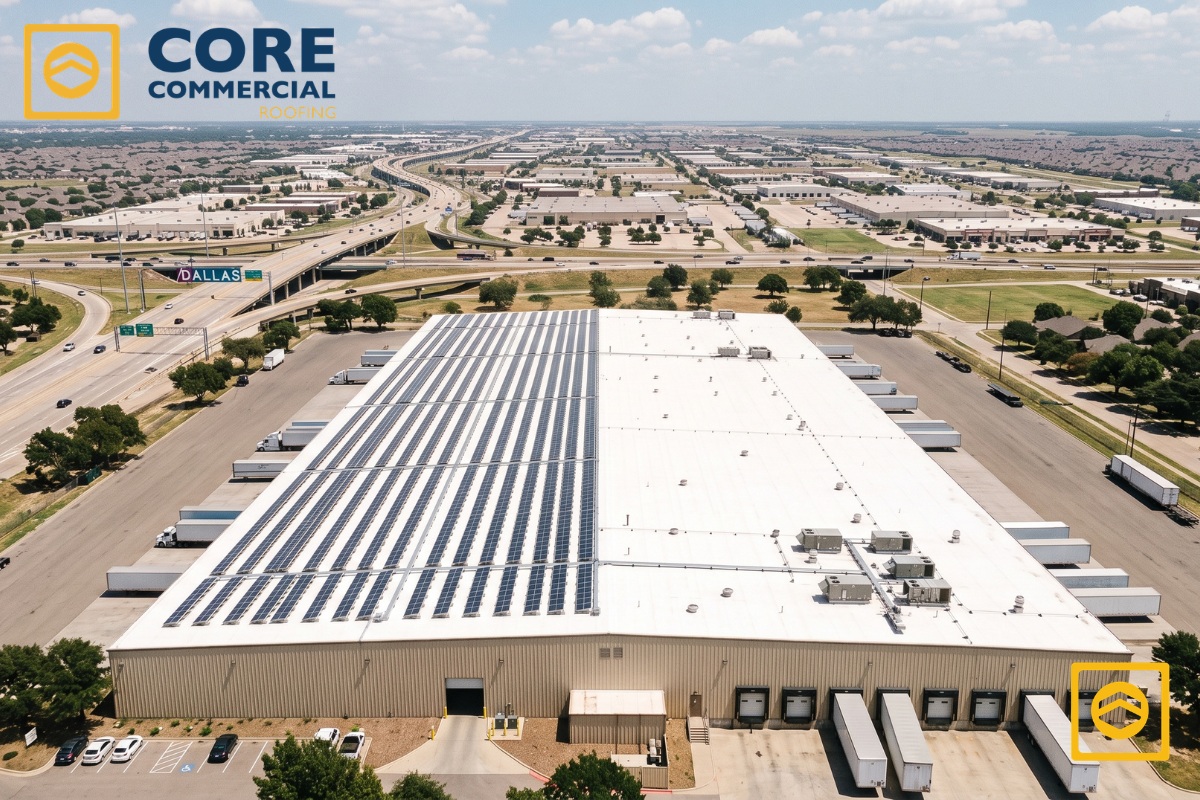
Yes, solar panels can be installed on a commercial flat roof, and low slope roofs are the most common platform for rooftop solar in the United States. Arrays go on TPO, PVC, EPDM, and modified bitumen membranes using either ballasted racking, which is weighted down with concrete, or mechanically attached racking, which fastens through the membrane into the deck.
The harder question is whether the roof underneath will last as long as the array. Solar systems are designed for roughly twenty five years of service. Commercial roofs frequently reach end of life well before that, which turns a routine roof replacement into an unplanned removal and reinstallation of the entire system.
This guide covers the decisions that determine the outcome: how mounting methods affect the membrane, when a roof warranty is voided, how much remaining service life you need, and what wind, hail, and drainage add to the calculation on Texas buildings.
Table of Contents
Can you install solar panels on a commercial flat roof?
Yes. Flat and low slope commercial roofs are the most common platform for rooftop solar in the United States, and arrays go on TPO, PVC, EPDM, and modified bitumen membranes every day.
Warehouses, distribution centers, retail strips, schools, and office buildings all make good hosts. The surface is wide open, there are no dormers or valleys breaking up the layout, and the panels can be tilted to whatever angle produces best instead of whatever angle the roof happens to sit at.
The question worth asking is a different one. Not can the panels go up, but will the roof underneath them still be doing its job in twenty years. That is a roofing question, and most of the content on this topic is written by solar companies who answer it in a sentence and move on.
How are solar panels mounted on a flat roof?
There are two methods. Ballasted racking sits on top of the membrane and is held down by concrete blocks or pavers. Mechanically attached racking fastens through the membrane into the structural deck using flashed standoffs.
Ballast is the default recommendation from most solar installers because it avoids penetrations. Mechanical attachment is lighter and holds by fastener strength rather than weight, which matters on buildings with limited structural capacity or in high wind zones. Some projects use both, with ballast across the field and mechanical anchors at the edges and corners where uplift is worst.
| Mounting method | How it resists wind | Effect on the membrane | Best fit |
| Ballasted | Weight of concrete blocks plus friction against the membrane | No penetrations, but concentrated point loads and possible rack movement across the surface | Newer membranes with confirmed structural capacity and a manufacturer approved slip sheet |
| Mechanically attached | Fasteners into the structural deck | Every anchor is a penetration that must be flashed to membrane manufacturer detail | Buildings with limited load capacity, high uplift zones, aging or thin assemblies |
| Hybrid | Ballast in the field, anchors at perimeter and corners | Fewer penetrations than full attachment, less ballast than a fully weighted array | Tall or exposed buildings where corner zone pressures drive the design |
Is ballasted racking actually safe for the roof?
Not automatically. Ballast avoids penetrations, but it puts concentrated weight on the membrane and insulation, and the National Roofing Contractors Association has documented that ballast loads can exceed the compressive strength of the roof membrane and insulation, and in some cases the capacity of the deck and joists.
There is a second issue that rarely makes it into solar marketing. Ballasted racks tend to shift laterally under high wind and seismic loading. The pads drag across the membrane, and that abrasion is exactly the kind of slow damage that does not show up until water is already in the assembly.
None of that means ballast is wrong. It means ballast is a design decision that belongs to the roof, not a free pass. The membrane manufacturer needs to approve the pad material and the slip sheet, the ballast plan needs to come from a wind load calculation for your building and your exposure, and someone needs to be responsible for what happens where the rack meets the roof. On a TPO roof the slip sheet usually has to be the same material and often the same brand. On an EPDM roof the compatibility rules are different again.
Will solar panels void my roof warranty?
They can. Roof system warranties contain provisions that void coverage when attachments are made to the system without the manufacturer’s prior approval, and that language covers ballasted racks resting on the membrane, not just anchors driven through it.
The fix is procedural and it is not difficult. Before anything is staged on the roof, the membrane manufacturer reviews the mounting plan and issues an approval, usually with conditions attached and sometimes with a fee. After installation, the manufacturer inspects to confirm the work matches what was approved. Skip that sequence and the warranty you paid for stops being worth anything at the exact moment you need it.
Owners with an FM Global approved roof assembly have an extra layer to clear, since adding rooftop equipment can affect the approval the insurer is relying on.
How much roof life do you need before installing solar?
Enough to match the array. Solar systems are built for roughly 25 years of service, while a roofing industry study puts the average life expectancy of a low slope commercial roof in the United States at about 17.4 years.
That gap is the whole problem, and it is where most rooftop solar projects quietly go wrong. If the roof gives out at year twelve of a twenty five year array, the panels come off, the roof gets replaced, and the panels go back on. That is a capital event nobody budgeted for, plus months of lost generation, plus the risk of damage during two extra handling cycles.
NRCA also makes a point that catches a lot of owners off guard. A manufacturer’s warranty length is not a prediction of service life. A twenty year warranty does not mean twenty years of roof. It means twenty years of a specific, limited set of defect coverage, with maintenance conditions attached. If you are using warranty years as your planning number, you are probably overestimating.
The honest way to get the number is to look at the roof. Core samples, seam and flashing condition, moisture survey, drain performance. An infrared thermal roof inspection will find wet insulation you cannot see from the surface, and a drone roof inspection gives you condition mapping across a large footprint without walking every square foot. In Texas heat and UV, a TPO roof typically runs shorter than the brochure suggests, which is worth factoring in before you commit to a 25 year array.
Should you re-roof before installing solar panels?
If the roof has less remaining life than the array, replace it first. Doing the roof and the solar as one coordinated project costs less than doing them five years apart, and it lets the new assembly be designed for the load and the attachment details from day one.
There is a middle case worth naming. A roof that is structurally sound but weathered on the surface is sometimes a candidate for a coating instead of a full replacement, which can buy real years. That decision has to be made before the array goes on, because recoating under a mounted array is not practical. The same logic applies to an EPDM roof sitting on the repair versus replacement line. Once panels are up, the cheap window closes.
What do West Texas conditions change?
Wind and hail. An array raises the profile of the roof and adds surfaces for wind to grab, and ASCE 7-22 Chapter 29 assigns the highest uplift pressures to panels sitting in the edge and corner zones rather than the open field.
That matters here more than it does in most of the country. Basic wind speeds across the South Plains are high, the terrain is open exposure in a lot of cases, and a ballast plan copied from a sheltered site is not going to hold. Corner and perimeter rows usually need extra ballast, aerodynamic deflectors, or mechanical anchors.
Hail is the other one. Modules take the visible damage and get the insurance attention, but the membrane and the flashings around the array take a beating too, and those are harder to inspect once panels are in the way. Roof assemblies vary in how well they absorb impact. Modified bitumen systems handle hail differently than a thin single ply, and if hail resistance is a priority the assembly should be chosen with that in mind rather than defaulting to whatever is cheapest per square.
What does an array do to drainage and maintenance access?
It changes how water and debris move. Racking rows and ballast pans interrupt flow toward drains and scuppers, which can create ponding where there was none before, and anything that blows onto the roof collects against the rows.
Ponding is not a cosmetic issue. Standing water adds weight, accelerates membrane aging, and finds seams. On a roof that already has marginal slope, an array laid out without drainage in mind will make a mild problem into a chronic one.
Access is the quieter cost. Every field seam, every penetration, and every piece of flashing that ends up under a panel becomes something you cannot inspect or repair without disassembling part of the array. That includes the details that fail most often on commercial roofs in the first place, like HVAC curb flashings. The layout needs walkway pads, service corridors, clear drain zones, and clearance around existing rooftop equipment, and all of that has to be drawn at design stage. It cannot be added afterward.
How do you make a commercial roof solar ready?
You upgrade the assembly before the panels go on, not after. NRCA’s recommendations for low slope roofs carrying rooftop PV include high compressive strength rigid board insulation, a thermal barrier directly under the membrane, increased membrane thickness on single ply systems, and a reflective surface.
Each of those addresses a specific failure mode. Compressive strength handles concentrated ballast and foot traffic. The thermal barrier protects against the higher service temperatures under and around an array. Thicker membrane survives the extra handling and traffic that solar maintenance brings. A reflective surface reduces the heat load, and it has a second benefit worth knowing about, since bifacial modules pick up light bouncing off a white membrane. If you are already weighing SPF against TPO or looking at reflective roofing for energy performance, solar readiness should be part of that same decision.
Who should install a rooftop solar system?
Three parties, working together. The solar company designs and commissions the system, a licensed electrician handles the electrical work, and a roofing contractor owns everything that touches the membrane.
That last division is where most rooftop solar problems start. Flashing a standoff is roofing work. Selecting a slip sheet is roofing work. Getting manufacturer approval, staging material without crushing insulation, and protecting traffic paths during installation are all roofing work. When a solar crew handles those tasks because it is faster, the building owner is the one holding the risk two years later when water shows up in the ceiling tile.
If you are lining up bids, ask the solar company who is doing the roof interface and get the answer in writing. The same questions that apply to choosing any commercial roofing contractor in Texas apply here, with one addition. Ask whether they have coordinated with a membrane manufacturer on a PV approval before.
Frequently asked questions
How much weight do solar panels add to a flat roof?
A ballasted array typically adds several pounds per square foot across the loaded area once panels, racking, and concrete are counted, while mechanically attached systems are lighter. A structural engineer has to confirm your building can carry that on top of existing dead, live, and wind loads before anything is ordered.
Can you repair a roof under a solar array without removing the panels?
Sometimes, if the damage is in an accessible aisle and the racking allows individual modules and ballast pans to be pulled. Anything under the array itself usually requires partial disassembly, which is why the layout should keep seams and penetrations out from under panels in the first place.
Do flat roof solar panels produce less power than pitched roof systems?
No. Flat roof arrays are tilted by the racking, usually somewhere in the 5 to 15 degree range, and the tilt can be set for optimal production instead of being fixed by the building. Larger uninterrupted roof area often means more total capacity than a comparable pitched roof.
Do solar panels make a commercial roof last longer?
Shaded membrane does see less UV and less thermal cycling, which helps. That benefit is offset if the array blocks drainage, collects debris, or puts critical details out of reach, so the net effect depends entirely on how the system was laid out.
The bottom line
You can install solar panels on a commercial flat roof, and in most cases you should be able to do it without any drama. Flat roofs are the best surface rooftop solar has. The array can be angled properly, the layout is not fighting hips and valleys, and there is usually enough open area to build a system worth having.
What decides the outcome is sequence. Assess the roof first, then design the solar around what the assessment says. That order costs nothing extra and it prevents the two expensive failures that show up on West Texas roofs a decade later: an array sitting on a membrane that gave out early, and a warranty that stopped applying the day someone set equipment on the roof without approval.
Three things are worth settling before you accept a solar bid. Get a real remaining service life number for the roof, based on inspection rather than warranty years. Get the membrane manufacturer’s written approval of the mounting plan, ballasted or attached. And get it in writing that a roofing contractor owns every detail that touches the membrane.
If the roof has plenty of life left and the details are handled properly, solar on a flat commercial roof is a sound move. If the roof is aging, the better project is a roof replacement designed to carry solar, done once, with the array going up on a surface that will still be there when the payback period ends.
Core Commercial Roofing works with building owners across West Texas on exactly that assessment. Get the roof looked at before the solar quotes come in, not after.