Spray polyurethane foam is one of the few roofing systems that insulates and waterproofs in the same layer. On a Texas commercial building, that changes the math on cooling load, on energy code compliance during a reroof, and on what happens the morning after a hailstorm. Here is what you need to know before you specify it.
Table of Contents
What is spray polyurethane foam roofing?
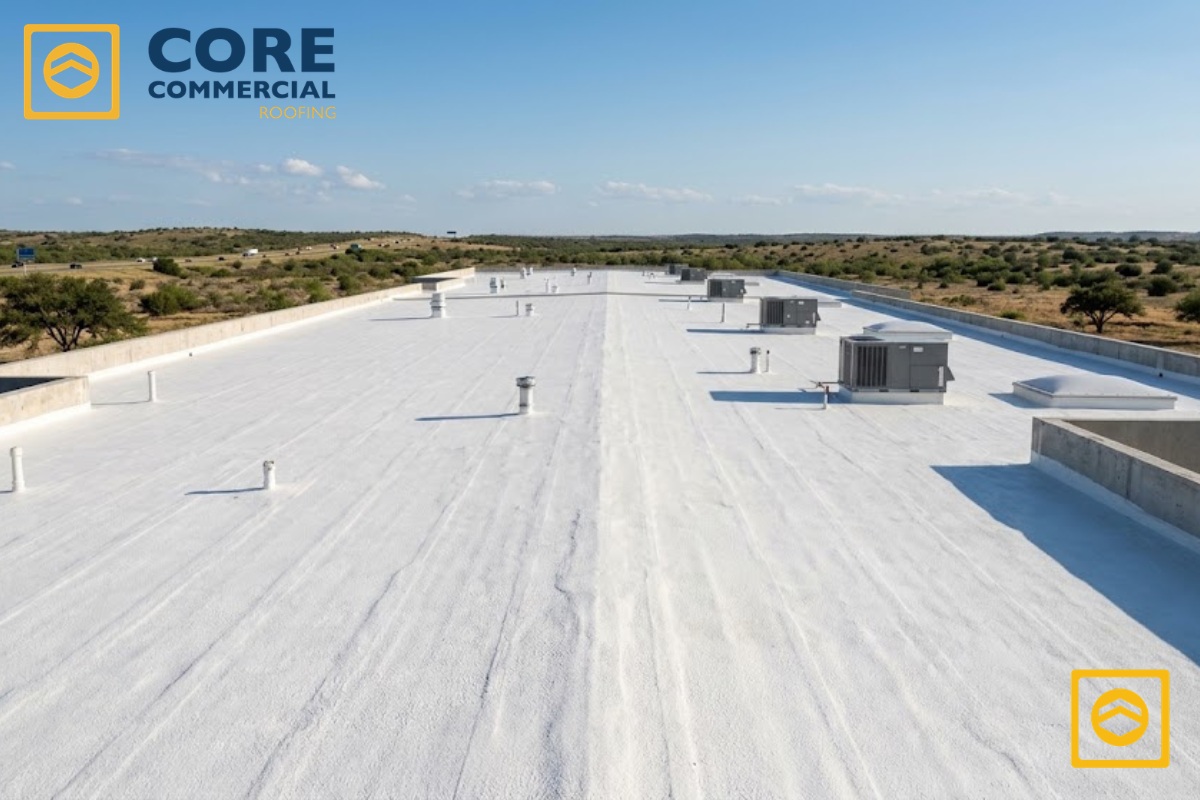
Spray polyurethane foam roofing is a two-part liquid sprayed on site that expands into a rigid, closed-cell foam. The foam serves as both the insulation and the waterproofing membrane, and it is covered with an elastomeric coating that shields it from ultraviolet light.
The two components are mixed under heat and pressure at the spray gun. They react within seconds of hitting the deck and expand roughly twenty to thirty times their liquid volume. Roofing-grade foam cures at a density of about 2.5 to 4.0 pounds per cubic foot with a compressive strength above 40 psi, which is firm enough to walk on and firm enough to carry service traffic when the coating is specified for it.
The result is seamless and fully adhered. There are no laps, no fasteners, and no separate flashing membrane at parapets, curbs, or penetrations, because the foam runs up the vertical surface and becomes the flashing itself. That matters more than it sounds. On most commercial roofs, the leak is not in the field of the membrane. It is at a transition. If you have chased water on a flat roof before, you already know this from our breakdown of commercial roof flashing types and common failures.
The coating is not optional and it is not cosmetic. Bare foam left in the Texas sun will darken within days and start to erode from the surface down. The coating is what buys the foam its service life, and it is also the part of the system that wears out first.
How thick does SPF need to be, and what R-value does it give you?
Roofing foam delivers roughly R-5.5 to R-6.5 per inch, and the minimum applied thickness is one inch. Total thickness is set by two things: the R-value the project needs and the drainage correction the roof needs.
That per-inch figure is high. It is the highest of any common commercial roof insulation, and because the foam is continuous and fully adhered, there is no thermal bridging at fastener heads or board joints. A roof insulated with board stock loses real performance at every seam and every plate. Foam does not have those.
Practically, most Texas commercial applications land somewhere between one and two inches of foam, with more added in low areas. Thickness is built up in passes, and no single pass should exceed what the manufacturer allows. The full specified thickness for any given roof area goes down the same day. A crew that leaves half the thickness on a section overnight has created a bond line that should not be there.
The coating goes on top at a dry film thickness that is generally 20 to 40 mils, applied as a base coat and a top coat in contrasting colors so the crew can see coverage as they work.
Does an SPF roof meet Texas energy code on a reroof?
Yes, and this is where foam has a quiet advantage. Texas adopted the 2015 IECC as the statewide commercial energy code effective November 1, 2016, and SPF hits the above-deck insulation requirement by adding thickness rather than by adding board stock.
Building owners are often caught off guard by this. The insulation requirement is not only a new-construction issue. When you replace a roof, you generally have to bring the assembly up to the current above-deck insulation minimum, and on an older building that can mean stacking several inches of polyiso, which raises every edge detail, every curb height, and every door threshold on the roof.
Foam solves that with less height and no fasteners. You spray to the thickness that gets you to the required R-value, and the transitions stay manageable. Local jurisdictions can and do amend the state baseline, so confirm the edition your city enforces at permitting before you finalize a specification. Austin, Dallas, and Houston all run their own amendments.
If energy performance is the reason you are looking at foam in the first place, it is worth reading how the full assembly affects operating cost in our guide to how a new commercial roof lowers energy bills in Texas buildings, and what a reflective topcoat does for Energy Star roof certification in Texas.
How does spray foam roofing hold up to Texas hail?
Hail damage to an SPF roof usually shows up as bruising or divots in the coating rather than as a breach. According to the RICOWI roof guide published by the Insurance Institute for Business and Home Safety, hail and wind-driven debris damage typically does not cause an SPF system to leak.
This is the single most misunderstood thing about foam in Texas, and most of what you will read online gets it backwards. Competitors will tell you hail is foam’s weakness. The honest version is more useful than that, and it cuts both ways.
Here is the mechanism. On a single-ply roof, the membrane is the waterproofing. Puncture it and you have a leak that day. On a foam roof, the waterproofing is an inch or more of closed-cell material with very low water absorption. Break the coating and dent the top quarter inch of foam and you have surface damage, not a breach. Water does not travel laterally through it the way it travels between a membrane and wet insulation board.
The repair follows from that. Divots get cleaned and caulked or filled and recoated. In a severe strike with dense, repeated impacts, the top layer can be ground off and resprayed in the affected area. You are not tearing off the roof. That is a fundamentally different insurance conversation than a hail-damaged single-ply that gets replaced.
The part that is genuinely a weakness: severity matters and neglect matters. Impact resistance for SPF products is evaluated under FM 4470 and systems carry a moderate hail (MH) or severe hail (SH) rating, or no rating at all. In a Panhandle or West Texas county, ask for the rating in writing before you sign. Then repair the divots. Damage that sits open through a Texas summer stops being cosmetic, because UV gets into the exposed foam and the erosion starts. Our explanation of FM Global approved roofing covers what those ratings actually certify.
The practical takeaway for a hail belt owner: foam does not stop hail. It changes what hail costs you. A hail event on a foam roof is usually a repair line item. On most membrane systems it is a replacement claim.
Can an SPF roof handle Texas wind?
Yes. The adhesion of foam to its substrate typically exceeds what uplift test equipment can measure, so the wind performance of an SPF roof is governed by what the foam is stuck to, not by the foam itself.
In uplift testing, assemblies do not fail at the foam. They fail at the fasteners holding the substrate to the deck, or at the deck. Sprayed directly onto a structural concrete deck, tensile adhesion has been recorded at roughly 900 pounds per square foot. There are no seams to peel and no fastener plates to back out.
This has a direct consequence for recovery work. If you spray foam over an existing built-up roof that is poorly secured to the deck, you have inherited that attachment. The foam will not separate. The old roof underneath it can. Substrate security is part of the inspection before anyone quotes the job, not a detail to sort out later.
Can spray foam go over an existing roof without a tear-off?
In most cases, yes. Foam can be applied as a recover over built-up, modified bitumen, metal, and single-ply roofs in serviceable condition, as long as the substrate is structurally secure, dry, and clean.
Avoiding a tear-off is often the largest single line item you can remove from a reroof budget. It also keeps the building operating. There is no day where your roof is open, and there is no landfill hauling.
The qualifiers are real, though. Wet insulation has to come out first, because foam cannot be sprayed over moisture and will not bond to a damp surface. Corrugated metal needs treatment to give the foam a flat plane. Slick TPO usually needs a mechanically attached cover board. And the added dead load has to be checked against the structure, though foam is light: a coated system generally adds less than half a pound per square foot per inch of thickness, which is far lighter than an aggregate-surfaced roof.
Finding the wet areas before you spray is the whole game on a recover. That is what an infrared thermal roof inspection is for, and on larger properties a drone roof inspection maps the problem areas faster than a walk.
Can SPF fix ponding water on a flat roof?
Yes, and this is something no membrane system can do. Because foam is sprayed rather than laid, it can be applied in varying thickness, so low areas are built up first to create a drainage plane before the specified thickness goes down.
On an older Texas roof with a sagging deck or a bad original slope, ponding is usually treated as something you live with. Water sits for days after a storm, the coating or membrane degrades faster in those areas, and the low spots become the first place you leak.
Foam lets you regrade the surface without touching the structure. The crew sprays the low areas first, establishes drainage toward the drains, then brings the whole field up to specification. Drains can be added before the foam goes on, and the surface can be sculpted after, as long as minimum thickness is maintained everywhere.
How long does an SPF roof last, and how often does it need recoating?
Maintained SPF roofs commonly exceed 30 years. The coating is recoated roughly every 10 to 20 years depending on coating type and original thickness, and the roof should be inspected twice a year, once in spring and once in fall.
The important word in that sentence is maintained. The foam itself is stable for decades and changes very little with age. The coating is the consumable. When the coating thins to the point that foam is exposed, the clock starts on real damage, and Texas UV is not forgiving about it.
This makes SPF a renewable system rather than a replaceable one. At the end of a coating cycle you clean, repair, and recoat. You do not tear off and start over. Done on schedule, the same roof can be renewed indefinitely. Skipped for a decade, you are grinding off degraded foam and paying several times what the recoat would have cost.
Put the recoat in your capital plan the day the roof goes on. Owners who treat it as an unplanned expense are the ones who defer it. If you are weighing renewal against replacement on any commercial roof, our comparison of commercial roof coating vs replacement lays out the decision.
What does spray foam roofing cost in Texas?
Installed SPF systems in the Texas commercial market generally run about $4.00 to $8.00 per square foot for foam plus coating. Recoats typically run $1.50 to $4.00 per square foot when performed on schedule.
Those are ranges, not quotes, and the spread is wide for good reasons. Foam thickness drives it, and thickness is driven by the R-value target and by how much drainage correction the roof needs. Roof size drives it, because mobilization is a large fixed cost and price per square foot drops on bigger jobs. Penetration count drives it, since every curb, skylight, and vent is hand work.
Substrate condition drives it hardest of all. A roof that needs wet insulation removed, a cover board installed, or a slick surface prepared is a different job than a clean recover, and any contractor who quotes you a firm number without seeing the roof is guessing.
Compare it on lifecycle rather than on install day. A membrane roof is a replacement cost every time it reaches end of life. A foam roof is an install cost once, then a recoat cost on a cycle. Over thirty years those two curves look nothing alike.
How does SPF compare to TPO, modified bitumen, and metal?
Each of these systems is the right answer on some Texas buildings. Here is how they differ on the points that actually decide the specification.
| Factor | SPF | TPO | Modified bitumen | Standing seam metal |
| Tear-off required | Usually not | Often yes | Often yes | Yes, or retrofit framing |
| Insulation | Built into the membrane, no thermal bridging | Separate board stock below | Separate board stock below | Separate, plus bridging at clips |
| Seams and penetrations | None, self-flashing | Welded seams, flashed curbs | Lapped plies, flashed curbs | Panel seams, curb transitions |
| Ponding correction | Yes, regraded with foam | Only with tapered insulation | Only with tapered insulation | Requires slope by design |
| How hail damage presents | Surface divots, rarely a leak | Punctures, leaks at impact | Bruising and fracture of plies | Denting, mostly cosmetic |
| End-of-life renewal | Recoat, repeatable | Coat or replace | Cap sheet or replace | Repaint or replace panels |
If TPO is the system you are weighing foam against, the head-to-head detail is in SPF roofing vs TPO, and the service life question is covered in how long a TPO roof lasts in Texas. For older industrial buildings in this region, modified bitumen roofing in West Texas is still a common and defensible choice.
When is SPF the wrong roof for a Texas building?
SPF is the wrong choice on roofs with heavy unplanned foot traffic, on decks that are not structurally sound, on schedules that cannot wait for dry conditions, and on buildings whose owners will not fund the recoat.
Foot traffic first. Foam handles service traffic when the coating is specified for it and walkways are laid out. A roof with technicians on it weekly and no walkway plan will wear through the coating in traffic lanes long before the rest of the roof needs anything.
Weather second. Foam cannot be sprayed onto a wet or damp surface, and it has temperature and humidity limits. Wind causes overspray, which is a serious problem on a tight commercial site with parked vehicles and adjacent buildings. In a Texas spring, that means weather delays are part of the schedule. If you have a hard deadline that cannot move, say so at the bid stage.
Ownership horizon third, and this is the one nobody says out loud. Foam pays off through renewal. If the building is being sold in three years and nobody is funding a recoat cycle, the economics that make foam compelling do not apply to you. A different system may serve you better.
How do you verify the installation was done right?
Verification on an SPF roof is measurable, not visual. The cured coating thickness is confirmed by cutting slit samples and examining them under magnification, and areas below the specified minimum get more coating.
Ask for these four things and you will separate a real installer from a sprayer:
- Slit samples with documented dry film thickness readings across the roof, not one reading at the hatch.
- Confirmation that the full specified foam thickness went on each area the same day, and that base coat followed within 24 hours.
- Base coat and top coat in contrasting colors, which is how the crew proves coverage as they spray.
- Written FM ratings for the system and manufacturer warranty terms, including what a future recoat does to coverage.
Foam is unforgiving of bad application in a way that board and membrane are not, because everything is field-manufactured on your roof. The material is only as good as the crew and the proportioner settings that day. That is worth weighing when you are choosing a commercial roofing contractor in Texas.
Frequently asked questions
Is a spray foam roof slippery when wet?
Smooth silicone topcoats can be slick when wet. Granules broadcast into the wet topcoat in traffic areas and around equipment solve it, and should be specified up front rather than added later.
Does recoating renew the warranty?
Most manufacturers issue 10, 15, or 20 year warranties on SPF systems, and a documented recoat at the end of the term typically renews coverage for another cycle. Confirm the renewal terms in writing before the coating is selected, because they vary by manufacturer.
Can you put solar panels or new HVAC units on a foam roof?
Yes, with planning. Stanchions should be anchored to structural members and set before the foam is applied where possible, panels should sit high enough for future roof maintenance access, and curb details need to be right from the start, which is covered in our guides to installing solar panels on a commercial flat roof and HVAC curb flashing leaks.
Will an SPF roof affect my insurance in a hail county?
Carriers underwrite on the rating and documented condition of the system, not on the material category alone. Keep the FM rating, the installation documentation, and your twice-yearly inspection records on file, because that paperwork is what supports the claim after a storm.
Conclusion
Foam suits a lot of Texas buildings. It gets you to code R-value on a reroof without raising every curb, it regrades a ponding roof without touching the structure, and after a hailstorm it usually leaves you with divots to repair instead of a roof to replace.
The catch is the coating. Foam roofs do not fail because the foam wears out. They fail because nobody recoated on schedule. Put the recoat in your capital plan from day one and an SPF roof can be renewed indefinitely.