Sun damage is the slowest way a commercial roof fails in West Texas, and the easiest one to miss. Hail gets the attention because it does its damage in a single afternoon. UV works every day of the year, and by the time a building owner sees a leak, the membrane has usually been breaking down for years. Below is what ultraviolet exposure does to each roofing material, where the damage shows up first, and what actually slows it down.
What does UV radiation actually do to a commercial roof?
UV radiation breaks the chemical bonds that keep roofing polymers and asphalt flexible, and the heat that arrives with it speeds that reaction up. The result is a membrane that slowly dries out, shrinks, and turns brittle.
Ultraviolet light is only a small share of sunlight. The EPA guide to cool roofs puts it at about 5 percent of solar energy, with 43 percent arriving as visible light and 52 percent as infrared heat. The UV slice does the chemical damage. The infrared slice sets the temperature, and the guide reports that traditional roofs reach summer peaks of 150 to 185°F, running 55 to 85°F hotter than the surrounding air.
Heat and UV work as a team. Every roofing material carries some built-in protection: single-ply membranes are compounded with UV stabilizers, and asphalt systems rely on mineral granules or a reflective surface. Heat burns through that protection faster. Once it wears thin, the material underneath takes the full load.
Why is UV damage harder on roofs in Lubbock and West Texas?
West Texas roofs get high UV, a long cooling season, and wide day-to-night temperature swings all at once. Each of those ages a membrane on its own, and together they compound.
Our summer UV index regularly sits at 10 to 11. The air is dry and the skies are mostly clear, so very little of that sun gets filtered before it hits the roof. The cooling season also runs long, which means more months of the year at damaging surface temperatures.
Then the temperature drops. An afternoon storm or a clear night can pull a roof surface down fast, and the membrane contracts. A fresh membrane flexes through that cycle without trouble. A membrane stiffened by years of UV cannot, so the stress concentrates at seams, corners, and flashings, and those are the places that crack first.
Blowing dust adds a third layer. Grit from our windstorms sandblasts the surface over time, wearing down granules and coatings that would otherwise shield the material underneath.
From the field
I will not specify anything under 60 mil TPO on a West Texas commercial roof. Under our summer UV, a 45 mil membrane starts surface chalking within about three years and can reach thermal fatigue at the seams within five. Thickness is the cheapest UV protection you can buy, and it is covered in more detail in our guide to how long a TPO roof lasts in Texas.
How does UV break down each roofing material over time?
Every roofing material gives way to the sun differently. Thermoplastics chalk and craze, rubber and asphalt dry out and crack, and coatings erode until the surface beneath them is exposed.
| Material | What UV and heat attack | First sign you will see | What slows it |
|---|---|---|---|
| TPO | UV stabilizers in the top ply, welded seams | Chalky residue, fine surface crazing | 60 mil or thicker, clean surface, walkway pads |
| PVC | Plasticizers that keep the sheet flexible | Stiffening, shrinkage pulling at the edges | Reflective surface, perimeter checks |
| EPDM | Heat on the black surface, seam adhesive and tape | Shrinkage, seam edges lifting | Reflective coating, regular seam checks |
| Modified bitumen | Asphalt oxidation, granule surface | Bare spots, surface checking | Reflective cap sheet or coating |
| Built-up roofing | Asphalt flood coat | Alligator cracking, blistering | Intact gravel or reflective surfacing |
| Spray foam | The foam itself, once the coating wears | Thin coating, exposed yellow or brown foam | Recoating on schedule |
| Metal | Paint finish, sealants at fasteners and laps | Faded, chalky finish, dried sealant | Restoration coating, resealing |
TPO
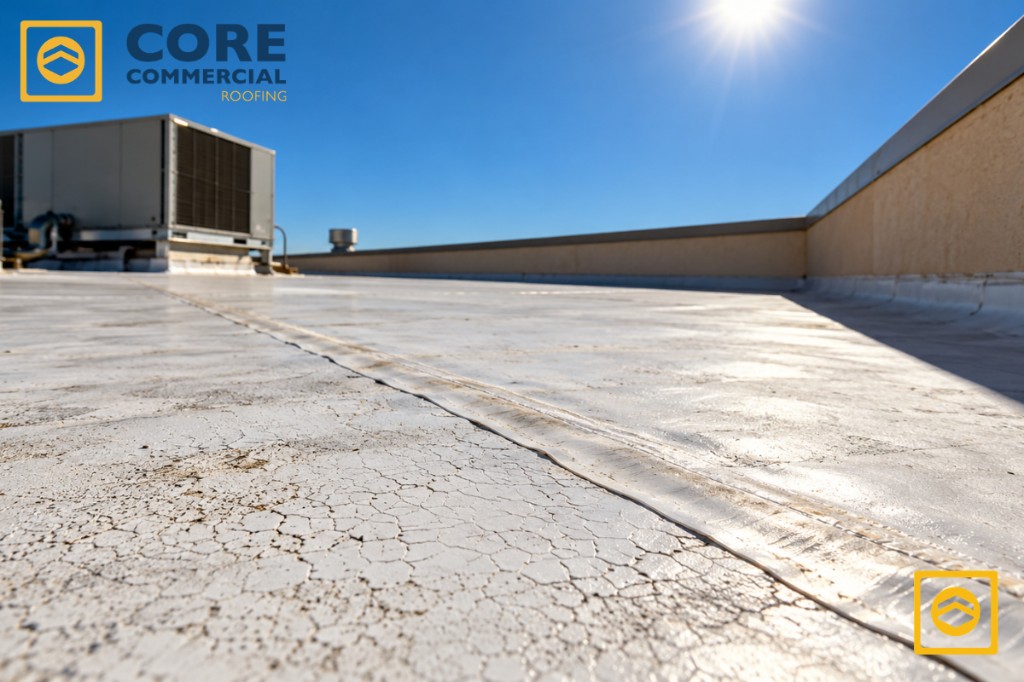
TPO roofing resists UV through stabilizers blended into its top ply. As years of sun use those stabilizers up, the surface starts to chalk, then craze with fine cracks, then lose flexibility. The heat-welded seams take the daily expansion and contraction, so a membrane that has gone stiff tends to show fatigue there first.
PVC
PVC stays flexible because of plasticizers in the sheet. Heat slowly drives those plasticizers out. The membrane stiffens and shrinks, and that shrinkage pulls hard on perimeters, corners, and penetrations.
EPDM
EPDM rubber itself holds up well to UV. The problem in West Texas is heat. A standard black sheet absorbs the sun, runs very hot, and shrinks over time, while the adhesive and tape at the seams loosen under constant thermal cycling. Our side-by-side on TPO vs EPDM roofing covers how that trade-off plays out on a commercial building.
Modified bitumen and built-up roofing
Asphalt oxidizes in the sun. On modified bitumen, the mineral granules on the cap sheet are the first line of defense, and once they wear or wash away, the asphalt underneath bakes and starts to check. On built-up roofing systems, an exposed flood coat ends up alligator-cracked across the field. A reflective cap sheet or coating slows both. The oldest mod bit roof I have inspected in our area was somewhere between 35 and 40 years old and still holding, which shows how long a well-surfaced asphalt roof can last. Our guide to modified bitumen roofing in West Texas goes deeper on cap sheet choices.
Spray foam
Polyurethane foam breaks down quickly when the sun reaches it directly, so a spray foam roof depends entirely on its coating. As long as the coating is intact, the foam is protected. Once it thins, exposed foam turns yellow to brown and starts to erode, which is why spray foam roofing lifespan is really a question of recoating discipline.
Metal
Metal panels do not degrade in the sun, but their finish does. Paint fades and chalks, and the sealants at fasteners, laps, and trim dry out and crack. Those dried-out sealants are where water gets in, long before the steel itself is a concern.
What does UV damage look like at year 1, year 5 and year 10?
UV damage moves in stages. First the surface loses its shine and some of its reflectivity, then it chalks and crazes, and finally it becomes brittle enough to crack and split.
Years 1 to 2. Dirt and early weathering dull a white roof, so it runs a little hotter than it did on day one. Nothing leaks, and most owners never notice the change.
Years 3 to 5. On thin membranes, chalking shows up and the surface starts to craze. Asphalt cap sheets show their first bare spots. Sealant around penetrations begins to harden. A 45 mil TPO sheet can reach seam fatigue around year five in our summers.
Year 10 and beyond. On a roof that has not been maintained, the membrane turns brittle. Cracks open at folds, corners, and flashings, and the sheet can split under a work boot. Asphalt roofs alligator. Leaks follow. Foot traffic speeds all of it up: a 60 mil membrane under regular HVAC service traffic with no walkway pads rarely reaches eight years here.
None of that timeline is fixed. A well-specified, maintained TPO roof lasts 20 to 30 years in Texas, and a good modified bitumen roof lasts 15 to 25. The roofs that fall short are usually the ones nobody walked until something leaked.
Where on a commercial roof does UV damage start first?
UV damage starts where sun exposure doubles up or where the membrane is already under stress. That means next to reflective walls and parapets, at seams and flashings, around rooftop equipment, and anywhere dirt or water sits.
- Next to parapets and light-colored walls. Sunlight bouncing off a wall hits the membrane a second time, so those strips age faster than the open field. Our guide to parapet wall waterproofing covers the details that fail there.
- Flashings and terminations. The membrane is folded and stretched at these points, and sealants dry out before anything else on the roof. Rooftop units are a common trouble spot, as our breakdown of HVAC curb flashing leaks explains.
- Seams. Every weld and lap takes the daily expansion and contraction, so a sun-stiffened membrane fatigues there first.
- Service paths and equipment areas. A membrane that would last years longer on its own cracks quickly when technicians walk across it after UV has made it brittle.
- Ponding areas. Water that sits leaves a film of dirt behind, and that patch runs hotter and ages faster than the clean roof around it.
A visual walk finds most of these. What it cannot find is water that has already slipped through an aging membrane into the insulation. An infrared thermal roof inspection shows that wet insulation before it turns into a ceiling stain.
Do white roofs and coatings stop UV damage?
A reflective surface slows UV aging because it keeps the membrane much cooler, but it does not stop it. Reflective roofs also lose some of their reflectivity as dirt and weathering build up, and a good cleaning brings most of it back.
Researchers at Lawrence Berkeley National Laboratory measured single-ply membranes taken from roofs across the country. Their study of aging and weathering on cool roofing membranes found that most weathered samples returned to within 90 percent of their original reflectivity after a detergent wash, though some needed an algaecide to get there. In practice, that means cleaning is a real maintenance task and not just cosmetic.
A coating works as a sacrificial layer. It takes the UV so the roof underneath does not. A properly applied commercial coating generally protects for 10 to 20 years, and the key is renewing it before it wears through. A coating also cannot fix a roof that is already wet underneath, which is the whole question behind deciding whether to coat or replace a commercial roof.
How can Lubbock building owners slow UV degradation?
Slow UV aging with four habits: specify enough membrane for the climate, inspect twice a year, keep reflective surfaces clean, and recoat before the protective layer wears through.
- Specify for the sun. Use 60 mil TPO at minimum, and 80 mil with walkway pads where HVAC techs are on the roof often. On asphalt systems, choose a reflective cap sheet over a dark one.
- Inspect in spring and fall. Look for chalking, crazing, bare granule spots, and hardened sealant. Add a check after any major storm.
- Keep it clean. A washed white roof stays cooler and ages slower than a dirty one.
- Recoat on schedule. Renew coatings while the surface underneath is still sound, not after it is exposed.
- Protect the details. Reseal penetrations and flashings as soon as sealant starts to crack, because those are the first places a sun-aged roof lets water in.
Frequently asked questions
How long does a TPO roof last under West Texas sun?
A properly installed 60 mil TPO roof typically lasts 20 to 30 years here, with maintenance deciding where in that range it lands. A thin 45 mil membrane chalks and fatigues much sooner under our UV.
Does insurance cover UV damage on a commercial roof?
Gradual sun damage is generally treated as wear and tear rather than a sudden covered loss, though every policy reads differently. Keeping inspection records helps separate old UV wear from new storm damage if you ever need to file a claim.
How often should a commercial roof coating be renewed in Texas?
Most commercial coatings protect for roughly 10 to 20 years, depending on the product and applied thickness. Recoat when inspections show the coating thinning, before the surface underneath is exposed.
Can you see UV damage on a roof from the ground?
Usually not. Chalking, crazing, and dried sealant only show up on a close walk of the roof, which is why twice-a-year inspections matter.
Conclusion
Texas UV does not ruin a commercial roof in one season. It wears down the protection built into every membrane a little at a time, and West Texas heat, temperature swings, and blowing dust speed the process up. The damage starts at the edges, seams, and flashings long before it shows up as a leak inside the building.
The roofs that last are the ones specified for the sun and walked on a schedule. Choose enough membrane thickness for our climate, keep reflective surfaces clean, recoat before the protective layer is gone, and catch dried sealant and early cracking while they are still cheap repairs. Do those things, and UV becomes a maintenance item instead of a replacement bill.
If you are not sure how much sun damage your roof has already taken, our team can walk it and give you a straight answer. Request a roof inspection or call (806) 404-1250.