Is ISO the same as polyiso?
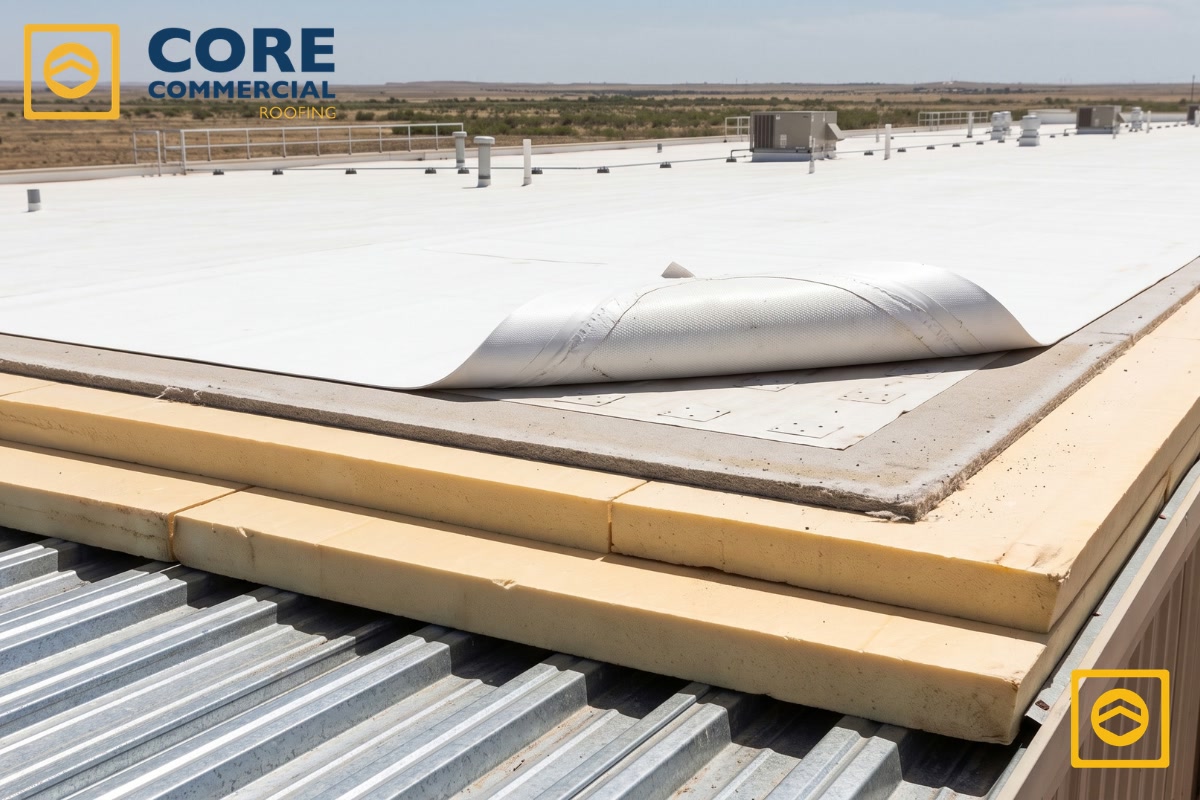
Yes. ISO, polyiso, and polyisocyanurate all name one product. It is a closed-cell rigid foam board with a facer bonded to each side, installed over the roof deck and under the membrane.
You will see it written several ways on a proposal. "Two layers 2.2 in. ISO", "tapered ISO", and "1/2 in. HD ISO cover board" are all polyiso. The only difference is thickness, shape, or density.
The confusion that actually costs owners money is mixing polyiso up with products that look or sound similar:
- Asphaltic fiberboard. It is black and comes in similar board sizes, but it insulates at only about R-2.5 per inch. It is a recovery board, not thermal insulation.
- Perlite. It is a mineral board found on many older Texas roofs. It is low in R-value and soaks up water.
- Spray polyurethane foam (SPF). SPF is sprayed in place and becomes the roof itself once it is coated. Polyiso is a factory-made board that always needs a membrane over it. Our SPF roofing guide for Texas covers how foam roofs work.
To check what went down on your roof, look at a cut edge. Polyiso has a pale yellow or off-white foam core between two facers, even when the facer itself is black.
What R-value does polyiso really give you on a roof?
Plan on R-5.0 to R-5.6 per inch, not the R-5.7 to R-6.0 printed on the label. Label values come from a mild lab test, and polyiso insulates less when the board gets cold or very hot.
Manufacturers report a long-term thermal resistance (LTTR) value measured at a 75°F mean temperature. Real roofs rarely sit there. Testing summarized in Building Science Corporation's research on temperature-dependent R-values found that polyiso loses insulating value once outdoor temperatures fall below freezing. It also loses value when solar-heated roof surfaces climb past about 113°F. The cause is the blowing-agent gas inside the foam cells, which starts to condense in the cold.
The roofing industry's own technical body takes the conservative view. NRCA set its design R-value for polyiso at 5.0 per inch and stood by that figure after the manufacturers' association pushed back. NRCA noted that independent testing by Building Science Corporation and RDH Building Engineering produced matching results. NRCA's practical advice is to specify polyiso by thickness, not by a label R-value.
Texas roofs swing between both extremes. A Panhandle norther can drive a roof deck well below freezing. A dark roof under a West Texas July sun runs far hotter than 113°F. A white TPO roofing membrane keeps the board underneath cooler in summer, which keeps more of the insulation working. That is one reason reflective membranes and insulation together lower energy bills in Texas buildings.
How does polyiso compare with EPS, XPS, and mineral wool?
Polyiso packs the most R-value into the least thickness, which is why it dominates Texas flat roofs. EPS and XPS hold their value better in cold weather, and mineral wool wins on fire resistance. Each of them needs more thickness to reach the same R-value.
| Insulation | Label R per inch | Cold weather | Thickness for R-25* | Best fit in Texas |
|---|---|---|---|---|
| Polyiso (ISO) | 5.7 to 6.0 (design 5.0 to 5.6) | Loses R-value below freezing | 4.5 to 5 in. | Most low-slope roofs: TPO, PVC, EPDM, mod-bit, BUR |
| EPS | About 3.9 to 4.6 | Gains R-value in cold | 5.5 to 6.5 in. | Cold storage, budget builds, deep tapered fill |
| XPS | About 5.0 | Holds or gains in cold | 5 in. | Protected membrane roofs, plaza decks, wet locations |
| Mineral wool | About 3.8 to 4.0 | Stable | 6.25 in. or more | Fire-rated assemblies, insurer-driven specs |
*Thickness uses conservative design values. Check product data sheets for exact numbers.
On a re-roof, thickness is not just a number on paper. Every extra inch raises the roof surface against curbs, parapet flashings, rooftop doors, and drains. Those details can add cost fast. Polyiso's thin profile is often what keeps a tear-off from turning into a curb-raising project.
The other boards still have their place. EPS is a smart choice for freezer and cold storage buildings, where the insulation sits cold all year. XPS goes on protected membrane roofs, where the insulation sits above the waterproofing and sees water. Mineral wool shows up when the fire rating or the building's insurer calls for it.
How thick does polyiso need to be for Texas energy code?
Texas uses the 2015 IECC as its statewide commercial energy code. It requires R-25 continuous insulation above the deck in climate zones 2 and 3, and R-30 in climate zone 4. At conservative design values, that works out to roughly 5 inches and 6 inches of polyiso.
Most of Texas falls in zones 2 and 3. That includes Houston, Austin, San Antonio, Dallas-Fort Worth, Lubbock, Midland-Odessa, and Abilene. The northern Panhandle, around Amarillo, Dumas, and Hereford, sits in zone 4 and needs the thicker R-30 assembly. Many Texas cities have adopted newer IECC editions, so confirm with your local building department before the bid is finalized.
A few code details matter on almost every Texas flat roof:
- Use two layers with staggered joints. The 2021 IECC requires it, and it is good practice under any code. A single layer leaves a straight gap at every board joint, where heat and air move freely.
- Tapered systems count by average thickness. Insulation is allowed to run thinner right at drains and scuppers, so the slope can carry water away.
- Tear-offs usually trigger the code. When a roof comes off down to the deck, the new insulation generally has to meet current minimums. Recovers and roofs with curb or flashing limits can qualify for exceptions, so ask your contractor which rules apply before you compare bids.
Which polyiso facer and grade should you specify?
Match the facer to the membrane and the grade to the traffic. Coated glass facers suit adhered single-ply. Felt-type facers suit hot asphalt and torch systems. Standard 20 psi board works unless equipment or heavy foot traffic calls for 25 psi.
The facer is the skin that the membrane or adhesive bonds to, so the wrong one can weaken the whole system. Fully adhered TPO and PVC systems usually call for coated glass mat facers, which give adhesives a strong, stable surface. Built-up roofing systems and modified bitumen roofing in West Texas often go over glass-reinforced felt facers made for hot asphalt. In practice, the membrane manufacturer's warranty requirements decide the facer, and a good contractor builds the spec from those requirements.
Compressive strength comes in grades. Grade 2 polyiso is rated at 20 psi and handles normal service traffic. Grade 3 is rated at 25 psi and is worth the upgrade around rooftop HVAC units, walkways, and roofs that see frequent trades on top. High-density polyiso, rated well above 100 psi, is a cover board and not a primary insulation layer.
Does polyiso hold up to Texas hail?
Not on its own. Hail can crush the foam under a membrane even when the surface looks fine. A high-density cover board over the polyiso is what protects a Texas roof from hail.
Standard polyiso is light and relatively soft. A direct hit compresses the foam and can fracture the facer. That breaks the bond between the membrane and the insulation, even though the membrane may look intact from the surface. Over time, the loose membrane flutters in the wind, seams get stressed, and water finds a way in.
A 1/4-inch or 1/2-inch cover board spreads each impact before it reaches the foam. There are two common choices:
- HD polyiso cover board. It is light, easy to handle, and cost-effective for most hail-exposed roofs.
- Gypsum cover board. It adds fire performance and hardness, but it is heavier and must be kept dry during installation.
If your insurer writes hail ratings into the spec, the full assembly has to be tested as a system, cover board included. Our guide to FM Global approved roofing explains how those ratings work. After a storm, crushed insulation is the damage that visual claim inspections tend to miss. A moisture survey and core samples are how it gets documented.
What happens when polyiso gets wet?
Wet polyiso loses most of its insulating value and will not dry out once it is sealed under a membrane. Wet boards have to be cut out and replaced.
The membrane above and the vapor-tight deck below trap any water that gets into the insulation layer. Water reaches it through a split seam, a failed curb flashing, or a hail fracture. Once there, it spreads sideways between boards. Facers delaminate, fasteners corrode, and the assembly loses wind uplift resistance long before a ceiling stain appears.
The way to find wet polyiso without tearing up the roof is a night-time infrared thermal roof inspection, confirmed with core samples. The amount of wet insulation also settles one of the biggest budget decisions an owner faces. A roof with widespread saturation is not a coating candidate, as our breakdown of commercial roof coating vs replacement explains.
Most leaks that soak polyiso start at details, not in the open field of the roof. Curbs, edges, and penetrations are the usual suspects, covered in our commercial roof flashing repair guide.
Can you keep the existing polyiso when you re-roof?
Yes, if a moisture survey and cores show it is dry and solid. Dry polyiso can stay under a recover. Wet, crushed, or delaminated boards have to come out.
Keeping good insulation is one of the biggest savings available on a Texas re-roof. It avoids tear-off labor and landfill fees, and it preserves R-value you already paid for. A new layer of polyiso and a cover board can often go over the existing board to bring the roof up to code. Building codes generally do not allow a recover over a water-soaked roof or over two existing roof layers, so the survey comes before the bid.
Ask any contractor bidding your roof how they verified the insulation condition. A number on a proposal without a moisture survey behind it is a guess. Our guide on choosing the right commercial roofing contractor in Texas lists the other questions worth asking.
Frequently asked questions
Is polyiso better than XPS for a flat roof?
For most Texas flat roofs, yes, because polyiso delivers more R-value per inch at a lower cost per R. XPS earns its place on protected membrane roofs, plaza decks, and spots where insulation may sit in water.
How long does polyiso roof insulation last?
Kept dry and undamaged, polyiso can outlast more than one roof membrane. Water and crushing are what end its life, so fast leak repair and a cover board protect the investment.
Is tapered ISO the same as flat ISO?
Yes, tapered ISO is the same polyiso cut into sloped panels, often 1/4 inch per foot, to move water toward drains. It is the standard fix for ponding on flat Texas roofs, and code counts its average thickness.
Can you put a roof coating directly over polyiso?
No, polyiso always needs a membrane above it, and coatings go over the membrane or over spray foam. If a bid describes coating bare insulation boards, ask whether the contractor actually means an SPF roof.
Conclusion
ISO and polyiso are one product, so the comparison that matters is not between the names. It is between a well-specified polyiso layer and a poorly specified one. For most Texas commercial flat roofs, polyiso is still the right insulation because it delivers the most R-value for the least thickness.
Getting it right comes down to a few choices. Size it by thickness at a realistic R-5.0 to R-5.6 per inch. Install two staggered layers that meet your climate zone's code minimum. Match the facer to your membrane, and protect the foam with a cover board against hail. Before any re-roof, confirm with a moisture survey whether the existing insulation is dry enough to keep.
When two bids both say "ISO", compare what sits behind that word: total thickness, number of layers, facer, cover board, and how the existing roof was checked. That is where the real difference in price and performance lives.