An EPDM roof coating can add years to an aging rubber roof and drop its surface temperature by a wide margin. It can also peel off in sheets if the roof was the wrong candidate or the prep was rushed. The difference comes down to a few checks that happen before a single gallon goes down.
Below is how we decide whether a commercial EPDM roof should be coated, which coating to use, and what the prep, testing, thickness and cost look like on the South Plains.
EPDM coating at a glance
- 2.0 PLI: Minimum adhesion before coating proceeds
- 60 to 65°F: Peak roof temperature drop measured on a coated commercial roof
- $4 to $9: Per sq ft installed on sound South Plains roofs
- 10 to 20 yrs: Added service life on a dry, sound membrane
What is an EPDM roof coating?
An EPDM roof coating is a fluid-applied elastomeric layer rolled or sprayed over an existing EPDM rubber membrane. It creates a seamless, reflective, waterproof surface on top of the rubber, but it does not repair wet insulation or a damaged deck underneath.
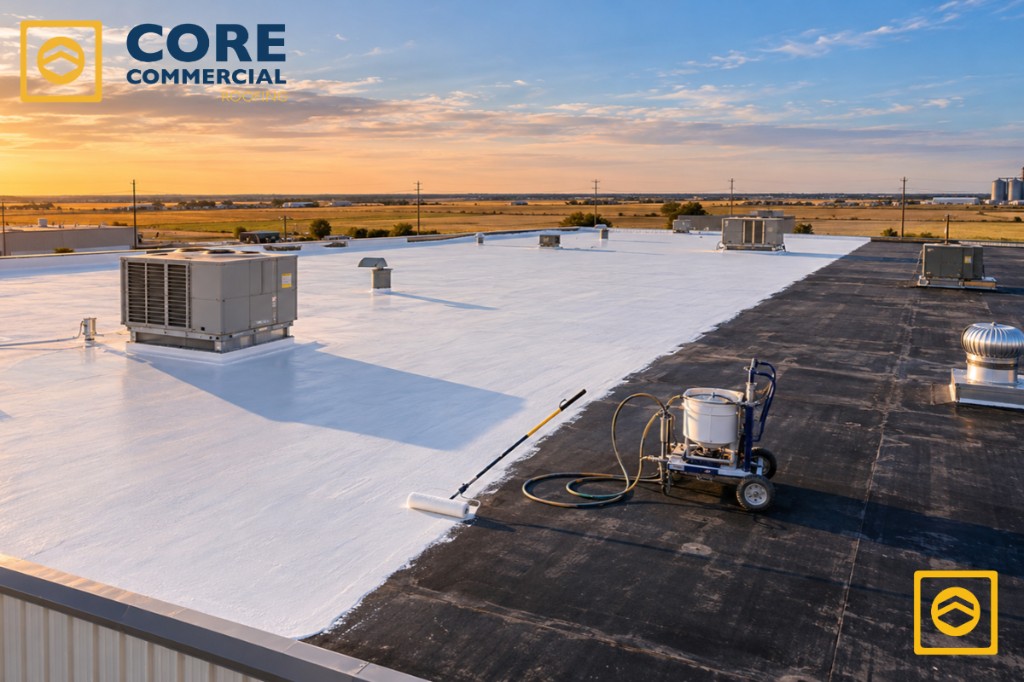
The EPDM stays in place and keeps doing its job as the base layer. The coating takes the sun, the weather and the foot traffic. On a black membrane, the most visible change is color. A white coating turns a roof that soaks up heat into one that reflects most of it.
A coating is a surface treatment. It is only as good as what sits below it. If you want the background on the membrane itself, our page on commercial EPDM roofing systems covers attachment methods, lifespan and where EPDM fits in West Texas.
Does a commercial EPDM roof need a coating?
No. A sound EPDM roof in good condition does not need a coating to keep water out. Coating is a restoration step for an aging membrane that is still dry, or for a building where cooling costs justify a reflective surface.
Plenty of EPDM roofs reach 20 years or more without ever being coated. So the question is not whether coating is required. The question is whether your roof is at the point where a coating buys more life for less money than the next alternative.
When an owner calls us about coating, the roof usually falls into one of two groups. The first is an older membrane that is starting to chalk, shrink at the edges or open at the seams, where the owner wants to push replacement out another decade. The second is a building with big cooling bills, such as a warehouse, cold storage space or retail store, where a black roof is working against the HVAC all summer. Both can be good candidates. Neither is a good candidate if water is already sitting under the membrane.
Can every EPDM roof be coated?
No. Wet insulation, hail fractures, failing seams, ballasted systems and roofs that already have two layers are poor candidates. A moisture survey and core cuts decide it, not the way the membrane looks from the surface.
Wet insulation is the deal breaker. A coating seals the top of the roof. If water is trapped below, you have just sealed it in. The insulation keeps losing R-value, the deck can deteriorate, and the coating will blister or delaminate. When we pass on a coating job, it is almost always because of what the core cuts showed, not because of the rubber on top.
Other conditions that push a roof toward repair or replacement instead:
- Hail fractures. Punctures and bruised membrane need to be addressed first. If the damage is widespread, a hail damage roof assessment comes before any coating conversation.
- Widespread seam failure. Loose seams can be reinforced during prep. Seams failing across the whole roof point to a membrane at the end of its life.
- Ballasted EPDM. The stone has to come off, and the roof has to be converted to an attached system before it can be coated. That changes the project scope and cost.
- Two existing roof layers. Building code limits how many roof systems can be stacked, and the decision gets more complicated.
If you are on the fence, our guide to deciding whether to restore or replace a commercial roof walks through the same criteria we use on site.
Silicone or acrylic: which coating works best on EPDM?
Silicone is the better choice for EPDM roofs that hold water after rain, which describes many dead-flat decks. Acrylic works well on EPDM roofs with positive drainage and costs less per square.
Acrylic is water-based. Under standing water that sits for days, it softens and can break down. Silicone does not have that problem, which is why we lean toward it on most EPDM decks around Lubbock. A lot of low-slope commercial roofs here were built with very little fall, and after a summer storm the low spots stay wet longer than you would expect.
Acrylic still has a place. It is easier to recoat with more acrylic down the road, and on a roof that drains well, it holds up and saves money. A hybrid approach also works: silicone in the ponding areas, acrylic on the rest of the field.
| Factor | Silicone over EPDM | Acrylic over EPDM |
|---|---|---|
| Ponding water | Tolerates standing water | Needs positive drainage |
| Best fit | Dead-flat decks, low spots, hard-to-drain roofs | Roofs that shed water well, tighter budgets |
| Primer on EPDM | EPDM-specific cleaner or primer required | EPDM activator or primer required |
| Future recoat | Recoat with silicone only | Recoat with acrylic, easier to prep |
| Weather window | More forgiving of humidity and cooler days | Needs warm, dry conditions to cure |
| Relative cost | Higher per square | Lower per square |
| Long-term look | Holds dirt, so reflectivity drops without cleaning | Stays cleaner on the surface |
You can compare both systems in more detail on our silicone roof coating service and acrylic roof coating service pages.
Do you need a primer to coat EPDM?
Yes. EPDM is one of the hardest roof surfaces for a coating to grip, so nearly every commercial system calls for an EPDM-specific primer, activator or rinseable cleaner. Skipping it is one of the most common reasons coatings peel off rubber roofs.
Aged EPDM carries a chalky surface layer, along with dirt and residue from years of weather. A standard detergent wash does not remove all of it. EPDM primers and activators are formulated to change that surface so the coating can bond. In GAF's acrylic over EPDM specification, the EPDM Activator goes down at 0.20 gallons per square after power washing, and loose seams are three-coursed with coating, fabric and coating before the field coats start.
Newer EPDM brings a different problem. Fresh rubber can bleed through a white coating and stain it, so new membrane and recent patches often need a bleed-blocking step. The primer has to match the coating manufacturer's system, too. Mixing one brand's primer with another brand's coating is a fast way to lose the warranty.
How do you test whether a coating will stick to EPDM?
With a field adhesion test. Fabric strips are embedded in small coated test patches, left to cure, then pulled with a scale. The coating needs to hold at least 2.0 pounds per linear inch, or the job does not move forward as planned.
The 2.0 PLI minimum is written into the same GAF specification as a requirement before coating, and the test patches use the same cleaner, primer and coating rates planned for the full roof. The patches typically cure for about a week before the pull. That waiting period matters. Adhesion on day one can feel solid and still fall short once the coating fully cures.
We do not skip this step, even on a roof that looks clean and tight. Test patches go in more than one spot, including shaded areas, low spots and any section with a different membrane age or patch history. If a patch fails, that tells you something about the prep, the primer or the substrate before you have coated 40,000 square feet of it.
How thick should an EPDM roof coating be?
Thickness is tied to the warranty term. In GAF's acrylic over EPDM system, 3.0 gallons per square gives about 25 to 28 dry mils for a 10-year term, and 4.0 gallons per square gives about 33 to 37 dry mils for a 15-year term.
Coating is sold by the gallon, but performance is measured in dry film thickness. GAF's published coverage rates split the 10-year system into two coats of 1.5 gallons per square, and the 15-year system adds a third coat of 1.0 gallon per square. The same spec calls for application at 50°F and rising, with no rain, dew, fog or freezing temperatures expected for eight hours.
When you compare bids, ask each contractor for the gallons per square and the target dry mils, not just the price. Two quotes for "a silicone coating" can describe very different amounts of material. A thinner system costs less up front and wears through sooner.
How much can a white coating cut cooling costs?
On a commercial roof monitored by Lawrence Berkeley National Laboratory, a white elastomeric coating cut peak roof surface temperature by 60 to 65°F and lowered air conditioning energy use by about 52 percent over the study period.
That result comes from a retail building in Sacramento, documented in LBNL's study on the energy-use effects of cool roofs on California commercial buildings. The under-roof temperature in the conditioned space dropped by about 40 to 50°F. For similar retail buildings across California's warmer climate zones, the researchers estimated savings of roughly 500 to 1,400 kWh per year for every 1,000 square feet of conditioned roof area.
Your savings will depend on insulation, how much of the building is conditioned, and how hard the HVAC runs. Still, the physics points the same way in West Texas. A black EPDM roof under a Lubbock summer sun gets very hot, and every degree it gives up is heat the rooftop units do not have to fight. Buildings with thin insulation and long cooling seasons tend to see the biggest difference.
How much does it cost to coat a commercial EPDM roof in West Texas?
Coating a sound commercial roof on the South Plains runs about $4 to $9 per square foot installed, as of August 2026. New EPDM on a comparable roof runs about $11 to $20 per square foot.
Where a project lands in that range depends on:
- Coating chemistry and the warranty term, since a longer term means more gallons per square
- How many wet areas need to be cut out and replaced before coating
- Seam, flashing and penetration work during prep
- Roof access, height and the number of rooftop units
- Whether ballast has to be removed first
There is also a cost you do not see on the bid. Coating avoids a tear-off, so there is no landfill fee, less noise and less disruption to tenants. A typical coating job takes a day or two of active application on a mid-size roof once prep is done. For broader budgeting, our commercial roofing cost guide compares coating with overlays and full replacement.
How long does an EPDM roof coating last?
A properly applied coating adds about 10 to 20 years of service life to a dry, sound EPDM membrane. When it wears thin, it can be cleaned and recoated, as long as the roof below has stayed dry.
The warranty term and the dry mils set the baseline. Maintenance decides whether you reach it. A coated roof still needs inspections in spring and fall, clear drains and scuppers, and quick attention to any spot where foot traffic or debris has worn through.
Hail is the wild card out here. After a significant storm, we recommend walking a coated roof the same way you would walk a bare one: looking for bruised membrane, cracks in the coating and damage around penetrations. Small damage is simple to repair with the same coating. Leaving it alone lets water reach the EPDM, and that is where problems start. A scheduled commercial roof inspection catches these issues while they are still cheap.
Frequently asked questions
Can you coat brand-new EPDM?
You can, but there is rarely a reason to coat a new membrane unless you need a reflective surface right away. New EPDM usually needs a bleed-blocking primer so the rubber does not stain the white coating.
Will a coating stop an active leak?
Not by itself. The leak source has to be found and repaired, and any wet insulation replaced, before the roof is coated.
Can you walk on a coated EPDM roof?
Yes, once the coating has fully cured, though silicone can be slippery when wet. For roofs with regular service traffic, walkway pads around rooftop units protect both the coating and the people on it.
Does coating void the original EPDM warranty?
It can, depending on the membrane manufacturer's terms, so check before you coat a roof that is still under warranty. Most coating warranties cover the coating film itself, not the EPDM underneath.
Is an EPDM roof coating right for your building?
A coating is one of the most cost-effective moves you can make on an aging EPDM roof, but only when the roof underneath is dry and sound. Get that part right, and you add 10 to 20 years of service life for a fraction of the cost of new EPDM, with a cooler roof and lower cooling loads as a bonus.
The order of operations does not change. Survey for moisture first. Fix the wet areas, seams and penetrations. Prime with a system made for EPDM, and prove adhesion with a pull test. Then choose silicone or acrylic based on how your roof drains, and apply enough material to earn the warranty term you are paying for.
Skip any of those steps and a coating becomes an expensive layer of paint. Follow them, and an old rubber roof can keep protecting your building well into the next decade.
Find out if your EPDM roof is a coating candidate
We start every coating conversation with a moisture survey and adhesion test, so you know what is under the membrane before you spend a dollar on coating.
Request a roof inspection or call (806) 404-1250.