Most Texas commercial roofs with insulation above the deck need R-25 continuous insulation. Roofs in Climate Zone 4, which covers Amarillo and the northern Panhandle, need R-30. A full tear-off usually has to meet these values, even if the old roof held far less.
Most commercial roofs in Texas with insulation above the deck need R-25 continuous insulation. Buildings in the Panhandle need R-30. Those numbers come from the statewide energy code. Your city can raise them, but it cannot go below them.
The rules matter most when a roof comes off. A full replacement usually has to meet today's R-value, not the value the building was built with. Below is what the code requires, where your building sits on the climate map, and when the requirement actually applies.
What R-value does a commercial roof need in Texas?
Texas requires R-25 continuous insulation for commercial roofs with insulation entirely above the deck in Climate Zones 2 and 3. Zone 4, which covers Amarillo and the northern Panhandle, requires R-30.
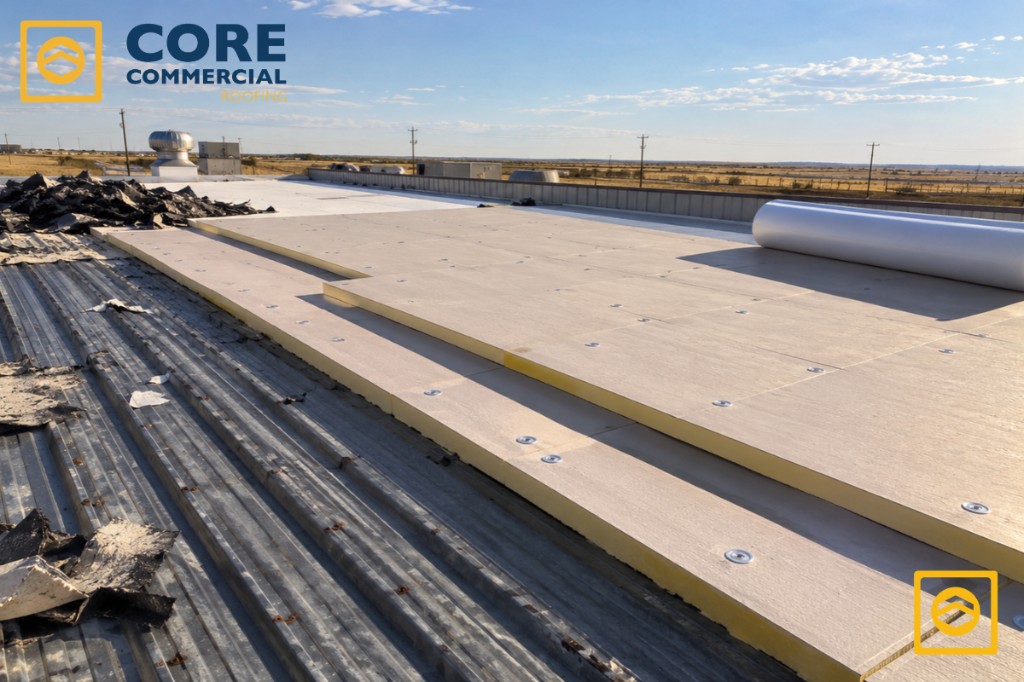
"Continuous insulation" (ci) means rigid board laid over the deck without framing breaking it up. Almost every low-slope roof under TPO, PVC, EPDM, modified bitumen, or built-up roofing falls into this category. The values come from Table C402.1.3 of the 2015 International Energy Conservation Code (IECC), the edition Texas enforces statewide.
The table has three roof rows. You need the row that matches how your roof is built.
| Climate zone | Example areas | Insulation entirely above deck | Metal building | Attic and other | Approx. polyiso thickness* |
|---|---|---|---|---|---|
| 2A | Houston, San Antonio, Austin | R-25ci | R-19 + R-11 LS | R-38 | 4.5 to 5 in. |
| 3A | Dallas, Fort Worth, Tyler | R-25ci | R-19 + R-11 LS | R-38 | 4.5 to 5 in. |
| 3B | Lubbock, Midland, Odessa, El Paso | R-25ci | R-19 + R-11 LS | R-38 | 4.5 to 5 in. |
| 4B | Amarillo, Hereford, Dumas, Plainview | R-30ci | R-19 + R-11 LS | R-38 | 5.5 to 6 in. |
The R-value table is the prescriptive path. The code also lets a designer comply on a U-factor basis or through whole-building energy modeling. Those paths help when the full R-value is hard to reach, but they require calculations submitted with the permit.
Which energy code applies to commercial buildings in Texas?
Texas enforces the 2015 IECC as its statewide commercial energy code. Cities can adopt a newer edition, so the code that governs your roof depends on where the building sits.
The Texas State Energy Conservation Office has kept the 2015 IECC in place for commercial construction since November 1, 2016. That includes multifamily buildings over three stories. A 2025 state law directed the office to begin updating the code, and the 2024 IECC is under review. Until a new rule takes effect, 2015 remains the statewide floor.
For roofs, the edition matters less than most owners fear. The above-deck R-values for Zones 2 through 4 are the same in the 2015 and 2021 editions. What changes between editions is mostly detailing: how layers go down, how tapered insulation is counted, and how air leakage is handled.
What code does Lubbock use?
Lubbock adopted the 2021 IECC in 2024. A low-slope commercial roof in Lubbock still needs R-25ci above the deck.
The 2021 edition adds two details worth knowing on a Lubbock reroof. Above-deck insulation goes down in at least two layers with staggered joints. Tapered systems are counted at their average thickness. Amarillo, Midland, Odessa, and other cities set their own adoption schedules, so ask the building department which edition your permit falls under before the bid is final.
What climate zone is my West Texas building in?
Lubbock, Midland, Odessa, and most of the South Plains sit in Climate Zone 3B. Amarillo and the northern Panhandle counties sit in Zone 4B, where the roof requirement rises to R-30ci.
Climate zones are assigned by county, and the line between Zone 3 and Zone 4 runs right through West Texas. On the 2015 IECC map, Potter, Randall, Deaf Smith, Moore, Hale, Hockley, Lamb, and Bailey counties all fall in Zone 4. That puts Plainview, Levelland, Hereford, Dumas, and Muleshoe in the R-30 group, even though some of them are less than an hour from Lubbock.
The letter after the number does not change the roof requirement. "B" means a dry climate. A 3B building and a 3A building need the same R-25ci above the deck.
Does a roof replacement have to meet the current R-value?
Yes, in most cases. A tear-off on a roof with insulation entirely above the deck must meet current code values, while a recover over the existing roof generally does not trigger the upgrade if the building's energy use does not increase.
The rule is Section C503.3.1 of the IECC. It applies when the existing roof is part of the building's thermal envelope and the insulation sits entirely above the deck. The International Code Council's technical staff explain the reasoning: adding insulation above the deck rarely requires structural changes, so the code treats the new roof like new construction.
A recover is different. Laying a new roof over the existing one does not expose the insulation, so the upgrade is not triggered. Building code still limits when a recover is allowed. You cannot recover over a water-soaked roof or over a roof that already has two layers.
Before you compare tear-off and recover bids, find out what is in the existing roof. A core cut shows the insulation type and thickness. An infrared thermal roof inspection shows where it is wet. Many older West Texas roofs carry far less than R-25, and some hold wet perlite or fiberboard that adds almost nothing. That answer often settles the commercial roof coating vs replacement decision before price enters the picture.
What if the extra insulation will not fit?
Rooftop units, door thresholds, and low parapets can limit how much insulation a roof can take. Get the building official's agreement in writing before you design around a lower R-value.
Going from an old R-10 assembly to R-25 can raise the roof surface by three inches or more. That height eats into curb flashing, through-wall flashing, door sills, and scupper openings. Raising a curb or rebuilding a threshold adds cost fast. It also creates new leak points if the work is rushed. Our guides to HVAC curb flashing leaks and parapet wall waterproofing cover what those details need.
Jurisdictions handle these limits differently. Some accept a reduced R-value where the full thickness would create a code problem elsewhere. Others require raised curbs or a U-factor calculation. Only the local building official can make that call.
How thick does polyiso need to be to hit R-25 or R-30?
Plan on roughly 4.5 to 5 inches of polyiso for R-25 and 5.5 to 6 inches for R-30. Those figures use conservative design values of R-5.0 to R-5.6 per inch rather than the higher number printed on the label.
Polyiso loses some insulating value in cold weather and on very hot roof surfaces, so size it by thickness at a realistic design value. Install it in at least two layers with staggered joints. A single layer leaves a straight gap at every board joint. Facers, cover boards, and hail protection are covered in our guide to polyiso roof insulation.
Does tapered insulation count toward the R-value?
Yes, but it is calculated differently. Under the 2021 IECC, tapered systems count at their average thickness and must be at least 1 inch thick at the low point. Under older editions, designers often show compliance with a U-factor calculation.
Tapered insulation does two jobs. It adds R-value, and it moves water to drains. On a flat roof that ponds, the tapered layer is often what brings the average R-value up to code at little extra cost. Poor slope design is behind many roof drainage failures during West Texas storms, so the taper plan deserves as much attention as the R-value.
What R-value does a metal building roof need?
Metal building roofs follow their own row in the code: R-19 plus R-11 with a liner system in Zones 2 through 4. A liner system is a continuous membrane installed below the purlins that holds unfaced insulation between them.
The common shortcut, batts draped over the purlins and compressed under the panels, loses much of its rated value at every purlin line. On a retrofit, owners have two main paths. One is an insulated liner system installed from inside. The other is a recover from above with rigid insulation and a new membrane, or spray foam over the existing panels. The right choice depends on the panel condition, the building's use, and whether the work counts as a recover or a replacement.
Is it worth going above the code minimum?
Often, yes. Most roofs get new insulation only once every 20 years or more, so the tear-off is the cheapest moment to add R-value.
At tear-off you are already paying for labor, disposal, and the new membrane. An extra inch of insulation adds material cost and little else. Each added inch saves less energy than the one before it, so the return flattens out. The sensible approach is to price the code minimum and one step above it, then compare the difference against your cooling and heating bills.
Panhandle buildings have the most to gain. Insulation works in both seasons. It cuts summer heat gain and winter heat loss without trading one against the other. The full picture of how insulation and surface reflectance work together is in our article on how a new roof can lower energy bills in Texas buildings.
Frequently asked questions
Does the building department check roof insulation on a reroof?
Where the energy code is enforced on reroofs, permit review and inspection can check insulation type and thickness. Keep the insulation delivery tickets and photos of each layer before the membrane goes down.
Does a cool roof replace insulation?
No. In Climate Zones 1 through 3, the IECC requires a reflective surface on most low-slope roofs over cooled space in addition to insulation, not instead of it. A white TPO roofing membrane typically meets that requirement.
Does spray foam count toward the R-value?
Yes. Roofing-grade spray foam applied above the deck counts as continuous insulation at roughly R-6 per inch. Our guide to spray foam roofing in Texas explains how thickness and coatings are specified.
Will the 2024 IECC change Texas roof R-values?
No new statewide commercial code is in effect yet, and any adopted edition will carry a delayed effective date. Until then, check which edition your city enforces and design to that.
Conclusion
The Texas code answer is simpler than it looks. Commercial roofs with insulation entirely above the deck need R-25ci in Climate Zones 2 and 3. Roofs in Zone 4 need R-30ci. Metal buildings and attic-style roofs follow their own rows in the same table.
Three questions decide what your roof actually needs. Which county is the building in? Which code edition does your city enforce? Is the job a tear-off or a recover? In West Texas, the climate zone line runs through the middle of the service area, so a building in Plainview and a building in Lubbock can face different requirements on the same day.
Start with what is on the roof now. A core cut and a moisture survey show the existing insulation, its condition, and how far it sits from code. With those facts in hand, you can compare bids on the same terms, plan for curb and flashing heights before they become change orders, and decide whether one step above the minimum is worth it for your building.