Yes, you can coat a TPO roof in Texas. It works when the membrane is aged but still sound, the insulation underneath is dry, and any hail damage has been documented and repaired first. Get one of those wrong and the coating fails early, usually within a few seasons.
Texas adds three problems that most coating guides skip. Summer heat runs past the temperature limits coatings are allowed to go down in. Hail fractures membranes without leaving an obvious hole. Flat roofs hold water. Each one changes the answer, so here is how to work through them before you sign a coating bid.
The short answer
- Coat it when the TPO is aged, flexible, and dry underneath.
- Use silicone on most Texas flat roofs, over a TPO-specific primer.
- Watch the window: application is limited to roughly 35°F to 100°F, so summer work happens in the morning.
- Document hail first. Coating over hail fractures can cost you the insurance claim.
- Do not coat over wet insulation, a brittle or shrinking membrane, or a roof that fails adhesion testing.
Can you coat a TPO roof?
Yes. A silicone coating over a TPO-specific primer is the standard way to restore an aging TPO roof, and it typically adds 10 to 20 years of service without a tear-off. The coating protects the membrane. It does not repair a membrane that has already failed.
TPO rarely wears out evenly. The field of the sheet usually holds up, while the heat-welded seams, flashings, and penetrations take the abuse. A fluid-applied coating covers all of those in one continuous layer, so the roof stops depending on hundreds of feet of seam welds to stay dry.
It also brings back the reflectivity the membrane loses over time. Years of Texas UV exposure leave TPO chalky and dull, and a fresh white coat resets the surface. That is why silicone roof coatings are the restoration we specify most often over TPO.
The timing matters. Coating pays off on a roof in the middle of its life, not one at the end of it. If you are unsure where yours stands, our breakdown of how long TPO lasts in Texas covers the wear signs worth checking.
Do you need a primer to coat TPO?
Yes. TPO has a slick, low-energy surface that coatings struggle to grip on their own, so manufacturers call for a TPO-specific primer before the silicone goes down. Skip it and you risk the coating releasing from the membrane.
The Duro-Last silicone coating installation guide is a good example of how strict this is. It requires its TPO primer at every warranty level, from 5 years to 20. The primer goes on thin, at about 900 square feet per gallon, and dries for 1 to 2 hours before the coating follows.
Every coating manufacturer has its own primer and its own rules. Use the primer specified for the coating you are buying. A primer from one brand under another brand's coating can put the material warranty at risk, even if the roof looks fine on day one.
Silicone or acrylic: which coating works on TPO in Texas?
Silicone, on most Texas flat roofs. Silicone tolerates ponding water, while acrylic breaks down under standing water and belongs only on roofs that drain reliably.
Most commercial TPO in West Texas sits on low-slope warehouses, retail centers, and plants. Those roofs almost always have a few low spots near drains or around rooftop units. Water that sits for days after a storm will soften and re-emulsify an acrylic coating. Silicone does not have that problem.
Silicone has its own tradeoff. It picks up dust, and our dust is relentless, so the surface dulls and needs an occasional wash to hold its reflectivity. Acrylic stays cleaner and costs less, which makes it a fair choice on a roof with real slope and clear drains.
One caution: a coating that handles ponding is not a fix for ponding. If water is sitting because a drain is clogged or undersized, solve that first. Our guide to commercial roof drainage failures explains where those problems start.
Can you coat TPO in Texas summer heat?
Yes, but only inside the manufacturer's temperature window. The Duro-Last installation guide limits its TPO primer and silicone coating to surface and air temperatures between 35°F and 100°F, and rules out application within 5°F of the dew point.
That upper limit is the one that bites in Texas. Afternoon air temperatures pass 100°F through much of the summer, and the roof surface runs hotter than the air. Summer coating becomes a morning job. The crew measures surface temperature on the roof itself instead of trusting the forecast, and stops when the reading climbs.
Mornings bring the opposite problem. Dew can sit on the membrane until the sun burns it off, and coating over a damp surface weakens the bond. The workable window is the stretch after the roof dries and before it overheats.
Wind is the third factor. The same guide warns that wind-blown overspray from airless sprayers can damage property next to the job. On a gusty High Plains afternoon, that means parked cars and neighboring buildings. On windy days, crews roll the coating or wait. In practice, spring and fall give the longest working windows of the year.
Can you coat a hail-damaged TPO roof?
Not until the damage is documented and the fractured membrane is repaired or replaced. A coating over hail fractures hides the evidence an insurance adjuster needs and can seal water into the roof.
Hail here is not a theoretical risk. The state's record hailstone, measured at 7.1 inches, fell near Vigo Park in Swisher County, between Lubbock and Amarillo, on June 2, 2024. A NOAA committee that included the National Weather Service office in Lubbock confirmed the new Texas hail record in 2026.
Hail rarely punches a clean hole in TPO. It cracks the membrane around the impact, crushes the insulation underneath, and stresses seams. From the ground, the roof looks fine. Coat over it and those fractures are buried under a fresh white surface, right when an adjuster needs to see them.
Our rule is simple: we do not coat or repair over undocumented hail damage. The order is inspect, photograph, probe, and file the claim if the damage supports one. Damaged sections are then repaired or replaced, and only after that does the coating go on. If your roof took a recent storm, start with hail and storm damage repair and a look at how commercial roof insurance claims work before anyone quotes a coating.
When is a TPO roof too far gone to coat?
When the insulation is wet, the membrane has gone brittle or is shrinking away from its flashings, seam failures run across the roof, or adhesion testing fails. Any one of those turns a coating into a short-term patch.
Wet insulation is the dealbreaker. The Duro-Last guide requires any wet insulation to be replaced before coating, and any torn, cracked, or buckled TPO to be repaired with like materials. It also spells out a field peel adhesion test. A strip of fabric is set into the coating on a primed test patch, left to cure, soaked, then pulled. A pull of 2 pounds per inch is the standard, and anything under 1 pound per inch is a fail.
You cannot see wet insulation from the surface. An infrared moisture survey maps it across the whole roof, and core cuts confirm it. Often the wet area is small enough to cut out and replace, and the rest of the roof still qualifies.
| What you find | Coat it | Repair, then coat | Replace |
|---|---|---|---|
| Membrane condition | Chalky but flexible | Isolated tears or punctures | Brittle, cracking, or shrinking |
| Insulation | Dry across the roof | Small, mapped wet areas | Wet across large sections |
| Seams | Intact welds | A few open seams | Failures across the roof |
| Hail | No damage found | Documented, localized fractures | Widespread fractures and crushed insulation |
| Adhesion test | 2 lb per inch or better | Passes after added prep | Under 1 lb per inch |
| Ponding | Minor, with silicone | Drains fixed first | Deck or slope needs rebuilding |
If the roof lands in the right-hand column, our guide to coating versus full replacement walks through the cost, tax, and lifespan tradeoffs.
How do you coat a TPO roof the right way?
Survey for moisture, repair the membrane with like TPO, clean it, prime it, reinforce the seams and penetrations, then apply silicone at the thickness the warranty requires. The coating itself is the last and shortest step.
- Inspect and survey. Walk the roof, scan for moisture, and pull cores to confirm what the scan shows. Run adhesion tests on primed patches while you are up there.
- Repair. Replace wet insulation, heat-weld TPO patches over tears and punctures, and rebuild failed flashings.
- Clean. Treat any growth, pressure-wash with the approved cleaner, rinse, and let the roof dry completely. Coating bonds to the membrane, not to the dirt on it.
- Prime and detail. Apply the TPO primer, then reinforce seams, curbs, drains, and pipe boots with sealant and fabric. Our guide to sealing roof penetrations covers the details that leak first.
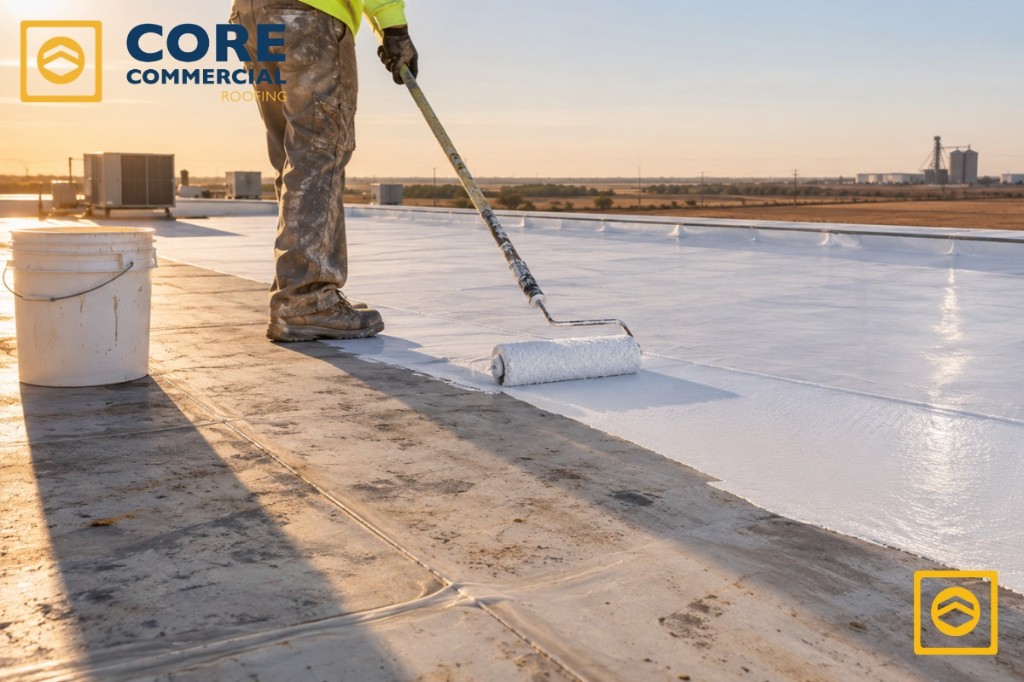
- Coat and verify. Apply the silicone at the specified thickness, checked with a wet mil gauge as it goes down. Where two coats are required, the second runs perpendicular to the first. Photograph everything and register the warranty.
What does coating TPO look like on a real Texas building?
At Shelby Cold Storage in Amarillo, we restored aging TPO across office, production, and refrigerated storage sections without shutting the plant down for a single day. Failed seams and punctures were repaired first, then silicone went over the repaired membrane.
Coating was the right call there for a reason that had nothing to do with price. A new mechanically fastened membrane over the production and refrigerated areas would have driven fasteners through the deck. Those fasteners would have created thermal bridges, threatened the vapor barrier, and dropped debris into active food-handling space.
The silicone restoration sealed the weathered TPO and added reflectivity while keeping a strict no-penetration rule over production. The full scope is in the TPO and silicone restoration in Amarillo case study.
How much does it cost to coat a TPO roof in Texas?
Most sound commercial roofs in our market run about $4 to $9 per square foot for a coating, compared with roughly $12 to $22 for a TPO tear-off and replacement, based on our August 2026 ranges. Prep, repairs, coating thickness, and access move the number.
The square-foot price is only half the comparison. Weigh cost per year of service. A coating that adds 15 years at a third of the replacement price is a strong deal. A coating over a roof that needs replacing in five years is not.
Read bids line by line. Two coating quotes can differ widely in repair allowance, primer, and dry mil thickness, and those differences decide how long the system lasts. Our commercial roofing cost guide breaks down what drives each number. Once the coating is down, a recoat at the end of its life costs less than the first application, so it is worth folding into your roof maintenance budget now.
Frequently asked questions
Will coating void my TPO warranty?
It can if the original membrane manufacturer has not approved the coating, so read your warranty terms before any work starts. A coating warranty covers the coating, not the membrane under it.
How long does a silicone coating last on TPO in West Texas?
Typically 10 to 20 years, depending on coating thickness, prep quality, and how much water sits on the roof. At the end of that cycle, it can be cleaned and recoated for less than the first application.
Can you coat a new TPO roof?
You can, but it rarely makes sense. A newer roof gets more value from routine maintenance and quick repairs, and coating starts to pay off once the membrane begins to age.
Can you recoat a TPO roof that was already coated?
Usually, once cleaning, repairs, and an adhesion test confirm the new coat will bond to the old one. Silicone is typically recoated with silicone, because little else sticks to it.
Find out if your TPO roof qualifies
Before you pay for a coating, get the moisture survey, adhesion tests, and hail check that prove the roof underneath can carry it. You get photographs, findings, and a straight answer on whether to coat, repair, or replace. Request a roof inspection or call (806) 404-1250.