Fully adhered TPO costs more up front but resists wind, hail, and billowing better because the membrane is bonded across its entire surface. Mechanically fastened TPO is the lower-cost, faster install, but it holds the sheet only at the seams. For most buildings, the right choice comes down to budget, deck type, and how much hail and wind the roof will see over its life.
Both methods use the same membrane. The difference is how that membrane stays on the roof, and that one decision affects cost, wind rating, hail resistance, energy performance, and warranty length. If you are still deciding on the material itself, start with what TPO roofing is and how it works, then come back here to choose the attachment.
What is the difference between fully adhered and mechanically fastened TPO?
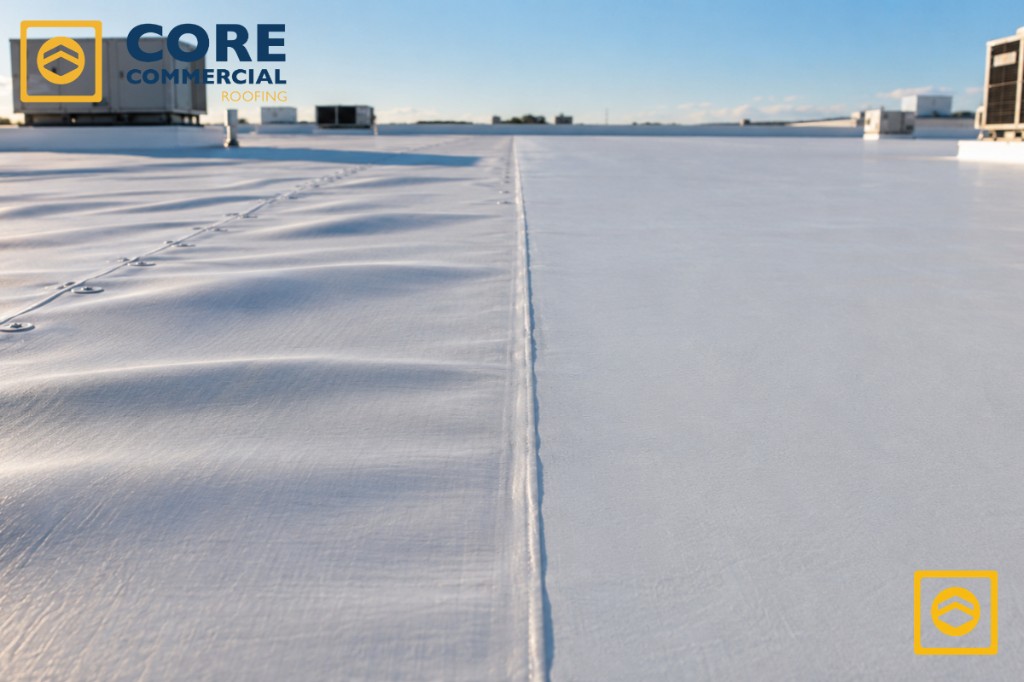
Mechanically fastened TPO is screwed through the insulation into the roof deck along each seam, and the next sheet is heat welded over the fasteners. Fully adhered TPO is glued to the insulation or cover board across its whole underside, so there are no fasteners through the membrane at all.
On a fastened roof, the fasteners and plates usually run in a row along the edge of each sheet, commonly about 12 inches apart. The overlapping sheet covers that row, and the seam is welded outside of it. Between those rows, the membrane is not attached to anything. It simply lies on the insulation.
On an adhered roof, the insulation is still secured first, either with its own fasteners and plates or with adhesive. The membrane then goes down in bonding adhesive. Fleece-back TPO, which has a felt-like backing, is often used for adhered work because the backing grips the adhesive well and adds some puncture resistance.
There is a third method, induction welding, where plates fasten the insulation and the membrane is bonded to the tops of those plates from above. It sits between the two main options and is worth asking about, but most bids you see will be one of the two systems covered here.
Which TPO attachment method costs less to install?
Mechanically fastened TPO costs less to install. It uses fewer materials, needs less labor per square, and goes down faster because there is no adhesive to roll out and wait on.
The premium for a fully adhered system comes from three places: the adhesive itself, the labor to apply it evenly, and the tighter weather window adhesives need. Fleece-back membrane also costs more than standard smooth-back sheet.
The lower install price is real, but it is not the whole number. A fastened roof can need extra insulation to make up for heat loss through the fasteners, an added air barrier to meet energy code, and more fastener rows at the corners and edges to reach the wind rating your building needs. Once those are in the bid, the gap between the two systems gets smaller. When you compare quotes, compare the full assembly, not the membrane line.
Which TPO attachment method handles high wind better?
Fully adhered TPO handles high wind better because the wind's pull is spread evenly across the entire sheet. A mechanically fastened sheet carries all of that pull at the seam fasteners, so its rating depends on fastener spacing and on how well the deck holds those screws.
Wind does not push down on a flat roof. It pulls up, and that pull is strongest at the corners and along the edges. On a fastened roof, the fix is to add more fastener rows or tighten the spacing in those zones. That works, but it puts concentrated loads on the deck, and older or lighter decks sometimes need an engineer to confirm they can take it.
Uplift ratings like FM 1-60 and 1-90 refer to pressure, not wind speed. Under the FM approval process, wind uplift ratings carry a 2:1 safety factor, so a 1-60 assembly is approved for up to 30 pounds per square foot of field uplift. Fastened and adhered systems are also tested on different frame sizes, so the rating belongs to the exact assembly that was tested, not to the membrane alone.
Both systems can reach high ratings when they are designed correctly. Adhered systems just get there with fewer weak points. For a deeper look at how ratings are calculated and specified, read our guide to wind uplift ratings for commercial roofs.
Why does mechanically fastened TPO billow in the wind?
Mechanically fastened TPO billows because the membrane is attached only at the seams, so wind and air pressure from inside the building can lift the open field between fastener rows. That repeated lifting and dropping is normal to a degree, but over years it stresses seams, fasteners, and the insulation underneath.
If you have ever stood on a fastened roof on a windy day, you have seen it. The sheet rises in long ridges between the seams and slaps back down when the gust passes. Building owners sometimes hear it from inside as a low flapping sound.
Billowing does more than make noise. Each time the membrane lifts, it can draw warm, humid indoor air up through gaps in the deck and into the insulation. In cold weather, that moisture can condense on the underside of the membrane, wet the insulation, and lower its R-value. A fastened membrane also does not count as an air barrier under current energy codes, so a separate air barrier is usually needed below the insulation. An adhered membrane does count as one.
When we see heavy billowing on an older fastened roof, we look for wet insulation before anything else. An infrared roof inspection is the fastest way to find it without cutting the roof open in a dozen places.
Does hail damage mechanically fastened TPO more than adhered TPO?
Yes, mechanically fastened TPO is more exposed to hail damage because hailstones can drive the membrane down onto the metal fastener plates and cut or bruise it there. Adhered systems bury the fasteners under a cover board, so the membrane sits on a smooth, firm surface instead.
On a fastened roof, the plates sit right under the seam. A large stone that lands on that line hits membrane, then metal, with nothing to absorb the blow. The rest of the roof sits over insulation, which can crush and leave the membrane unsupported. Both are common hail failure points.
FM Approvals rates roof assemblies for hail in three classes: Moderate, Severe, and Very Severe. The Very Severe Hail test uses 2-inch ice balls, which FM equates to hailstones up to 2.5 inches, and it tests samples after UV weathering and 42 days of heat aging so the rating reflects an older roof, not a new one.
Most hail-rated TPO assemblies follow a hybrid pattern. The first layer of insulation is fastened to the deck, a high-density cover board goes on top, and fleece-back TPO is adhered to that board. The fasteners are still there, but they are buried two layers down where hail cannot reach them. If your building sits in a hail-prone area, this is the assembly to ask for. Our guide to FM Global approved roofing explains how to check that an assembly actually carries the rating your insurer expects.
Fully adhered vs mechanically fastened TPO at a glance
| Factor | Mechanically Fastened TPO | Fully Adhered TPO |
|---|---|---|
| Install cost | Lower | Higher (adhesive, labor, often fleece-back sheet) |
| Install speed | Faster | Slower, weather dependent |
| Wind uplift | Good, depends on fastener spacing and deck | Excellent, load spread across the sheet |
| Hail resistance | Weaker at fastener plates | Stronger, especially over a cover board |
| Billowing | Yes, between seams | None |
| Counts as air barrier | No | Yes |
| Cold-weather install | Possible at low temperatures | Limited by adhesive temperature range |
| Warranty terms | Standard | Often longer |
| Best fit | Large, simple roofs on steel deck with a tight budget | Hail and wind exposure, concrete decks, long ownership |
Does fully adhered TPO get a longer warranty?
In most cases, yes. Manufacturers usually offer longer warranty terms on fully adhered systems, and longer still when the adhered system uses a thicker membrane and a cover board.
The reason is simple. Manufacturers pay warranty claims, and adhered roofs give them fewer claims from wind, billowing, and hail at the fasteners. A 60-mil fastened roof and an 80-mil fleece-back adhered roof from the same manufacturer can sit at very different warranty tiers.
Read the hail language closely. Some manufacturer hail coverage applies only when the membrane is adhered over an approved cover board, and a fastened system may not qualify at all. Thickness and attachment together also shape how long a TPO roof lasts in real service, which matters more than the number on the warranty certificate.
Can fully adhered TPO be installed in cold weather?
Yes, but with limits. Standard bonding adhesives need about 40°F and rising, while newer low-temperature adhesives can be applied down to roughly 20°F.
Below those temperatures, adhesive does not cure properly and the bond can fail later. That is why adhered projects in winter can slip a few days while crews wait for a warm enough window. Mechanically fastened systems are much less sensitive to temperature, which is one reason they are popular for fast-track or winter work.
Adhesive odor is the other scheduling question. Solvent-based adhesives can draw fumes into rooftop air intakes on an occupied building. Low-VOC and water-based options solve most of that, so ask which adhesive is in the bid if your building will stay open during the work.
Which TPO attachment method is right for your building?
Choose fully adhered TPO if your roof sees regular hail or high wind, sits on a concrete deck, or covers a building you plan to own long term. Choose mechanically fastened TPO when the roof is large and simple, the deck is steel, the budget is tight, and hail exposure is low.
- Warehouses and distribution buildings: Fastened TPO is a sound budget option on wide, open steel decks. If hail is a real risk, a hybrid system with an adhered top layer is worth the added cost.
- Retail and offices: Adhered TPO is usually the better fit. There is no billowing noise inside, it helps the building meet air barrier requirements, and it tends to carry a stronger warranty.
- Concrete decks: Adhered is the practical choice. Drilling fasteners into concrete is slow and expensive.
- Buildings with heavy rooftop traffic: Adhered over a cover board holds up better to foot traffic and equipment carts around HVAC units.
- Short ownership or interim roofs: Fastened TPO keeps the upfront spend down when you do not expect to hold the building for the full life of the roof.
Energy performance belongs in this decision too. Fasteners pass heat through the insulation layer, and an adhered membrane over adhered upper layers cuts that loss. If you are adding or replacing insulation as part of the job, check the roof insulation R-value the assembly will actually deliver, not just the rating printed on the board. For the full list of TPO strengths and weak spots beyond attachment, see our breakdown of TPO roofing pros and cons.
Frequently asked questions
How can I tell if my TPO roof is fully adhered or mechanically fastened?
Walk the roof on a windy day and look for long raised ridges between the seams, which point to a fastened system. You can also press along a seam and feel for the bumps of fastener plates, or check the original warranty paperwork, which names the system type.
Can a roof use both mechanically fastened and adhered methods?
Yes, and many of the best-performing assemblies do. The bottom insulation layer is fastened to the deck, and the cover board and membrane are adhered on top, which keeps fasteners out of reach of hail and cuts heat loss.
Can new TPO be installed over an existing roof?
Often it can, as long as the existing roof is dry, there is only one roof layer in place, and the deck is sound. Wet insulation must come out first, because sealing it under a new membrane traps the moisture and shortens the new roof's life.
Is fully adhered TPO worth the extra cost?
For buildings exposed to hail or high wind, or owned for the long term, it usually is. On a large, low-risk roof with a short planning horizon, a well-designed fastened system can be the smarter spend.
Does fully adhered TPO last longer than mechanically fastened TPO?
With the same membrane thickness and good workmanship, an adhered roof often stays in service longer because it avoids billowing wear and hail damage at the fasteners. A fastened roof that is well maintained and not exposed to severe weather can still reach a long service life.
Is fully adhered TPO harder to repair?
No, routine repairs are about the same on both systems, because a TPO patch is heat welded to the membrane surface either way. The difference shows up at tear-off, when an adhered membrane takes more labor to remove than a fastened one.
Does the attachment method affect my insurance?
It can, because insurers look at the wind and hail rating of the full roof assembly, and attachment method is part of that rating. If your policy or lender requires a specific FM rating, confirm the exact assembly before you sign a bid.
What is induction-welded TPO, and is it a middle option?
Induction-welded TPO uses plates that fasten the insulation, and the membrane is bonded to the tops of those plates with an induction tool, so no fasteners pass through the sheet. It reduces billowing and exposed fasteners compared to a seam-fastened roof, though it does not spread the load as evenly as a fully adhered system.
Does fastener spacing matter on a mechanically fastened roof?
Yes, spacing is what sets the wind rating of a fastened system, and corners and edges need tighter spacing or extra rows than the middle of the roof. A roof fastened at one spacing all the way across is under-secured exactly where wind pull is strongest.
Conclusion
Fully adhered and mechanically fastened TPO use the same membrane, but they behave like two different roofs. Fastened TPO wins on install price and speed. Adhered TPO wins on wind resistance, hail resistance, energy performance, and warranty, and it removes billowing entirely.
If your roof faces regular hail or strong wind, sits on concrete, or covers a building you plan to keep, an adhered or hybrid system is usually the better long-term value. If the roof is large and simple, the deck is steel, and the budget is fixed, a properly engineered fastened system is a sound choice. Either way, judge the bid on the full assembly and its tested rating, not on the membrane line alone.
Fastened TPO saves money on day one, and adhered TPO usually saves money over the life of the roof. If you want help comparing bids or checking which system is already on your building, request a roof inspection and we will walk the roof with you.