Energy costs are one of the largest ongoing expenses for any business, and the roof over your building has more to do with that number than most owners realize. A dark, under-insulated, or aging roof pushes your HVAC system harder every summer afternoon, and in West Texas those afternoons run long.
The good news is that most of this is fixable without a full tear-off. Reflective commercial roof coatings remain the fastest route to measurable savings, because they extend roof life and cut heat gain at the same time. Pair one with better insulation, a membrane suited to the climate, and honest maintenance, and you end up with a roof working for the building instead of against it.
Here are eight upgrades worth considering, what each one actually does, and which ones make sense on a low-slope roof in Lubbock, Amarillo, or anywhere else across the South Plains.
Table of Contents
Why does your commercial roof matter so much to your energy bill?
Your roof is the largest surface your building presents to the sun, which makes it the biggest single source of heat gain in summer and heat loss in winter. Fix it and your HVAC system stops fighting a losing battle every afternoon.
The numbers behind that are less abstract than they sound. The U.S. Department of Energy notes that conventional roofs can reach 150°F or more on a sunny summer afternoon. That heat does not stay on the roof. It works its way down through the deck and into the space below, and your air conditioning pays for every degree of it.
Efficiency upgrades target that problem directly instead of waiting for damage to appear. Most commercial roof assemblies can be retrofitted with coatings, added insulation, or solar without a full replacement, which means the work is usually scoped around your operations rather than the other way around. Preventive work also overlaps almost completely with the steps that prevent roof leaks in a Texas commercial building, so you are rarely paying for one benefit alone.
There is a budgeting argument too. A building that uses less energy is a building whose costs you can forecast, which matters more every year that utility rates move.
Do reflective roof coatings actually lower cooling costs?
Yes, and they do it faster than anything else on this list. A reflective coating drops the roof surface temperature, which reduces the heat pushed into the building and eases the load on your air conditioning.
According to the Department of Energy’s cool roof guidance, a reflective roof can stay more than 50°F cooler than a conventional one under the same summer conditions, and white roofing products reflect roughly 60 to 90 percent of sunlight. Silicone, acrylic, and elastomeric coatings all get you there, with silicone generally holding up best on roofs that hold water after a storm.
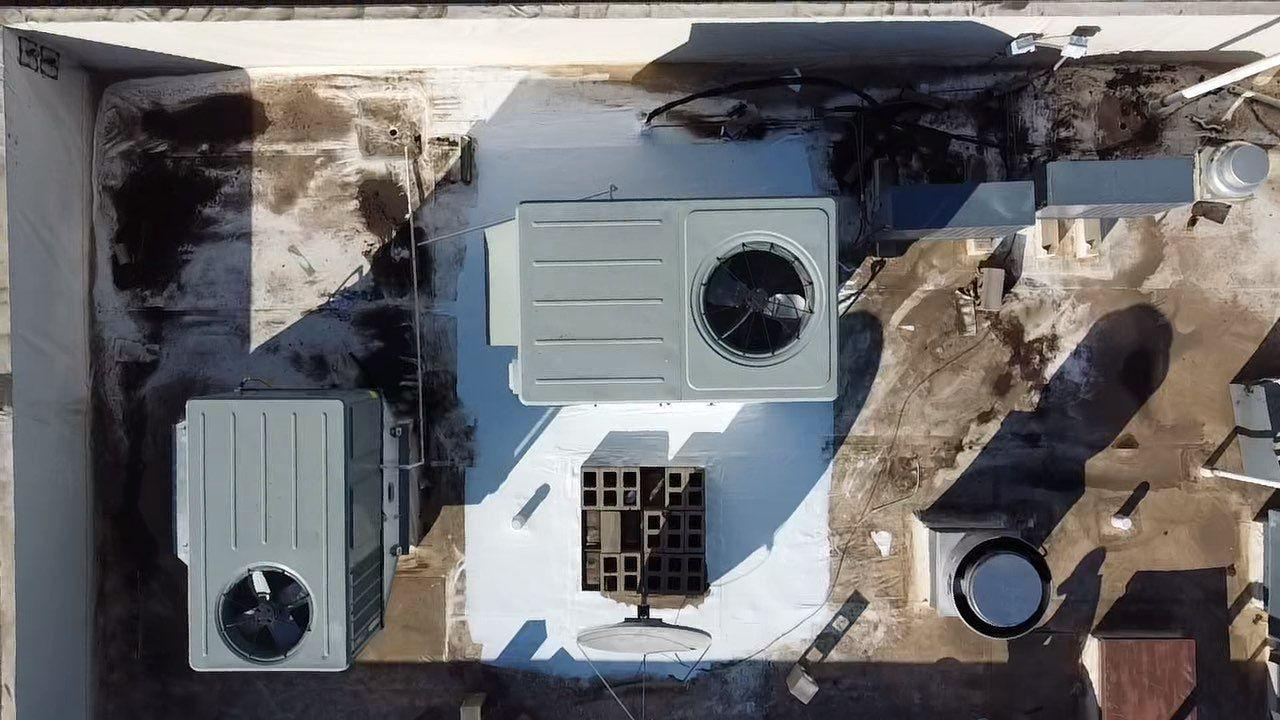
This is work we do constantly. On Project 1058, an aging PVC roof already carrying two layers, a tear-off would have been expensive and disruptive. The building owner restored it with a silicone coating instead and came out of it with a 15-year manufacturer no-leak warranty on a roof that had reached the end of its original service life.
What a coating gets you:
- Lower cooling costs through the summer
- A cooler roof surface, which means less thermal stress on the membrane below
- Added service life without the downtime of a replacement
- Eligibility for utility or local rebate programs in some service areas
- Far less disruption than a tear-off, since most of the work happens above your operations
Two honest caveats. First, a coating is only as good as the roof under it, so a saturated or failing assembly needs repair before anything gets sprayed. Second, DOE notes that converting a roof that is still in good condition into a cool roof can be expensive, which is why coatings usually make the most sense on a roof in the back half of its life. If you are weighing chemistries, the advantages of silicone roof coatings and the broader roof coating options that extend a roof’s lifespan are both worth reading before you commit.
Which commercial roofing materials are the most energy efficient?
Single-ply membranes like TPO and PVC, along with factory-coated metal, outperform dark asphalt and tar because they reflect more sunlight and hold less heat. The gain is largest when you are already replacing the roof anyway.
Older built-up and modified bitumen systems were built to shed water, not sunlight, and they absorb heat accordingly. Modern membranes are engineered for both. Our comparison of roofing materials for Texas commercial buildings lays out the pros and cons side by side. If you are choosing between the two most common options here, our breakdown of TPO vs EPDM roofing for Texas commercial properties covers where each one earns its place, and the full guide to what TPO roofing is explains why it has become the default on West Texas low-slope buildings.

Material choice does more than reflect sunlight:
- Better reflectivity paired with the insulation package underneath it
- Assemblies that can often go over an existing roof, cutting disposal costs
- Lower routine maintenance than aging built-up systems
- Recyclable options, metal in particular, at end of life
- A documented, warrantied roof that holds up during a building sale
One thing to check rather than assume: fire and impact ratings sometimes affect insurance, but that depends entirely on your carrier and your assembly, so ask before you build it into the math. On cost, DOE points out that cool roofing products usually cost no more than comparable conventional products when you are already replacing a roof. If you are budgeting a full replacement, our breakdown of commercial roof replacement cost per square foot in Texas gives you real ranges to plan against.
How much roof insulation does a West Texas commercial building need?
Enough that the coating above it is not doing all the work. Insulation is what actually slows heat flow, and the right R-value depends on where your building sits, because Lubbock and Amarillo do not fall in the same climate zone.
Polyisocyanurate is the workhorse on commercial low-slope roofs, with EPS and spray foam filling specific roles. What matters more than the brand is whether the existing insulation is still doing its job. Wet, compressed, or settled insulation loses R-value permanently, and no amount of reflectivity on top will make up for it.
Tapered insulation deserves a mention on its own. It solves drainage and thermal performance in the same layer, which is why it shows up on so many West Texas re-roofs where ponding water was the original complaint. If your roof holds water for more than a couple of days after a storm, insulation is part of that conversation, not an afterthought.
What a proper insulation package buys you:
- Lower bills in both directions, summer cooling and winter heating
- More stable indoor temperatures across the building footprint
- Less strain on HVAC equipment that is already working hard
- Drainage improvement when the package is tapered
Insulation upgrades are usually cheapest when bundled into other work, which is one reason a commercial re-roof can extend your roof’s lifespan further than most owners expect.
Does roof ventilation improve energy efficiency on a flat roof?
On a low-slope commercial roof, ventilation matters less for cooling than it does for keeping moisture out of the assembly. Wet insulation loses R-value, and once that happens, nothing above it can compensate.
This is where a lot of general roofing advice goes sideways. Attic ventilation logic from residential roofing does not transfer cleanly to a commercial deck with no attic. What you are managing instead is vapor drive and condensation inside the assembly, plus heat buildup under equipment curbs and in dead air spaces.
Get it right and you avoid:
- Condensation forming inside the roof assembly where you cannot see it
- Mold and mildew problems that surface as indoor air quality complaints
- Insulation quietly losing performance year over year
- HVAC equipment compensating for a problem nobody has diagnosed
Ventilation and insulation are a single system, not two line items. Balance them and the roof holds its performance for years.
Are light-colored roof surfaces worth it on a commercial building?
In a cooling-dominated climate like West Texas, yes. Light surfaces reflect substantially more sunlight than dark ones, and the difference is large enough to change how hard your air conditioning works in July.
Just as wearing a black shirt on a sunny day makes you hotter, a dark roof absorbs more heat. DOE puts white roofing products at roughly 60 to 90 percent solar reflectance, while cool-colored products, which use pigments that reflect invisible near-infrared light, land closer to 30 to 60 percent. That gives you options if a stark white roof is not what you want visible from the parking lot.
The benefits stack up:
- Lower cooling costs through the hottest months
- Easier compliance with local energy code requirements
- A cleaner, more current look on visible roof areas
- Less thermal expansion and contraction, which is what opens up cracks and seams
Worth knowing before you commit: DOE also flags a winter heating penalty, since a roof reflecting sunlight in July is still reflecting it in January. In West Texas the cooling season dominates, so the trade usually lands in your favor, but it is a real consideration and not every contractor mentions it. If you want to compare products on measured performance rather than marketing, the Cool Roof Rating Council publishes solar reflectance and thermal emittance figures for thousands of roofing products.
Do green roofs make sense in West Texas?
Usually not. Green roofs earn their keep in wet, dense urban settings, and West Texas is neither, so the irrigation demand and structural load rarely pencil out here.
We are including this one because it appears on every energy-efficiency list, and building owners deserve a straight answer rather than a recycled one. DOE is direct about the trade-offs: green roofs are considerably heavier and more expensive to build and maintain than non-vegetated roofs, the structure has to be able to carry the additional load, and because the waterproofing membrane sits beneath the soil and plants, leaks are much harder to find and much more difficult to repair.
Now add the local reality. Vegetation on a Lubbock or Amarillo rooftop needs irrigation in a semi-arid climate drawing on a declining aquifer, and it has to survive wind and hail that punish anything saturated and heavy. That is a lot of ongoing cost and risk for a thermal benefit you can get another way.
What we recommend instead: a reflective surface over a properly specified insulation package delivers most of the thermal payoff at a fraction of the cost, with none of the structural or leak-detection risk. If you genuinely want a green roof for stormwater management or tenant amenity value, it can be done well here, but start with a structural engineer rather than a roofer.
Is solar worth it on a commercial flat roof?
A flat roof is good real estate for solar, with the open space and sun exposure that panels want. The catch is sequencing: the array should never outlive the roof underneath it.
First, a correction worth making. Solar shingles are a residential steep-slope product and are not what goes on a commercial low-slope roof. What you will actually be quoted is a ballasted racking system that sits on the membrane without penetrating it, or a mechanically attached or adhered system where every penetration becomes a detail somebody has to flash correctly.
That leads to the single most expensive mistake in commercial solar: mounting a 25-year array on a membrane with eight years left. When that roof fails, the array comes off, the roof gets replaced, and the array goes back on, and you pay for all three. Coat or replace the roof first, then add solar to a surface with life ahead of it.
Handled in the right order, solar delivers:
- Meaningful reduction in grid electricity costs
- Potential to sell excess generation back, depending on your utility
- Support for corporate sustainability commitments that tenants increasingly ask about
- Added property value on a building you plan to hold or sell
Two details to nail down in writing before signing: who carries responsibility for roof penetrations, and what the array does to your roofing warranty. That second question matters more than most owners expect, particularly at resale, which is why it is worth understanding whether roofing warranties transfer to new owners before the panels go up.
How do maintenance and infrared scans protect your energy savings?
Every upgrade above assumes the roof is dry. Infrared scanning finds wet insulation and trapped moisture before it spreads, which is often the difference between a targeted repair and a full replacement.
The physics are straightforward. Wet insulation holds heat differently than dry insulation, so after sunset a thermal camera shows saturated areas glowing against the cooler roof around them. You can map the wet area, cut out only what is compromised, and leave the rest of the roof intact.
Consistent maintenance protects everything you have spent:
- Catches water damage while it is still a repair and not a re-roof
- Confirms coatings and insulation are still performing as specified
- Extends the service life you paid for
- Gives you documentation that holds up in an insurance claim or energy audit
Inspect at least twice a year and after any major weather event, which in this part of Texas usually means after hail. Our roof inspection checklist covers what to look for, and a comprehensive roof report gives you the documented condition assessment that budgeting decisions should be built on. When something does turn up, catching it early keeps it in commercial roof repair territory rather than replacement.
What federal tax incentives are still available in 2026?
Considerably fewer than a year ago, and this is the part of most energy-efficiency articles that is now out of date. The 179D deduction no longer applies to property whose construction begins after June 30, 2026, so that window has closed for new projects.
Here is what changed. The One Big Beautiful Bill Act, enacted July 4, 2025, added a termination provision to the 179D energy efficient commercial buildings deduction. Building envelope, HVAC, interior lighting, and service water heating property all previously qualified, with a minimum 25 percent energy savings threshold. For the 2025 taxable year the deduction ran from $0.58 to $1.16 per square foot, rising to between $2.90 and $5.81 per square foot for projects meeting prevailing wage and apprenticeship requirements. On a 100,000 square foot warehouse, that was real money.
If your project broke ground on or before June 30, 2026, you may still be eligible and should talk to your CPA promptly. If you are planning a project now, build your numbers without it.
What has not disappeared: utility rebate programs and local incentives operate separately from the federal deduction, and DOE lists qualifying for utility or government rebates among the standard benefits of a cool roof. Those vary by provider and service area, so check yours specifically rather than assuming. None of this is tax advice, and the rules here are genuinely technical, so bring your accountant in before you plan around any of it.
Which roof upgrade should you do first?
Start with whatever protects the roof you already own, then move to what reduces heat gain, then to what generates power. Taken in that order, each step protects the investment in the one before it.
| Upgrade | What it changes | Retrofit or replacement | Fit for a West Texas low-slope roof |
|---|---|---|---|
| Reflective coating | Surface temperature and membrane life | Retrofit | Strong, best on a sound roof in the back half of its life |
| Membrane replacement | Reflectivity plus the whole assembly | Replacement | Strong, when the existing roof is at end of life |
| Added or tapered insulation | Heat flow and drainage | Usually with a re-roof | Strong, especially where ponding is a complaint |
| Ventilation and moisture control | Assembly moisture, not cooling load | Either | Situational, driven by the assembly |
| Light-colored surface | Solar reflectance | Either | Strong, cooling season dominates here |
| Green roof | Insulation and stormwater | Replacement, with structural review | Weak, water demand and load rarely justify it |
| Solar array | Generates power | Retrofit, onto a roof with life left | Strong, but only after the roof is sorted |
| Maintenance and IR scanning | Protects everything above | Ongoing | Essential regardless of the rest |
Final thoughts on energy-efficient roof upgrades
Investing in energy-efficient roof upgrades is about more than lowering bills. It is about protecting the building, extending the life of the roof, and creating a space people can actually work in through a West Texas August.
The sequencing matters more than the shopping list. A coating on a wet roof buys you nothing. A solar array on a dying membrane costs you twice. Insulation under a roof that ponds water gets ruined. Sort out condition first, then reflectivity, then generation, and every dollar does the job you paid it to do.
If you are working through a replacement budget, our cost-saving tips for commercial re-roofing in Texas pair well with everything above, and a commercial re-roof is often where several of these upgrades get bundled into one mobilization. If you would rather start with a straight assessment of where your roof stands today, get in touch and we will come look at it.
FAQs
What is the best cool roof coating for flat roofs?
Silicone and elastomeric coatings both perform well on flat commercial roofs, with silicone generally holding up better where water sits after a storm. Both reflect sunlight, reduce heat absorption, and add UV protection that extends the membrane’s service life, as our silicone roof coating project shows in practice.
Which insulation is best for commercial flat roofs?
Polyisocyanurate is the most common choice on commercial low-slope roofs, with EPS used in specific assemblies. The more useful question is whether your existing insulation is still dry, since wet or compressed insulation has already lost the R-value you are paying to maintain.
How does roof ventilation improve energy efficiency on a commercial building?
On a commercial roof, ventilation mainly protects the assembly from condensation and trapped moisture rather than cooling the building directly. Keeping the insulation dry is what preserves its performance, and that is where the energy savings actually come from.
Are white roofs better for commercial buildings?
In cooling-dominated climates like West Texas, yes. White and light-colored surfaces reflect substantially more sunlight than dark ones, lowering roof temperature and air conditioning load, though they do carry a small winter heating penalty worth understanding before you decide.
Are green roofs a good idea for businesses in West Texas?
Rarely. Green roofs need irrigation, structural capacity for the added load, and a membrane that is much harder to inspect and repair once it is buried under soil, none of which suits a semi-arid climate with hail. A reflective surface over good insulation delivers most of the thermal benefit without those trade-offs.
Is installing solar panels on a flat roof effective?
Flat roofs offer excellent space and sun exposure for solar. The critical step is confirming the roof has enough service life left to outlast the array, because removing and reinstalling panels for a roof replacement erases the savings.
How often should commercial roofs be inspected?
Twice a year at minimum, plus after any significant storm or hail event. Regular inspection catches small problems while they are still repairs, and keeps your efficiency upgrades performing the way they were specified.
Can infrared scans detect roof energy losses?
Yes. Infrared thermography identifies wet insulation and moisture intrusion by reading temperature differences across the roof surface, usually after sunset. It lets you replace only the compromised sections instead of guessing or replacing the entire roof.