Ask this question in Houston and you get one answer. Ask it in Lubbock and the honest answer is different, because the roof loads are different. Most of the guidance published on modified bitumen in Texas is written for the Gulf Coast, where the problem is sustained heat and humidity. On the Caprock and across the Panhandle, heat is only half the problem.
Table of Contents
Which performs better in Texas heat, SBS or APP?
APP handles sustained high heat better than SBS because it has a meaningfully higher softening point. In West Texas that advantage matters less than it sounds, because our membranes are stressed more by daily temperature swing and hard winter freezes than by peak summer temperature alone.
The two materials are the same base asphalt with different polymers blended in. APP is atactic polypropylene, a plastomer, which makes the finished sheet stiffer and more resistant to flow when it gets hot. SBS is styrene butadiene styrene, an elastomer, which makes the sheet behave more like rubber. It stretches under stress and returns to shape.
That single difference drives everything else. APP resists softening, foot traffic, and ultraviolet exposure. SBS resists cracking and splitting when the deck moves. Neither one is better in the abstract. The right question is which failure mode your building is more likely to see, and in this part of Texas that answer is not automatically the heat one.
If you are still deciding on a system rather than a modifier, our overview of types of commercial roofing systems covers where modified bitumen sits against the alternatives.
What is the actual softening point difference between SBS and APP?
APP modified compound typically softens above roughly 150 degrees Celsius, while conventional SBS modified compound softens near 120 degrees Celsius. Softer SBS compounds can begin to flow above 110 degrees Celsius, which is where the heat argument against SBS originates.
Those figures come from a US patent filed by a modified bitumen manufacturer, Polyglass USA, covering self adhering underlayment products. They are industry stated numbers rather than independent laboratory results, so treat them as a reasonable order of magnitude rather than a spec you can hold a supplier to. What matters is the gap. Roughly 30 degrees Celsius separates the two compounds, and the SBS number sits lower than most building owners assume.
Almost nobody publishes those numbers. Every competing guide says APP has a “higher softening point” and stops there, which leaves the reader unable to do the one calculation that actually settles the argument.
How hot does a commercial roof actually get in Lubbock or Amarillo?
A dark low slope membrane can reach 150 degrees Fahrenheit or more on a clear summer afternoon. That is roughly 66 degrees Celsius, which sits well below the softening point of either polymer, including the softer SBS compounds.
The US Department of Energy publishes that 150 degree figure in its cool roofs guidance, along with the finding that a reflective surface can run more than 50 degrees Fahrenheit cooler under the same conditions. Convert 150 degrees Fahrenheit and you get a surface temperature with a comfortable margin below the 110 degree Celsius threshold where softer SBS compounds start to move.
This is the part the Gulf Coast framing gets wrong. The heat argument is real at the material level, but on a properly built West Texas roof, neither membrane is sitting anywhere near its softening point on a normal August afternoon. Where heat does become the deciding factor is on unusual assemblies, dark unsurfaced membranes with no granule cap, and roofs over metal decks that trap and re-radiate heat into the underside of the sheet.
If you want to know what your own roof is actually running, an infrared thermal roof inspection will tell you far more than a general temperature figure will.
Why does the Gulf Coast answer not work in West Texas?
Lubbock records more heating degree days than cooling degree days, so a membrane specified purely for heat resistance is being optimized for the smaller half of the problem. The Panhandle is a cold weather roofing market that happens to get hot in July.
The 1991 to 2020 climate normals published by the National Weather Service in Lubbock put the city at 3,243 heating degree days against 1,950 cooling degree days. Daily normal high is 75.0 degrees Fahrenheit, daily normal low is 47.9 degrees, and the station sits at 3,254 feet of elevation. That is a heating load closer to Kansas than to Houston.
Two numbers in there matter more than the rest. The first is the roughly 27 degree gap between daily high and daily low, which is the thermal cycling load. Every day of the year, a membrane on a Lubbock or Amarillo roof expands and contracts through that swing. Elevation makes it worse, because thin dry air at 3,254 feet sheds heat fast after sundown and lets surfaces overshoot in both directions.
The second is the heating degree day total. Roofs here freeze, and they freeze hard. Low temperature flexibility is not a nice to have on the Caprock, it is the property that keeps a membrane from splitting in February. That is the property SBS is built to deliver and APP is not.
Buildings across Lubbock, Amarillo, Midland-Odessa, and Abilene all sit in this same trap. The published advice tells owners to spec for a heat problem their membrane is already comfortably surviving, while ignoring the freeze that actually opens the seams. For a broader look at how local conditions should drive material choice, see our breakdown of roofing materials for Texas commercial buildings.
What does field data show about SBS and APP failures in Texas?
A NIST field study of 53 modified bitumen roofs, 11 of them in Dallas, found that every documented case of membrane slippage involved SBS sheets set in hot asphalt in warm climates. Unsurfaced APP membranes in the same study showed extensive surface cracking by about year eight.
The study, Observations From a Field Study of the Performance of Polymer-Modified Bitumen Roofing, inspected 27 APP and 26 SBS roofs ranging from two to eleven years old. Seven roofs showed slippage, meaning plies sliding down the slope and exposing what sits beneath. All seven were SBS with base plies installed in conventional roofing asphalt, all in the warm climates of Dallas and Jacksonville, on slopes around half an inch per foot.
Read that carefully, because it is not an argument against SBS. It is an argument against SBS installed in hot mopped asphalt with the wrong viscosity, on slope, without strapping or mechanical attachment. The same study noted a building wing where the membrane was installed in strap fashion, and slippage did not occur there. The failure was in method, not modifier.
The APP finding cuts the other way. Two unsurfaced APP roofs at about eight years old showed cracking that resembled the alligatoring you see on weathered built up asphalt. The cracks extended into the membrane. Coated APP roofs and granule surfaced sheets in the same study held up considerably better, which tells you the cap sheet is doing more work than the polymer underneath it.
Slope, drainage, and attachment method drove more of these outcomes than material chemistry did. If you are unsure how water actually leaves your building, start with where the roof drains before you argue about polymers.
Which one should a West Texas building owner spec?
For most West Texas commercial buildings the deciding factor is not the polymer, it is the attachment method, the cap sheet, and the tested low temperature flexibility on the submittal. Between the two, SBS is the safer default here because our freeze exposure is larger than our softening risk.
| SBS | APP | |
| Typical softening point | Around 120°C, softer compounds flow above 110°C | Above roughly 150°C |
| Behavior in cold | Stays flexible, stretches and recovers | Stiffens, more prone to cracking |
| Common attachment | Hot asphalt, cold adhesive, self adhered, torch grade available | Almost always torch applied |
| Documented hot climate failure | Slippage on slope when set in hot asphalt | Surface cracking on unsurfaced sheets |
| Cap sheet requirement | Granule or foil surfacing standard | Granule cap strongly recommended, unsurfaced sheets weathered poorly |
| Best West Texas fit | Most buildings, especially with freeze exposure and thermal movement | Heavy foot traffic decks, roofs where slippage risk on slope is the primary concern |
Three specification points carry more weight than the SBS versus APP decision itself.
Attachment method comes first. If SBS is going down on any meaningful slope, it needs correct asphalt viscosity, sheets run parallel to the slope, and mechanical attachment where the slope approaches half an inch per foot. Get that wrong and you reproduce the exact failure the field data recorded.
Cap sheet comes second. An unsurfaced membrane of either type is exposed asphalt sitting in West Texas sun, and the field evidence on unsurfaced APP is not encouraging. Specify a granule surfaced cap, and specify a light or reflective granule if energy performance matters to you.
Ply count comes third. A two ply system is the commercial minimum. A three ply system buys real redundancy on larger buildings and in hail exposed markets, which describes most of this region. Our comparison of re-roofing versus full replacement walks through when the extra layer is worth the cost.
How do you verify what a contractor is actually selling you?
Both polymers are governed by ASTM material standards that require testing for low temperature flexibility and peak load after heat conditioning, so the submittal data matters more than the polymer name on the bid. Ask for the tested values, not the marketing sheet.
SBS sheets with polyester reinforcement fall under ASTM D6164/D6164M, and APP sheets with polyester reinforcement fall under ASTM D6222/D6222M, both maintained by ASTM Subcommittee D08.04. The SBS standard requires manufacturers to report thickness, mass per unit area, peak load before and after heat conditioning, elongation at peak load, ultimate elongation, tear strength, low temperature flexibility, dimensional stability, compound stability, and granule embedment. Those are the numbers that answer the heat and cold question for the specific product in front of you.
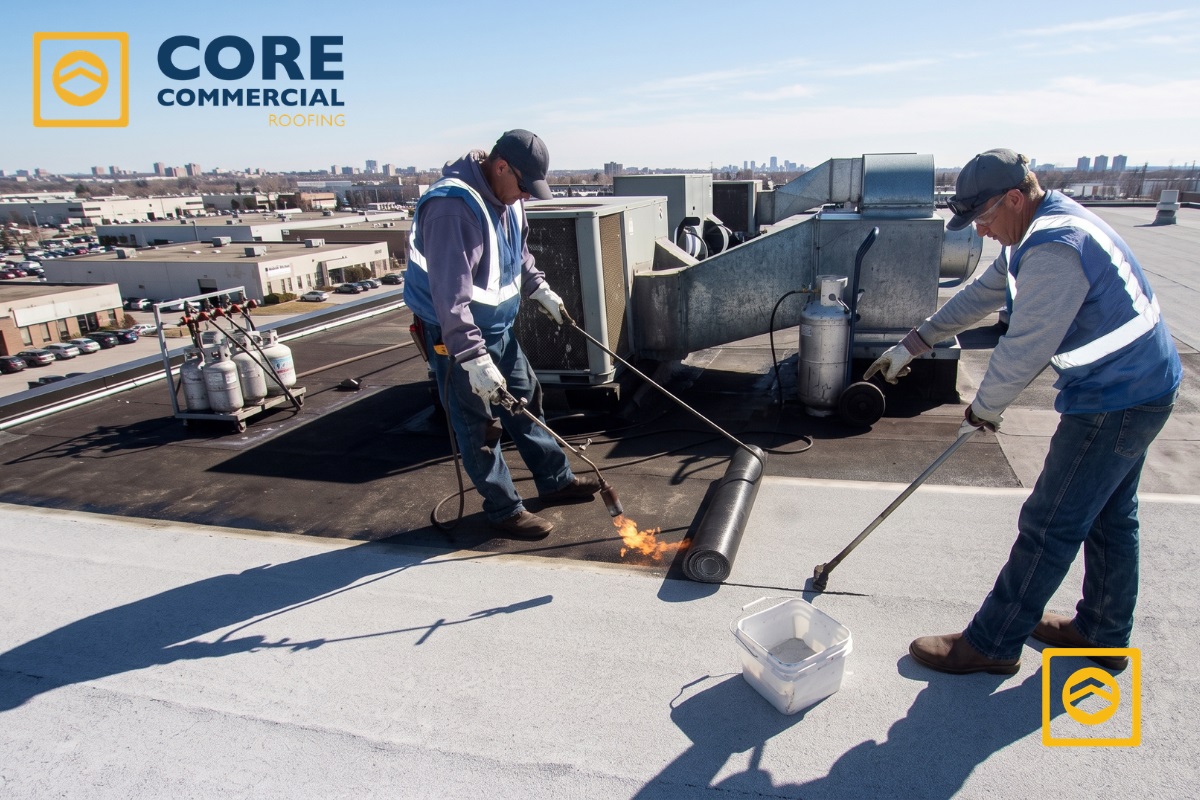
Two things are worth correcting while you are reading bids. First, the claim that torch application does not apply to SBS is wrong. Torch grade SBS products exist, and the NIST field study documented torch applied SBS roofs decades ago. A contractor who tells you SBS cannot be torched is either working from a narrow product line or does not know the category.
Second, “APP is better in heat” is not a specification. It is a category level statement about polymer chemistry that says nothing about the sheet being delivered to your building. A well formulated SBS cap with strong low temperature flexibility numbers will outperform a cheap APP sheet on a West Texas roof most years, and the submittal is where you find out which one you are getting.
Once the system is installed, service life comes down to maintenance rather than the original polymer argument. Mid life, a reflective coating is often the cheapest way to extend a sound membrane, and our guide to roof coating options that extend the lifespan of Texas commercial roofs covers when that path makes financial sense.
Frequently Asked Questions
Which lasts longer, SBS or APP?
Both typically deliver 15 to 25 years in West Texas when properly installed and maintained, and installation quality separates them far more than chemistry does. The NIST field data showed both materials performing acceptably on most roofs, with failures traced to method, slope, and surfacing rather than to the modifier itself.
Can SBS be used in a hot climate?
Yes, and it is used across hot climates every day. The material caution is real only where the assembly pushes surface temperatures unusually high or where SBS is set in hot asphalt on slope without proper attachment, which is the specific condition the field data flagged.
Does a reflective cap sheet change the answer?
It narrows the gap considerably, because a reflective surface can run more than 50 degrees Fahrenheit cooler than a dark one according to Department of Energy figures, which pulls both membranes further from their softening points. Note that DOE also flags a winter heating penalty from reflective roofing, which is a real consideration in Amarillo and the northern Panhandle where the heating load is substantial. A new commercial roof can lower energy bills in Texas buildings when that balance is calculated for the specific site.
How do I tell which membrane is already on my building?
Pull the original submittal or warranty paperwork first, since the ASTM designation on it identifies the modifier directly. Failing that, a roofing contractor can usually identify the sheet by inspection, since APP is commonly torch applied and frequently unsurfaced or coated, while SBS is most often granule or foil surfaced.
The short version
If your building sits in Lubbock, Amarillo, Midland-Odessa, Abilene, or anywhere on the Texas Panhandle, the heat question is largely settled before you start. Neither membrane is running close to its softening point on a normal summer afternoon. The freeze, the daily 27 degree swing, and the way the sheet is attached to your deck will decide whether the roof reaches its rated life.
Spec for the cold and the movement. Verify the low temperature flexibility number on the submittal. Insist on a granule surfaced cap sheet. And make sure whoever is installing it knows why sheets get run parallel to the slope.
Core Commercial Roofing & Coatings works on low slope commercial buildings across West Texas. If you have a modified bitumen roof and want to know what is actually on it and how much life is left, we can tell you before you spend anything.