
Flat roof repair in Abilene
Big Country hail and wind drive many Abilene flat roof failures. We isolate the leak source before any patch, document storm impact when it is involved, and repair seams, flashing, or ponding so the same leak does not return next storm.
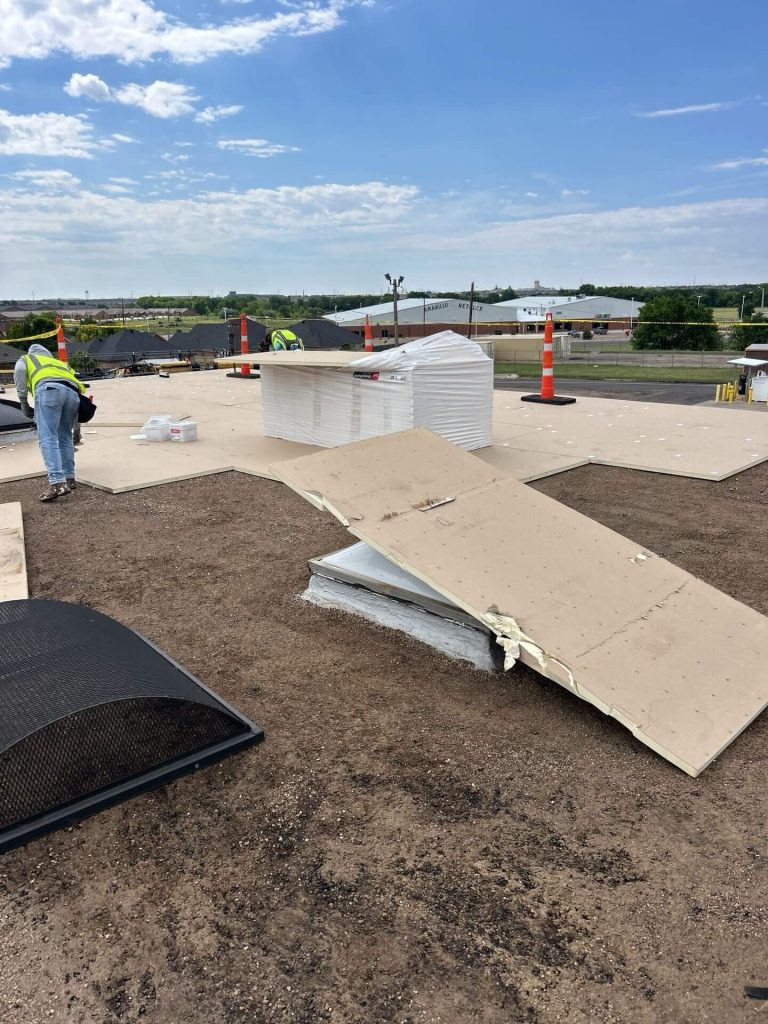
- Emergency prioritized
- Scan, core cut, probe
- Seam, flashing, ponding
- Twice yearly
- Photographs and report
- Entry is isolated
What flat roof repair is, done right
Water travels. A stain on the ceiling is usually far from where water entered the roof, because a low-slope deck carries water to the lowest point before it shows inside. Hunting the stain is how a leak comes back next storm. A repair done right isolates the entry first, with a moisture scan and a seam probe, and documents the cause before any material goes on the roof.
Most flat roof failures are seam and flashing failure, ponding, fastener back-out on metal, and hail puncture. All of them are repairable when the deck is dry and the affected area is small. When the deck is saturated or the membrane is fractured across a large area, repair buys weeks, not years, and we route to a coating or replacement recommendation instead.
When Flat roof repair is and is not the right call
- +Active leak with an isolated entry point
- +Seam or flashing failure in a small area
- +Ponding from drainage failure, not structural sag
- +Aging membrane with years of life left after a fix
- +Maintenance program to extend an existing roof
- -Saturated deck shown by core cuts, replace instead
- -Hail-fractured membrane across a large area
- -Roof at two layers per the IBC
- -A repair offered without isolating the cause, do not accept
How we repair a flat roof
Leak isolation
Moisture scan, core cuts, and seam probe locate the actual entry, not the ceiling stain where water appears.
Documentation
The cause is photographed and a condition report written before any material goes on the roof, for you and an insurer.
Repair scope
The compromised seam, flashing, or membrane section is repaired or replaced to manufacturer detail.
Ponding correction
Where ponding is the driver, tapered insulation, added drainage, or a ponding-tolerant coating is specified.
Verify the fix
The repair is verified and the report updated so the fix is documented, not assumed.
Maintenance schedule
The roof enters a twice-yearly program to catch the next failure before it becomes a replacement decision.
Repair vs coat vs replace
| Factor | Repair | Coat and restore | Replace |
|---|---|---|---|
| Right when | Entry isolated, small area | Substrate sound, membrane aging | Deck saturated or fractured |
| Cost | Lowest | Low | Highest |
| Life added | Years | 10 to 20 years | 20 to 30 years |
| Disruption | Minimal | Low | Higher |
| Documentation | Yes | Yes | Yes |
A repair offered without isolating the cause is not a repair. We isolate first.
Abilene flat roof repair questions
How do you find the source of a flat roof leak?
Most flat roof leaks appear inside far from the actual entry point, because water travels the deck. We isolate the entry with a moisture scan, core cuts, and seam probe, then document with photographs before any repair. Repairing the ceiling stain without finding the entry is how leaks come back.
What are the most common flat roof failures in West Texas?
The common failures are seam and flashing failure, ponding water, fastener back-out on metal, hail puncture on single-ply, and UV embrittlement at aging membrane. Ponding water is the number one low-slope failure mode, which the NRCA recommends draining within 48 hours.
How fast can you respond to an active leak?
Emergency leak response is prioritized. For an active leak, call (806) 404-1250 and we confirm the response window before dispatch across West Texas to stop water entry before the cause is fully documented.
Will my flat roof insurance claim work for hail?
When hail damage is documented before any repair, insurance may cover the work per the policy. We do not coat or patch over undocumented hail damage, because that hides the evidence and can void the claim. We document with photographs and a condition report an adjuster can use.
Can ponding water be fixed without replacing the roof?
Often yes. Ponding is corrected with tapered insulation to create slope, added drains or scuppers, or a coating system that tolerates standing water. We assess whether the ponding is structural or drainage-driven, because a coating over structural ponding is a temporary answer, not a fix.
What is included in a flat roof repair?
A flat roof repair isolates the entry, documents it, repairs or replaces the compromised seam, flashing, or membrane section, and verifies the fix. We do not do blind tar and patch work without isolating the cause, because that is how the same leak returns the next storm.
Do you offer a flat roof maintenance program?
Yes. A maintenance program catches fastener back-out, seam aging, and ponding before they become replacement decisions. Twice-yearly inspection with photographs and a written report is the schedule we recommend for West Texas commercial roofs, with more frequent checks after a hail season.
When is repair the wrong call and replacement needed?
Repair is the wrong call when core cuts show a saturated deck, the membrane is hail-fractured across a large area, or the roof is at its two-layer limit per the IBC. In those cases a repair buys weeks, not years. We say so on site and route to a coating or replace recommendation.
Related steps after this system
Get a condition report before you commit to a system.
Photographs, documented findings, and a written recommendation. Certificate of insurance available before contract.