A commercial roof in Lubbock or Midland takes a beating that most of the country never deals with: triple-digit summer heat, sudden hailstorms, and winds that don’t quit. When damage sets in, it rarely announces itself. These seven signs are what to watch for before a manageable repair becomes a full replacement.
Table of Contents
Why Your Commercial Roof Needs More Than a Casual Glance
Your roof protects everything inside your building, including inventory, equipment, employees, and the structure itself. In West Texas, the combination of extreme UV exposure, hailstorms, and thermal cycling puts commercial roofing systems under constant stress. Catching early warning signs is the difference between a targeted repair and a costly roof replacement.
Regular visual checks after storms and bi-annual professional inspections are the baseline. If you notice any of the signs below, call for an assessment before the damage compounds.
Sign 1: Water Stains, Drips, or Moisture Inside the Building
Water intrusion is the most urgent sign that your commercial roof needs attention. If you see stained ceiling tiles, damp insulation, or dripping water inside your building during or after a storm, you are already past the early-warning stage: the membrane or flashing has been breached.
In West Texas, moisture often travels along structural beams or decking before it ever shows up on a ceiling. The visible stain may be several feet away from the actual entry point. Document the location with photos and note whether the leak is recurring or appeared after a specific weather event. That information directly helps a roofing inspector trace the source.
For recurring interior leaks (the same ceiling tile showing damage after every storm), the problem is almost always systemic rather than isolated. That pattern signals that the commercial roof repair scope will be larger than a single patch.
Sign 2: Damaged, Missing, or Deteriorating Roofing Materials
A single breach in your roof’s waterproof envelope (a torn TPO membrane, cracked modified bitumen, or a section of missing material) is all it takes for water to reach your decking and insulation. Once the substrate gets wet, the clock starts on rot, mold, and structural deterioration.
What to check:
- Torn, lifted, or bubbled membrane sections (common after high-wind events in Lubbock)
- Cracked or split modified bitumen at seams
- Missing or displaced aggregate on built-up roofing
- Worn or peeling surface coating that has lost its reflective properties
After a wind event or hail storm, a visual sweep from the roofline or a comprehensive roof inspection is the fastest way to catch material damage before water finds it.
Sign 3: Sagging, Dipping, or Structural Deformation
A roof that sags or shows visible dips in the field is a structural warning, not a cosmetic one. Sagging on a commercial flat or low-slope roof typically means the decking or support structure has been compromised, usually by long-term water infiltration that went unaddressed.
This is the sign that requires immediate professional evaluation. A sagging roof deck can fail under load, particularly after a West Texas rain event deposits standing water on an already weakened structure. Do not walk on a sagging section. Call for an inspection.
If you also have persistent ponding water (Sign 4 below), the two problems are connected: standing water adds dead load to the deck, accelerates membrane breakdown, and deepens any structural deflection already present.
Sign 4: Standing Water That Won’t Drain (Ponding)
Standing water that remains on your roof 48 hours or more after rainfall is defined as ponding by the Asphalt Roofing Manufacturers Association (ARMA), and it is one of the leading causes of premature roof failure on commercial flat and low-slope systems.
Ponding isn’t just a drainage nuisance. Every inch of standing water adds approximately 5 pounds per square foot of dead load to your roof deck. Over time, that weight compresses insulation, deepens existing depressions, and accelerates membrane deterioration from UV magnification through the water surface. In West Texas, where summer storms can dump significant rainfall quickly, drainage systems that are undersized or partially blocked create ponding conditions fast.
The common causes in this region:
- Clogged or debris-blocked internal drains and scuppers
- Compressed or settled insulation creates low spots
- Inadequate slope from the original design
- Foundation settling has changed the roof’s pitch
Persistent ponding also voids most commercial roofing manufacturer warranties. If your flat roof regularly holds water after storms, a drainage evaluation is the first step.
Sign 5: Hail Impact Damage to the Membrane or Surface
West Texas sits in one of the most active hail corridors in North America. Lubbock, Midland, and Odessa see significant hail events multiple times per year, and hail damage to commercial roofing is not always visible from the ground or from a casual walk-around.
On TPO and EPDM membranes, hail impact creates circular bruise marks or punctures that may look minor on the surface but compromise the waterproofing layer beneath. On modified bitumen, hail can crack the surfacing and expose the base membrane to UV damage. On metal roofing, dents can break protective coatings at the impact point, starting a rust cycle.
After any significant hail event affecting the Lubbock area, a professional inspection is the only reliable way to assess impact density and severity. The repair-vs-replace threshold on commercial flat roofs generally comes down to impact count and area affected; a roofing professional can document that accurately for both your repair planning and your insurance claim.
Sign 6: Rising Energy Bills Without an Occupancy Change
An unexplained spike in your building’s cooling or heating costs is often the first measurable signal that your roof’s insulation layer has been compromised. When ISO board or other roof insulation becomes saturated with moisture, it loses its thermal resistance (R-value), forcing your HVAC system to work harder to maintain interior temperature.
In West Texas summers, where commercial cooling loads are already high, a compromised insulation layer can add hundreds of dollars per month to utility bills before the leak ever shows up on a ceiling tile.
If your energy costs have climbed without a corresponding change in occupancy, equipment, or hours of operation, roof insulation is worth investigating. Core Commercial uses core cut analysis (removing a small plug of roofing material) to check whether the insulation beneath is wet and how far any saturation has spread.
A commercial roof coating applied to an existing TPO or modified bitumen system can also significantly reduce cooling loads by improving the roof’s solar reflectance, often the right move once repairs are complete.
Sign 7: Damaged, Rusted, or Separated Flashing
Flashing is the metal or membrane material that seals every roof penetration: HVAC curbs, vent pipes, skylights, parapet walls, and roof-to-wall transitions. It is the most failure-prone component on a commercial roof, and the most commonly missed during a casual walkover.
West Texas is hard on flashing. Extreme temperature swings between winter nights and summer days cause metal flashing to expand and contract repeatedly, which eventually breaks the sealant bond. High winds pull at parapet edges. Hail dents and cracks metal counter-flashing.
What damaged flashing looks like:
- Visible gaps or separation at roof-to-wall joints
- Rust staining or corrosion on metal flashing sections
- Sealant that is cracking, pulling away, or completely missing
- Standing water collecting specifically around HVAC curbs or parapet base
Flashing failures are among the most cost-effective repairs on a commercial roof when caught early; catching them is far cheaper than the structural damage that follows when water penetrates through a failed seal for months.
What to Do When You Spot Any of These Signs
Do not wait for the next storm to confirm the problem. Here is a direct sequence:
1. Document what you see. Photograph the interior damage (stains, drips) and any exterior issues you can safely observe from the roofline or ground level. Include the date and note whether recent weather preceded the damage.
2. Schedule a professional inspection. A comprehensive roof report gives you a full documented condition assessment with photos, findings, and repair recommendations that you can use for budgeting and insurance purposes. Do not rely on a walk-around alone for a definitive assessment.
3. Prioritize by risk. Structural issues (sagging, collapse risk) and active interior water intrusion are Priority 1. Flashing failures, ponding, and material damage that hasn’t yet leaked are Priority 2. Energy efficiency and coating issues are Priority 3.
4. Get repairs completed before hail season peaks. In West Texas, late spring through early fall is the highest-risk period. Roof repairs scheduled before storm season costs less and gets done faster than emergency work after damage has already occurred.
5. Set a maintenance schedule. Bi-annual inspections, spring and fall, catch the damage accumulated from hail season and winter before it compounds. Budget one to three percent of your roof’s total replacement value annually for maintenance and minor repairs. That range keeps most commercial roofs in active service well beyond their baseline design life.
Call Core Commercial Roofing & Coatings at (806) 404-1250 to schedule an inspection across Lubbock, Midland, Odessa, Amarillo, and surrounding West Texas markets.
Frequently Asked Questions
How can I detect hidden leaks in a commercial building?
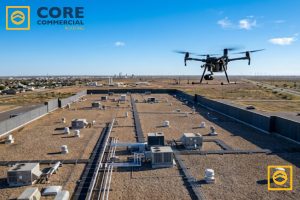
Look for localized discoloration on ceiling tiles, bubbling or soft spots in wallboard, or a persistent musty odor in specific areas. Water often travels along structural beams before dripping, so the stain may be far from the actual entry point. Core Commercial uses thermal imaging during inspections to locate moisture trapped between roof layers before it compromises the deck.
What are the dangers of a sagging commercial roof?
Sagging indicates rot in the decking or weakened support structure from long-term water infiltration. It is a structural safety hazard; a sagging roof can fail under the weight of standing water or a subsequent rain event. If you see visible dipping or deflection, do not delay the inspection.
Can a missing membrane section or torn TPO cause structural failure?
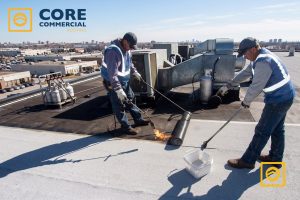
Yes. A single breach in the waterproof envelope allows water to reach the insulation and deck below. Once the substrate stays wet, rot and rusting of metal decking follow. Core Commercial provides rapid-response patching to seal these breaches before minor material loss escalates into a re-roof.
Why are my energy bills spiking without any change in operations?
Saturated roof insulation loses its R-value, forcing HVAC systems to compensate. If utility costs have risen without a production or occupancy increase, compromised insulation is a likely cause. Core Commercial performs core cut analysis to identify wet insulation and determine how far saturation has spread.
What does hail damage look like on a commercial flat roof?
On TPO and EPDM, hail creates circular bruise marks or punctures. On modified bitumen, look for cracked surfacing that exposes the base membrane. On metal panels, impact points break protective coatings and start corrosion. Impact damage is often not visible from the ground; a post-storm inspection is the only reliable method of assessment.
What are the signs of failing roof flashing?
Inspect for gaps or separation at roof-to-wall joints, rust on metal flashing, and sealant that is cracking or pulling away around HVAC curbs, vents, or parapet edges. Flashing failures caused by West Texas thermal cycling are one of the most common entry points for water on commercial buildings.
How do I identify ponding water problems on a flat roof?
Any water still standing on your roof 48 hours after rainfall is ponding. Look for persistent depressions or low spots, algae growth in shaded areas, and staining rings on the membrane from repeated ponding events. Persistent ponding typically indicates a drainage failure, compressed insulation, or structural settling.
What causes blisters on a commercial roof membrane?
Blisters form when moisture or air becomes trapped between membrane layers or between the membrane and substrate. Solar heat expands these pockets, stretching the material. If a blister pops, it creates an immediate breach. Professional repair involves bleeding the blister and resealing the area to restore the waterproof bond.
Does ponding water void my commercial roof warranty?
Most commercial roofing manufacturers require water to drain within 48 hours as a warranty condition. Standing water that persists beyond that window is often classified as neglect and can void coverage. If your roof regularly ponds after storms, address it before your next warranty review.
How does West Texas wind affect commercial roof sealants?
Wind uplift pressure pulls at roof edges and stresses sealants at every penetration and perimeter termination. Over time, repeated wind cycling creates micro-fissures in caulking, allowing wind-driven rain to enter. Perimeter edge inspections after high-wind events are a standard part of Core Commercial’s maintenance programs.