What does a commercial roofing contractor actually do?
A commercial roofing contractor is more than a crew with a lift, they act as project manager, problem solver, and the party accountable for your building while the roof is open. On a commercial job that also means coordinating around tenants, rooftop units, deliveries, and your operating hours.
Many building owners make the mistake of treating the contractor like a one-time vendor instead of a partner. When you treat them as a partner, you create space for collaboration, which makes it much easier to handle the things nobody can schedule: a wet insulation discovery, a supply delay, a hail event mid-project.
That partnership matters more when you’re buying commercial re-roofing services than on almost any other building trade, because the roof is the one system that fails loudly and expensively when it’s rushed. Recognizing the contractor’s role sets a tone of respect and cooperation, and that usually leads to smoother work and higher-quality results.

What should you agree on before work begins?
Agree on schedule, scope, materials, cleanup, roof access, and change-order process in writing before the first fastener comes out. Anything left to a handshake is the thing you’ll argue about in week three.
Before work begins, walk through each of these with your contractor:
- Discuss the schedule in detail. Ask about start and substantial completion dates, but also ask what happens when weather or a material delay hits, and who notifies you.
- Review the scope line by line. Know exactly what is included, whether it’s a full tear-off, a recover over the existing system, a coating, or repairs, and what happens to the existing insulation.
- Pin down the materials. Membrane type and thickness, insulation R-value, and attachment method belong in the contract, not in a verbal assurance.
- Clarify cleanup responsibilities. Roofing generates real debris. Ask about daily debris removal, dumpster placement, magnet sweeps of the parking lot, and protection for landscaping and vehicles.
- Settle roof access and staging. Where the crane or lift sets up, which parking spaces come out of service, and which entrances stay open all affect your tenants.
Putting these details into writing, whether through a signed contract or a written scope exhibit, keeps both sides accountable.
What to put in writing vs what owners tend to assume
| Item | Put this in the contract | What owners often assume |
|---|---|---|
| Schedule | Start date, substantial completion date, weather delay procedure, who notifies you | “They said about three weeks” |
| Materials | Membrane type and mil thickness, insulation R-value, attachment method, manufacturer | Whatever is standard |
| Cleanup | Daily debris removal, final magnet sweep, dumpster location, landscape protection | Cleanup is always included |
| Roof access | Staging area, parking spaces used, hours of noisy work, tenant entrances kept open | The crew will work around us |
| Warranty | Manufacturer warranty type and term, plus the contractor’s separate workmanship warranty | One warranty covers everything |
| Changes | Written change order with price and schedule impact before any extra work proceeds | Small extras get absorbed |
| Insurance | Current certificate of insurance naming your entity, plus workers’ compensation status | They’re insured, they said so |
How do you verify a roofing contractor in Texas?
Verify a Texas roofer with insurance certificates, manufacturer certification, and references, because the state does not license roofing contractors at all. There is no state exam or registration standing between a qualified commercial roofer and someone who bought a truck last week.
This surprises most building owners. The Roofing Contractors Association of Texas states plainly that the Texas Department of Licensing and Regulation does not administer licensure for roofing contractors, and that anyone can call themselves a roofer in Texas without being knowledgeable, insured, licensed, or registered with the state. The RCAT Licensed Roofing Contractor program exists as voluntary self-regulation to fill that gap.
The program is worth understanding because it tells you what a serious credential actually looks like. RCAT licenses individuals rather than companies, requires the applicant to have been a principal in a Texas-domiciled roofing company for at least two continuous years, and requires commercial applicants to show $500,000 combined single limit general liability coverage or the ability to obtain a $100,000 surety bond, property bond, or irrevocable letter of credit. Applicants also pass a business and safety exam plus a commercial roofing exam at 70% or better, and renew annually with continuing education.
So your verification list on a commercial project looks like this:
- Certificate of insurance sent directly from the insurer or agent, naming your entity, not a PDF forwarded by the contractor.
- Workers’ compensation coverage or a filed notice of non-coverage. Ask which one applies before anyone steps on your roof.
- Manufacturer certification for the specific system being installed, since no-dollar-limit warranties are generally only issued when a certified contractor does the work.
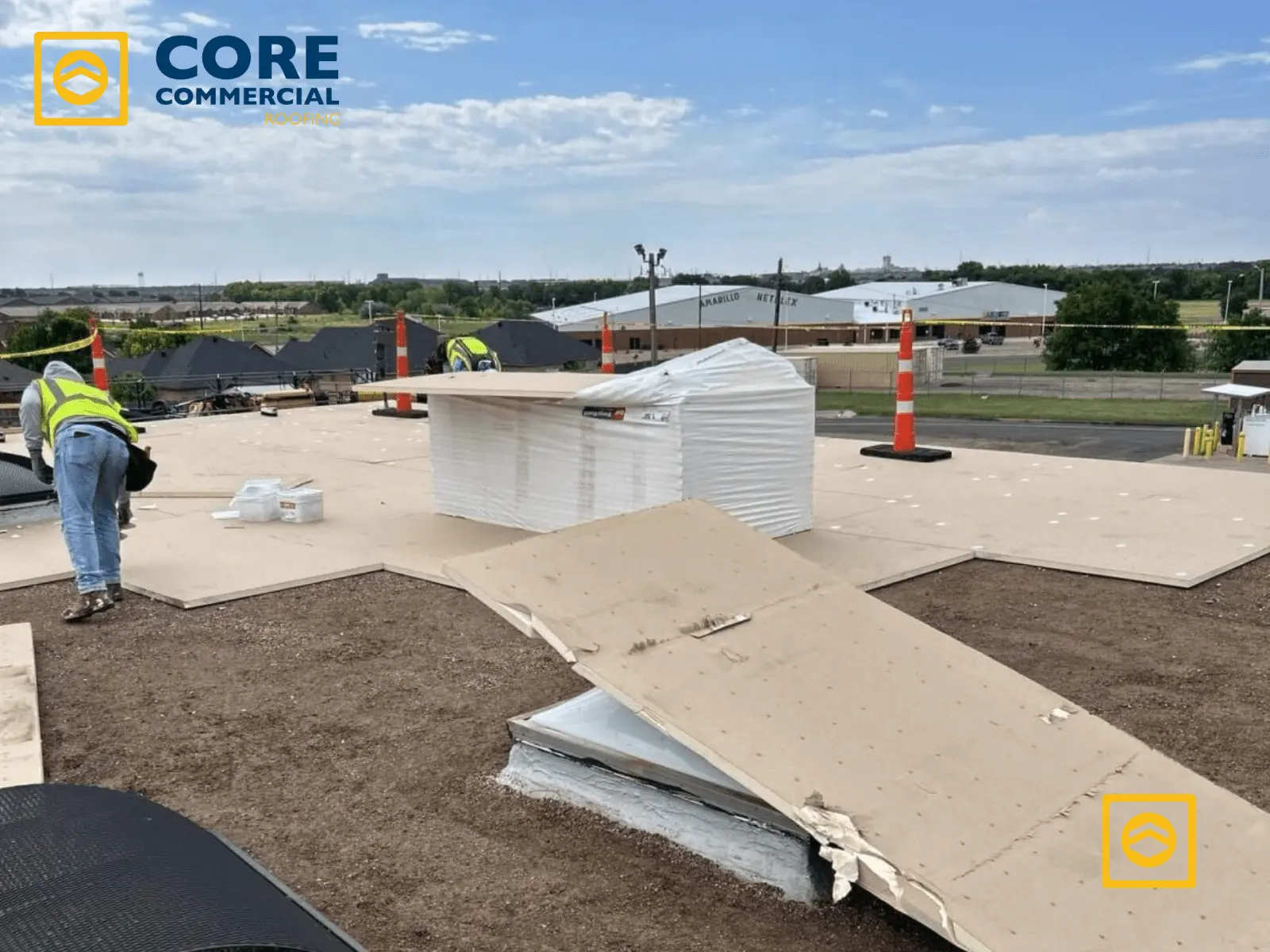
- Commercial references at similar scale, plus a look at their completed commercial roofing projects rather than a folder of stock photos.
- A local address you can drive to. Storm-chasing crews rarely have one.
How should communication work during a roofing project?
Communication works when there is one named point of contact, one agreed channel, and a set update cadence. Everything else is a game of telephone across a crew, a foreman, an office, and your tenants.
Good communication is the backbone of a successful commercial re-roof project. Many owners hesitate to ask questions, worried they’ll slow the crew down. In reality, most professionals would far rather answer a question on Tuesday than defend a decision in a claim letter in October.
Best practices for communication include:
- Name one point of contact on each side. Usually a project manager on their end and a facility manager or owner representative on yours.
- Agree on the channel before mobilization. Phone, text, email, or a shared project thread, whichever it is, pick one so nothing gets lost between three of them.
- Set the update cadence. Daily end-of-day summaries during tear-off and weekly written updates on longer projects is a reasonable baseline.
- Ask for photo documentation. Deck conditions, wet insulation, and flashing details are all buried permanently once the membrane goes down.
When both parties are proactive, misunderstandings shrink and problems get handled while they’re still small.
How do payments work on a commercial roofing project?
Commercial roofing payments are normally structured as a deposit, progress payments tied to defined milestones, and a final payment released after a successful walkthrough. You should never pay the full amount up front.
Money is the most common source of tension on any construction project, so settle the mechanics early:
- Understand the payment schedule before signing. Which milestones trigger which payments, and what documentation comes with each one.
- Never pay in full up front. Reputable contractors won’t ask for it.
- Ask for itemized invoices. You should be able to see materials and labor separately rather than a single lump figure.
- Request a signed lien waiver with each payment. This protects you from a supplier or subcontractor claim on your property after you’ve already paid the general contractor.
- Hold a retainage amount until closeout. Releasing everything before the final walkthrough removes your only real leverage on punch list items.
Discuss budget limits early, because that’s what prevents surprise add-ons. If unexpected conditions appear, and on an aging roof they often do, you’ll already have a written process for handling the change instead of an argument about it. Owners budgeting a capital replacement should also look at what drives commercial roof replacement cost per square foot in Texas before comparing bids, since two numbers on two pages are rarely measuring the same scope.
What does Texas law require when insurance is paying for the roof?
Texas law requires the property owner to pay their own insurance deductible, and it is a criminal offense for a contractor to waive, absorb, rebate, or help you avoid it. Any “we’ll cover your deductible” offer is not a discount, it’s an invitation into a Class B misdemeanor.
This comes from House Bill 2102, which took effect on September 1, 2019. The enrolled text of Texas House Bill 2102 added Chapter 707 to the Insurance Code and rewrote Section 27.02 of the Business and Commerce Code. Three parts of it matter directly to you as a building owner.
First, a person insured under a property insurance policy must pay any deductible applicable to a first-party claim. Second, any contract for goods or services reasonably expected to be paid wholly or partly from property insurance proceeds, with a contract price of $1,000 or more, must carry a specific statutory notice in at least 12-point boldfaced type stating that requirement. If your roofing contract is tied to a claim and that notice is missing, that tells you something about the contractor before you ever get to the roof.
Third, an insurer with replacement cost coverage may refuse to pay withheld recoverable depreciation or a replacement cost holdback until it receives reasonable proof that you paid the deductible. The statute lists what counts: a canceled check, a money order receipt, a credit card statement, or a copy of an executed installment plan or other financing arrangement requiring full payment of the deductible over time. Keep that documentation, because the holdback is often the largest single piece of the claim.
Storm season in Lubbock, Amarillo, and the surrounding West Texas markets brings a wave of out-of-area crews making exactly the offer this law prohibits. Knowing the rule is the cheapest form of protection available to you.
How do you prepare your building and tenants before work starts?
Prepare by clearing the staging area, notifying tenants in writing, protecting rooftop and interior equipment, and confirming which entrances stay open. A commercial roof project is loud, dusty, and visible, and tenants handle it far better when they hear about it from you first.
Practical steps that reduce friction:
- Clear the staging and dumpster area of parked vehicles, and mark it before the crew arrives.
- Notify tenants in writing with dates, expected noise windows, and any parking or entrance changes.
- Protect or relocate sensitive interior equipment under the work area, since vibration can shake dust loose from deck and ceiling assemblies.
- Coordinate rooftop HVAC shutdowns and service access in advance, especially where units sit close to seams and curbs. Poorly sequenced work here is a common source of HVAC curb flashing leaks later.
- Secure or cover exterior stock, patio furniture, and signage near the drip edge.
These steps show respect for the crew’s work and cut down on the small damage claims that sour an otherwise good project.
What are the most common misunderstandings on a commercial roof project?
The most common misunderstandings involve warranty coverage, weather delays, and cleanup scope. All three come from assuming something is included rather than confirming it in writing.
- Assumptions about warranties. Ask whether the manufacturer warranty is material-only or a no-dollar-limit system warranty, and get the contractor’s workmanship warranty term separately. They are not the same document and they don’t cover the same failures. If you’re buying or selling the building, also confirm whether roofing warranties transfer to new owners.
- Confusion about timelines. Rain, wind holds, and supply delays are normal. What matters is the agreed procedure for communicating them and whether the completion date shifts formally or informally.
- Cleanup disputes. Never assume daily cleanup and a final magnet sweep are included. If it isn’t in the scope, it isn’t in the price.
- Unclear responsibility for existing conditions. Wet insulation, deteriorated deck, and inadequate drainage are frequently discovered after tear-off. Agree in advance on how those are priced and approved.
By asking clear questions and documenting the answers, you keep these from escalating into disputes.
How involved should you be once work begins?
Stay reachable, stay off the roof, and inspect at agreed intervals rather than daily. Availability helps the project. Hovering does not.
The best approach is balance:
- Be available to answer questions quickly, especially on change orders that stop work until you decide.
- Let the crew work without constant interruption, and follow their site safety rules if you do go up.
- Check progress at agreed intervals, ideally with the project manager rather than pulling a foreman off a seam.
- Keep your own file of daily photos and written updates as the project runs, not reconstructed afterward.
This balance shows respect and keeps the project moving without unnecessary tension.
How should you raise a problem mid-project?
Raise it early, in writing, with photos, to the project manager rather than the crew. A concern documented on day four is a punch list item. The same concern raised at final invoice is a dispute.
No project is perfect, and issues will come up. A few examples of how to handle them well:
- If you see damage to landscaping, curbs, or a tenant’s vehicle, photograph it and send it to your point of contact the same day.
- If progress seems slow, ask for an updated schedule rather than accusing the crew of dragging.
- If you disagree with a repair decision, request a written change order so the reasoning, the cost, and the schedule impact are all on record.
- If something looks wrong at a detail, a seam, a termination, a flashing, ask for a photo and an explanation before it gets covered.
Resolving issues quickly protects the relationship and keeps the project on track.
What should happen at project closeout?
Closeout should include a joint walkthrough, a punch list, warranty registration, lien waivers, and a complete document package. The job isn’t finished when the crew leaves, it’s finished when the paperwork is in your hands.
Ask for and confirm each of the following:
- A joint final walkthrough covering seams, terminations, flashing at curbs and penetrations, drains, and the parapet edge.
- A written punch list with completion dates, signed by both sides.
- Manufacturer warranty registration confirmation, not just a promise that it was submitted.
- The contractor’s workmanship warranty in writing, with its term and what it excludes.
- Final lien waivers from the contractor and any subcontractors or suppliers.
- Photo documentation of concealed conditions and completed details.
Then inspect the site, the parking lot, and the interior below the work area before releasing final payment. Store the whole package somewhere you can actually find it, because a warranty is only worth what you can produce when you need it. Scheduling a comprehensive roof report at handover also gives you a documented baseline to compare against at the next inspection.
If the contractor did excellent work, a review helps other owners in your market and strengthens the relationship for the next building in your portfolio.
Building trust with your roofing contractor
Trust is not automatic, it’s built over time through consistency and transparency. Owners strengthen it by being upfront about concerns and asking for clarification instead of quietly assuming the worst.
Contractors earn it the same way: by showing up when they said they would, communicating changes before they become surprises, and documenting each step with photos, invoices, and written notes. On a commercial roof, where most of the work disappears under the membrane, that documentation is the trust.
The stronger the trust, the smoother the collaboration. Projects with trust rarely escalate into disputes.
Final thoughts
Working with a roofing contractor doesn’t have to be stressful. When you focus on clear communication, expectations set in writing, and mutual trust, you build the foundation for a project that lands on schedule and on budget. Our favorite strategy, writing down every project detail before the first fastener comes out, remains the most powerful way to prevent disputes and keep both sides aligned.
Add verified insurance and certification, an open conversation about budget, and a real closeout package, and you end up with more than a new roof over your building. You end up with confidence that the investment was sound and the asset is protected for years to come.